Source: www.breakingviews.com is Europe’s leading financial commentary service.
Has the law of large numbers finally caught up with Vodafone? The FTSE 100 has risen by 20% since April 1, and the FTSE global telecoms index by nearly as much. But Vodafone shares have managed only half that increase. Moreover, its share rating of 15 times forecast 2003 earnings suggests investors aren’t terribly optimistic about it.
Wasn’t Vodafone’s global acquisition spree part of a plan to make it more profitable than rivals – and hence more attractive to investors? Perhaps – but investors have doubts about Europe’s leading mobile phone operator on three scores. First, its growth prospects are seen as lacklustre.
Second, new entrants to its markets threaten its earnings. And third, it has an inefficient balance sheet. It isn’t capturing the tax benefits of cheap debt, even though its tax rate is rising.
It isn’t easy to see how Arun Sarin, Vodafone’s new chief executive, can turn the supertanker around. Mobile markets are saturating and fierce competition is restraining call prices.
Sarin’s main opportunity is to drive revenues from multimedia services. Indeed, his enthusiasm for these may have landed him the job. If multimedia could boost the group’s organic revenue growth rate from, say, 5% to 7%, Vodafone would probably trade on closer to 20 times earnings. And that would mean a whopping rise in the share price.
But the challenge is formidable; finding an extra 2% of annual sales means generating £700 million of additional revenue. Many investors do not expect this to happen.
Meanwhile, Sarin has to allay concerns that Vodafone’s investments in multimedia services technology might not pay off. The worry is that new entrants might use the technology’s extra efficiency to slash prices for voice calls, in a bid to seize market share.
Sarin’s other opportunities are smaller – but not much easier to carry through. Take acquisitions. His predecessor, Christopher Gent, stamped out Vodafone’s unique near-global footprint by doing breathtaking deals. Sarin has little to do but fill in the last gaps.
But even that will be difficult. The owners of the few assets that Vodafone still covets know they are in an advantageous position. They will demand a big premium to sell out. But Vodafone shareholders are sensitive to the risk of overpaying – as Gent did in the bull market – even though valuations are much lower now. Sarin will have to tread carefully.
What’s more, even if Sarin can cut good deals, they won’t have a massive impact on the share price. The biggest deal he might be able to do soon is buying a 56% stake in French mobile business SFR for roughly £8 billion ($13 billion). Assuming the deal increased SFR’s overall £15 billion value by 20%, that would be worth £3 billion to Vodafone. That’s not a huge amount in the context of its near-£100 billion enterprise value.
Leverage is the easy option Sarin can most easily make a difference through tweaking the balance sheet. After all, Vodafone will have only £8 billion of net debt at the year-end and it generates enough cash to pay this down in two years.
Sarin could take on extra debt of perhaps £15 billion without jeopardizing Vodafone’s single-A credit rating. This would not only be tax efficient but would also allow cash to be returned to shareholders. That would be a welcome move as the company currently pays out only 25% of its earnings as dividends and the stock yields just 2%.
The snag is that even this wouldn’t give the stock that much of a fillip. A £5 billion stock repurchase would increase next year’s earnings per share by an estimated 2% or 3%. Spending a similar amount mopping up an awkward minority position in Japan could have a similar impact. Nice, but hardly sufficient to put a rocket under the stock.
In any event, Sarin is unlikely to spend this much. He will almost certainly keep at least £8 billion of cash in reserve in case SFR comes into play.
Add it all up, and Sarin has quite a slog ahead of him. Sure, he can leverage up the balance sheet. And, at a push, he might be able to create value from deal-making. But all this will only take him so far. If he is really to make his name at Vodafone, he needs to manage the transition to multimedia services flawlessly.
| Vodafone versus FTSE Global telecoms index |
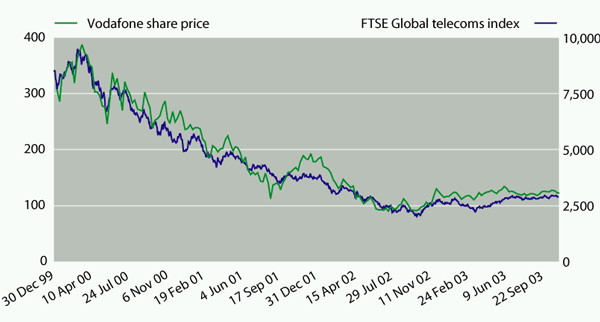 |
| Source: Morgan Stanley |
breakingviews is Europe’s premier English-language online subscription commentary service, supplying the top investment banks, hedge funds, asset managers and corporations with timely insight into markets, economics, companies and business.
In addition to its online service, breakingviews supplies its market-moving commentary to a handful of prestigious daily newspapers. These print partners include the Wall Street Journal Europe, Gaceta de los Negocios, la Repubblica, NRC Handelsblad, l’Agefi, Kauppalehti and others.