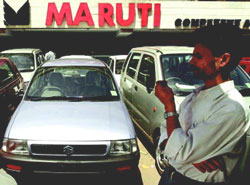
Indian privatisation got the thumbs-up from the capital markets when investors bid over 10 times the number of government shares offered for sale in Maruti, India’s biggest car-maker now controlled by Suzuki Motors.
Global and local investors bid up the price on Maruti shares from Rs115, the floor price of the IPO, to Rs125 when the offer closed on June 19. The government exercised a greenshoe option, increasing the number of shares sold by 10% to 27.5% of Maruti’s shares, which fetched it close to Rs10 billion ($213.5 million).
That makes the Maruti sale the largest book-built IPO in India, and has rallied a stock market emerging from a year-long slump. Lead manager Kotak Bank and co-managers ICICI Securities and HSBC say global investors were among the first to bid and the issue sold out on the first day.
Among those who bid were funds managed by Franklin Templeton, Merrill Lynch, Deutsche, Capital International, Citigroup and Schroders. Not all of them would have got Maruti shares. The government decided to allot 60% to retail Indian investors, hoping to keep investor interest alive and prices firm once the shares list in early July.
Indian minister in charge of privatisation Arun Shourie said the success of the IPO was a vote for Maruti, a vote for India and a vote for economic reforms. Shourie knows that a cheering stock market has silenced his many critics for now. But Indian retail investors expect quick returns from their investments in new issues. Should Maruti’s shares fail to deliver those returns once they are listed, Shourie’s support could wane in that constituency.
Soon after the Maruti sale, Shourie said the government was preparing to sell shares in two government companies, National Aluminium (Nalco) and Bharat Petroleum (BP), to global and local investors later this year. Nalco’s shares will be sold in the local and international markets. However, those sales might not get the same response as Maruti from investors. “The strategy of delivering the company into safe hands and then selling its shares to retail investors worked well for Maruti,” says K Balakrishnan, head of corporate finance at HSBC.
Last year the government announced a rights issue that gave Suzuki Motors, its joint venture partner in Maruti, control over the company. Suzuki paid Rs10 billion as control premium and promised to make Maruti a manufacturing hub for its sales of small cars worldwide. Also, Maruti is the first car manufacturer to list on the Indian stock market and is best placed to tap the huge potential market in a country where just six in every thousand Indians owns a car.
Irate workers The government’s efforts to sell a controlling stake to a strategic buyer in Nalco and BP face a political logjam. Last year irate company workers supported by the local state government in an eastern state stalled the sale of a strategic stake in Nalco when they stopped potential buyers from visiting its plant to conduct due diligence.
A stand-off with Ram Naik, oil and petroleum minister, who opposed the sale of Hindustan Petroleum (HP) and Bharat Petroleum (BP), ended in a compromise with the government deciding to privatize HP and sell BP’s shares to minority investors. Nalco and BP shares may have to be sold cheap.
Some argue that the government could be testing privatization through the public market where there is no dominant shareholder and majority shares are widely held after privatization. “There are professionally managed Indian companies such as HDFC that have no majority shareholder. BP was once a foreign-owned company and its managers are as customer-friendly as any in the private sector,” points out UR Bhat, head of equity at JPMorgan India.
Others see risks in the prospects for these companies. “If the government does not want a dominant, possibly foreign, core shareholder for strategic reasons, it should say so and retain a golden share. Minority investors must know exactly who is in charge of the company,” says an investment banker from a UK bank. The government owns 87% of Nalco and 66% of BP.
A simultaneous sale of shares in the two oil companies in vastly different ways could
also prove embarrassing for the government. Six of the eight prospective buyers for 34% of the government’s 51% stake in HP are foreign. They are Shell, British Petroleum, Chevron, Petronas, Kuwait Petroleum and the Sun Group. The buyer of HP must make a tender offer to buy 20% of the company’s shares from investors at the same price, in line with India’s takeover laws. That offer is likely to be at a healthy premium to the market price of HP’s share of around Rs327.
The government is likely to sell shares in BP at a discount to its price of Rs278. BP has marginally higher earnings per share than HP and minority investors in BP, including foreign investors who own 12% of the shares, are likely to feel short-changed. That is the sort of damage any government facing elections next year would not like to risk.