|
Malaysia’s local players encouraged to grow banking business |
AS MALAYSIA’S FINANCIAL sector continues to recover from the 1997-98 economic crisis, investment banking is playing a more prominent role and, unusually for an emerging market, it is largely local investment banks that are at the forefront.
True, the biggest deals from Malaysia are still led by the the global players, since jumbo international deals require the international distribution that only they can provide. Nevertheless, the domestic market has been transformed. Foreign investment banks dominated the local debt market until the mid-1990s but most have either disappeared or been left behind. Deutsche Bank, Citigroup, ABN Amro and HSBC are the only active foreign banks in the domestic capital markets. Local players such as Commerce International Merchant Bankers (CIMB), RHB Sakura, Am Merchant Bank, and Aseambankers now dominate.
And this market is growing at a healthy clip, partly as bank loans are transformed into bonds. The total bond market has doubled in size in five years and CIMB expects the primary market to grow by 40% this year.
The Malaysian banking system is due to be liberalized under World Trade Organization rules over the next few years but is still protected from the full force of foreign competition. Foreign banks are straitjacketed in terms of the services they can provide. Malaysian banks are taking advantage of the few years of protection they have left to build up their merchant banking businesses and in some cases to transform them along the lines of the classic investment banking model.
For now, banks in Malaysia require a separate licence for each type of business they provide. This, however, is set to change under the ambitious financial sector master plan, which will facilitate business along universal banking and investment banking lines.
Each of Malaysia’s 10 core banking groups, formed from forced mergers after the financial crisis, is keen to grow – or start up – its own merchant or investment banking arm. They are drawn by the scent of cross-selling opportunities in much the same way as European banks swarmed into the business in the 1980s and US banks in the 1990s. The top three or four local merchant banks are way ahead of the competition and between them scoop up the lion’s share of the deals.
| View graph. | ||||||
The country’s banks learned the hard way during the financial crisis that lending large sums directly to big clients can lead to dangerous risk concentrations. After having given loans so generously in the past only to see them turn sour, Malaysian commercial banks are now much more cautious, turning away borrowing clients and inviting them to lunch to discuss bonds with their merchant bankers instead.
The Malaysian bond market has doubled over the past five years to M$160 billion (US$42 billion). But at only 48% of GDP of US$87.5 billion, compared with 150% of GDP in the US, the bond market has plenty of room to grow. CIMB, effectively Malaysia’s most successful investment bank (it is legally still a merchant bank until the law changes), expects M$40 billion to be raised in the bond market this year , compared with M$28 billion in 2002.
Initially the bond market was boosted by large volumes of issuance from Danaharta and Danamodal, the bodies established by the government to clear up the bad debts of the banking sector. Now, however, Malaysian corporates are driving the growth as they seek to secure cheaper sources of funding and lock in low interest rates.
Investors too have become keen on bonds. Like the banks, investors also parted with their money foolishly before the crisis and are now becoming risk sensitive and seeking out high-grade issues. Bond investors are mainly interested in issuers that are rated A and above, although there is also some appetite for structured deals. There is plenty of demand to cope with the increase in issuance from corporates. As one senior portfolio manager at a large Singaporean fund management firm says: “We want the bonds but we can’t get them because the insurance companies and the EPF [employees’ provident fund] are buying them all up.”
Equities have traditionally been seen as the capital market of choice for Malaysian corporates. However, after a bumper year in 2002 in which M$12.8 billion was raised in IPOs, thanks largely to two sizeable deals from mobile phone operator Maxis and toll road operator Plus, equities are expected to take a back seat to debt in 2003. Only M$4 billion in IPOs is expected.
With record debt mandates up for grabs and more corporate advisory opportunities on the horizon, Malaysia’s top investment and merchant banks will be competing fiercely in 2003. But they might not be competing on a level playing field because the biggest deals in Malaysia are often built on connections as well as investment bank capability. Having just one of those is often not enough: success requires connections and capability.
|
Rashid Hussain: time will tell whether, as many are |
RHB Sakura
At the start of 2003 RHB Sakura and CIMB stand out as Malaysia’s top two merchant banks and appear well matched in most respects. But as one undergoes substantial internal changes the balance of power could be shifting.
RHB Sakura is the merchant banking arm of Rashid Hussain Berhad, the banking group built up by high-profile Malaysian banker Rashid Hussain. It has operated as a merchant bank under various names since 1974, when it started as D&C Nomura Merchant Bankers, and has always been a powerful force in Malaysian merchant banking.
In 2002 it was the lead bookrunner and managing underwriter for the retail tranche of the $2.3 billion Plus Expressways IPO, the second largest of the year. It was also joint bookrunner and joint lead underwriter for the domestic tranche of the $2.5 billion Maxis IPO, the largest in Malaysian history. On the debt side it worked on the M$5.1 billion Plus Islamic debt issue, and in M&A on over M$1 billion of acquisitions made by the AMMB Holdings group, another Malaysian bank.
But despite RHB Sakura’s impressive track record and success last year, market experts are concerned by the departure of several key figures from the group last month, including Rashid Hussain himself and managing director George Ratilal. The group’s share price is trading at a discount to its peers. The concern is based on the perception that these individuals, particularly Rashid, were the people with the skills and connections to win and execute deals and that without them the bank will lose its way.
At the time of going to press Sakura is still being run by a temporary management team.
Sakura may be further distracted by internal upheaval in the RHB group, which is undergoing restructuring following the complicated takeover of the group by smaller rival Utama Banking Group (UBG) imposed by the government under its bank-restructuring programme. Utama is a well-connected Sarawak-based bank controlled by Cahaya Mata, the conglomerate owned by the Taib family, whose patriarch Taib Mahmud is the eastern Malaysian state’s long-standing chief minister.
Under the deal’s structure, RHB Bank, a profitable subsidiary of RHB Capital, acquired Utama Bank, which is about a seventh of its size. UBG then used the cash to help it become the largest shareholder of RHB Berhad, the weak holding company at the top of the chain. RHB Sakura, a cash cow that comes under RHB Bank, came along with the deal. RHB Sakura was then taken private at the end of 2002 (it is now owned by RHB Capital) and is now working on transforming itself into an investment bank following an announced plan to acquire the securities and securities-related businesses of RHB Capital. This is expected to take place in the first half of 2003. Malaysian Resources Corp Berhad (MRCB), a major shareholder in the group, is then to sell its share of the business for M$504 million by the second quarter of 2003.
Rashid, who has already sold his shares to UBG, is estimated to have received M$726 million.
Ratings Agency Malaysia believes that the new structure will eventually help strengthen RHB Sakura’s position by enabling it to offer a wider range of financial services. But the general view from Kuala Lumpur’s tall, air-conditioned skyscrapers is that while the restructuring drags on at RHB group RHB Sakura is losing out.
The crucial question for many is whether RHB without RH is anything more than a “B”. Many believe that the charismatic 56-year-old British-educated Rashid Hussain, who transformed his brokerage business into one of the country’s largest financial services group in less than 20 years, was not merely the face but also the brains, legs, arms – the entire body of the group.
There is, though, a minority dissenting view that departure of the group’s founder could ultimately be good for the bank. Chua Ma Yu, the wealthy Malaysian private financier who co-founded Rashid Hussain Securities with Rashid Hussain in 1983 and who was president of the group until 1992, believes that the change is desirable.
From his enormous private office decorated with Chinese ink paintings and historic securities certificates from such issuers as oil baron JD Rockefeller and the Chinese imperial government, Chua describes RHB as a bank unhealthily dominated by a single man. “RHB has been a personality-driven bank for too long, driven by Rashid Hussain,” says Chua. “When everything is geared towards one person it creates a lot of risk. It’s how a lot of mistakes are made,” he says. “Rashid has achieved a lot of success but his record is not indisputable. You can’t say he’s the best banker when he also made some big mistakes. I’d say his record is 50:50,” says Chua, referring to RHB’s expensive acquisition of Kwong Yik Bank in 1997 and the group’s substantial losses during the financial crisis.
Reducing reliance on a single man might be a wise move but there are plenty of analysts who also question the ability of the Utama Group to run an investment bank. As one fund manager with an intimate knowledge of the RHB group points out: “Utama’s track record of running itself isn’t brilliant.” UBG recognizes this: it is seeking to bring in experienced outside managers to run the group. So far it has recruited Michael Hague, former CEO of Standard Chartered in Malaysia, to be the CEO of the RHB group. His appointment is seen as controversial in some circles as he will be the first foreigner to run a local bank in Malaysia. But it is also viewed positively as it is hoped that as an experienced outsider he will be able to drive through tough changes. An appointment to replace Ratilal and other senior appointments at RHB Sakura are expected in the next few weeks.
Conjecture now surrounds what UBG will do with its spare banking licence and its merchant banking business, Utama Merchant Banker, which was not consolidated into the RHB group. The talk in the capital is that Utama is trying to persuade the regulators to allow it to convert its banking licence to an Islamic banking licence, which will allow it to establish Malaysia’s third purely Islamic bank. There is speculation that Hong Leong Bank, which does not have a merchant bank of its own, might buy Utama Merchant Banker just for the licence.
Politics and business in Malaysia, as in most of the developing world, is not easily divorced. Rashid ‘s surrender of his empire is widely perceived to be connected to his association with the jailed former finance minister and deputy prime minister Anwar Ibrahim and the MRCB group, also linked to Anwar. When Daim Zainuddin replaced Anwar as finance minister after the crisis and the latter’s imprisonment, RHB was a surprise loser when the government selected the anchor banks around which other weaker banks would have to join. As a small Sarawak-based bank, Utama was a surprise winner. The well-connected Utama Group was chosen as an anchor bank in order to humour the east Malaysian states of Borneo and because of Utama’s links to more favoured government officials.
Things are not running in RHB’s favour at the moment. Its attempt to repossess 34 buses from a Kuala Lumpur public transport company before rush hour on a Wednesday at the end of January did not make it popular and the company later won an injunction to prevent the bank from disposing of or selling the vehicles. But RHB Sakura was a strong merchant bank before Rashid Hussain took over and it has a strong franchise. If it can put aside its internal problems and harness the benefits of its new investment bank structure, and, if competent new management can be found soon, the group should still be capable of winning and executing jumbo mandates in the future.
|
Nazir Razak |
CIMB
“CIMB is enjoying a bit of a purple patch” at the moment, reckons the head of a foreign investment bank in Kuala Lumpur. Indeed the Malaysian investment bank has been going from strength to strength. It featured at or near the top of the league tables for all its core businesses in 2002 and started 2003 with a successful IPO of its own.
The M$225.4 million deal, which it entrusted to local rivals AM Merchant Bankers and OSK Securities, was fittingly innovative for an investment bank. It was structured as a restricted offer for sale to the minority shareholders of its parent, Commerce Asset Holdings Berhad (CAHB), and to its own directors and employees: the first exercise of its kind in Malaysia.
CIMB has also been undergoing a significant reorganization in the past few years, integrating its acquisition of Bumiputra-Commerce Discount House and establishing an offshore subsidiary, CIMB (Labuan), in Labuan to develop its non-ringgit products. As part of the government-driven consolidation of the brokerage industry, CIMB was forced to purchase an additional brokerage. Seeing no need for one it opted to buy Labuan Securities which, at just M$20 million, was the cheapest securities house that it could find.
CIMB, which was the other joint bookrunner with RHB Sakura on the Maxis IPO last year, has begun 2003 with a busy pipeline. The notable deals include a proposed M$1.5 billion Islamic bond deal for Malaysian conglomerate Sime Darby, and advisory mandates for Sapura group’s proposed acquisition of Crest Petroleum, MRCB’s purchase of a 24.9% stake in UDA holdings, and a corporate restructuring of KFC Holdings.
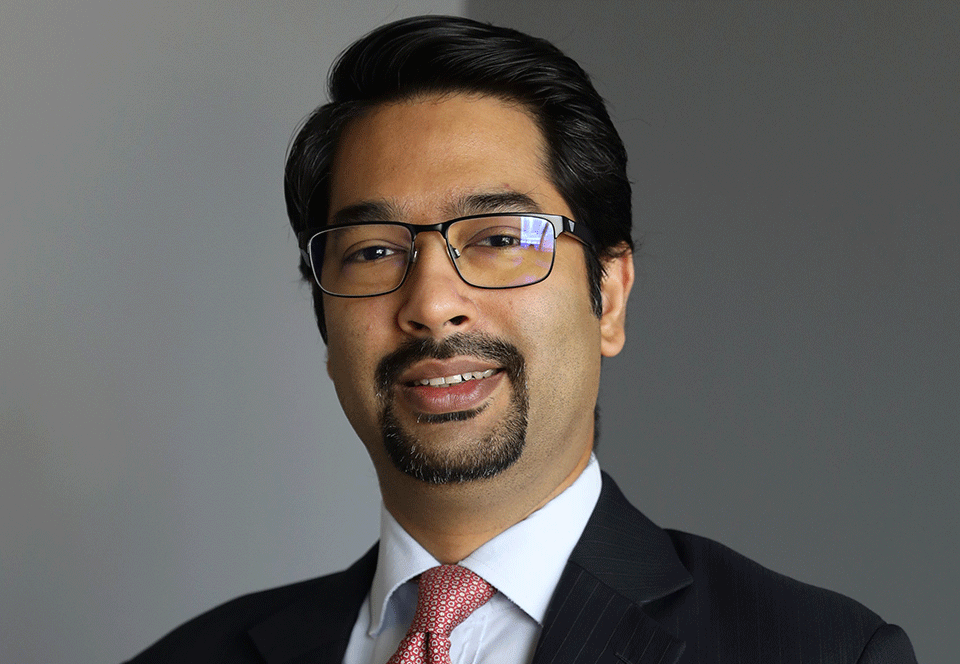
CIMB and its 36-year-old chief executive and managing director, Nazir Razak, are up-and-coming forces in Malaysian investment banking. CIMB has successfully transformed itself into the first and arguably the top investment bank in Malaysia. Nazir, who joined the bank in 1989 after completing a masters degree at Cambridge, has also won a personal reputation as one of Malaysia’s top deal makers. The son of former Malaysian prime minister Tun Abdul Razak, Nazir has made a choice of career in contrast to that of his brother Najib, who is Malaysia’s defence minister and is widely tipped to be deputy prime minister once Abdullah Badawi succeeds Mahathir Mohamad in October.
A professional investment banker through and through, Nazir smoothly handles discussion about the importance of political connections in winning mandates in Malaysia, integrating a confident and cheerful tone into a robust defence. “When you win mandates it’s much easier for people to put it down to connections and say that’s why,” says Nazir matter-of-factly, “we used to say the same about Rashid, but it’s not really accurate because at the end of the day it’s about delivery.” He points to CIMB’s corporate finance business as an example. “We’ve been number one in corporate finance since forever and people used to say it was because we were connected to the Renong group [formerly one of Malaysia’s largest conglomerates], but even after the Renong group disappeared we were still number one.”
The international investment banks like to say that local players can handle the smaller deals but are unable to do the big ones. But CIMB is confident that it can handle reasonably sized US dollar transactions by itself and points to the recent $400 million convertible offering from Tenaga Nasional, the dominant Malaysian power company, for which it was the sole bookrunner, as an example. CIMB was able to execute the transaction because there is strong demand for dollar deals among Asian accounts and better recognition of local corporates. “If a deal is good it doesn’t matter who you are, clients will come to you,” says Nazir.
Despite its confidence being buoyed by its recent enviable successes, CIMB’s feet are still firmly on the ground when it comes to expansion plans. Nazir claims to have no grandiose dreams of a “glamorous regional investment banking franchise” but is testing the water with the acquisition of a small brokerage operation in Indonesia. The broker, Niaga Securities, is only the 65th largest in Indonesia and was purchased for less than $2 million. CIMB is using it to test its ability to run an operation overseas – to see if existing structures and management processes are portable.
CIMB is the one to watch in Malaysia and is well poised to give even the global universal banks a run for their money.