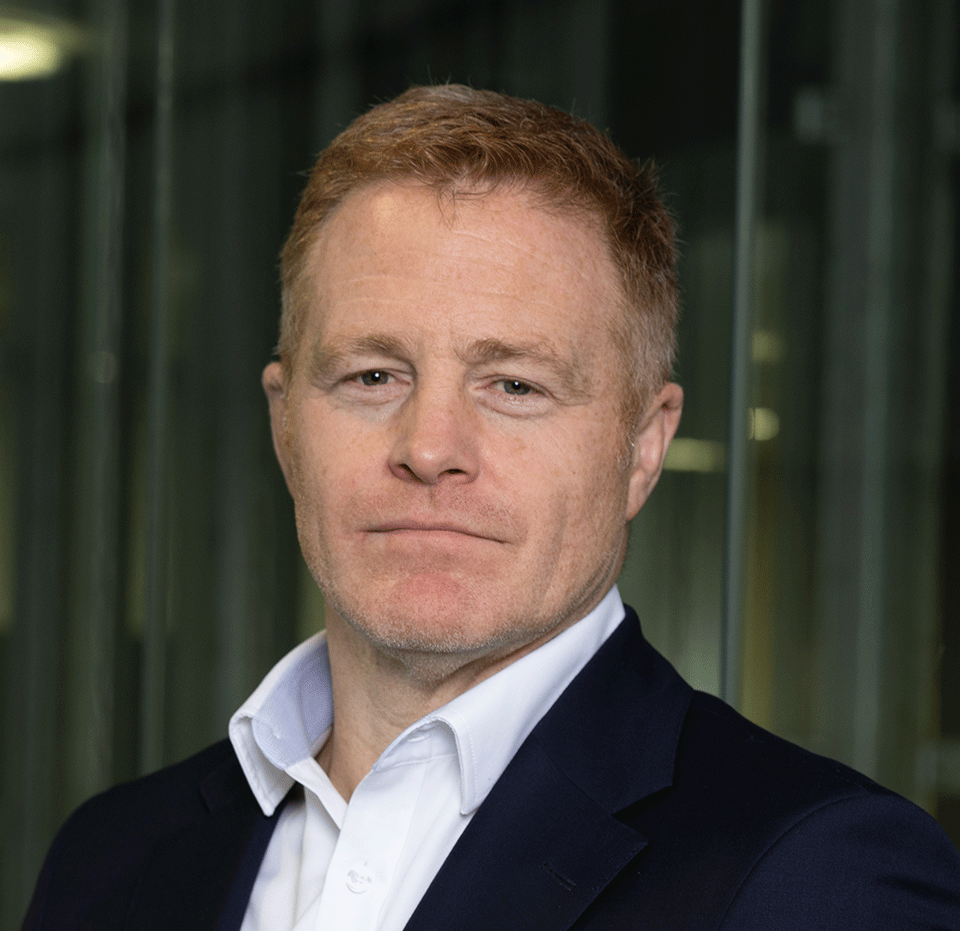
When Phil Suttle arrived at JPMorgan to become global head of foreign exchange research, he didn’t need to get acquainted with new colleagues. He had left his position as an economist at the World Bank in Washington for the new post in New York, but having previously spent 13 years at JP Morgan, he still considered his old colleagues as friends.
He joined JP Morgan originally in London in 1988, before transferring to New York in early 1992. Then, after a brief stint at the Federal Reserve Bank of New York, he moved to the World Bank. And now, at a time when so many talented people are leaving banking to set up hedge funds or do something completely different, he has gone against the trend.
His time away from the firm has provided a marked change of scene, and the opportunity to do things rather than talking about other people doing them, as he puts it.
“Nothing compares to the World Bank,” he says, with just a hint of a mid-Atlantic accent in his British voice. “The World Bank is like a financial United Nations, with all the tensions of getting stuff done. I’m not disparaging it – it is a fine institution, but aside from the attractiveness of the offer that JPMorgan made me, and the chance to work with old friends, life in the private sector is more what I want to do.”
The JP Morgan Suttle left in the 1990s is very different from the JPMorgan Chase where he works today. He is proud of that initial period. “When I arrived in the economics team, it was in a little bit of disarray. Through the 1990s we made it one of the best respected teams in the City and on Wall Street.”
He was involved in developing new regular reports such as the weekly Global Data Watch, which he says is popular with US clients. He also helped to revive a quarterly outlook publication called World Financial Markets. “We transformed that from a London- and New York-focused product to a global product,” he says. “That is the kind of thing I am looking forward to in the forex area now. The bank has a lot of piecemeal products, and I want to unify them and bring them together.”
In hindsight at least, the research work from his earlier years at JP Morgan was unfulfilling: “A lot of research in the 1990s was not really research – it was casual chit-chat analysis and following trends. That let the system down in the late 1990s – we didn’t look at the fundamental market play. Now we are getting some discipline and a framework for thinking.”
Similarly, he says that in the past the bank’s foreign exchange business as a whole was not as competitive as it might have been: “In the old days, it was a dying business. The client base was as good at forex as we were, frankly. The Chase merger has brought the business more depth in terms of corporates and in the client base as a whole.”
Suttle’s time at the World Bank should provide useful insight into trends that he might otherwise have missed, such as foreign direct investment flows, which he says now exceed fixed-income investment in emerging markets. And he can now combine that with the full-service investment banking, commercial banking and investor services activities that JPMorgan Chase boasts. The flow-of-funds analysis tool, which tracks investment flows through JPMorgan’s securities services business, is one example of this. “That is one of the benefits of being part of a huge infrastructure,” he says.
Areas of focus for the bank’s research effort now include the weakness of the US dollar relative to some Asian currencies – a correction before the end of the year is likely. Longer term, the integration of more countries into the eurozone will provide plenty of debate for economists. “Adding new countries will be more traumatic than people realize,” says Suttle.
But he doesn’t claim to know everything. “I have been in this industry long enough to see that I can get a lot right, but I can also get a lot horribly wrong. [Market value] theories keep changing, and one of the reasons for this is not that we are stupid, but that the world is complex. Look at monetary supply, for example. Nobody talks about it now, but if you go back 20 years, everyone cared about it.”