 |
|
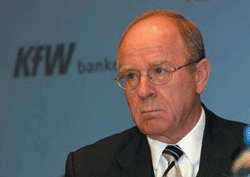
Reich: initiative is “vital for improving conditions for SMEs in Germany and stopping the credit crunch” |
Will Germany finally start to generate true-sale securitizations next year, with all that means for the German economy?
“To be the biggest economy in Europe and not participating in the fastest-growing asset class is not logical,” says a London-based asset-backed securities specialist. “Germany has been dominated by synthetic deals, and they are hard to sell. You need true-sale deals to achieve critical mass, and it’s inevitable they will happen.”
But German true-sale deals have been a long time coming. In July, German development bank KfW and 12 other banks signed a letter of intent to set up a special purpose vehicle to promote their True Sale Initiative (TSI). The banks would then pool loan portfolios and sell them into the capital markets through the SPV. At a press conference in London, Hans W Reich, the chairman of KfW’s board of managing directors, described the TSI as “vital for improving conditions for SMEs in Germany and stopping the credit crunch”.
By late November, no deals had been done under the TSI, and prospects for one by the year-end were slim. Like the synthetic deals done under KfW’s Promise and Provide platforms, deals structured under the TSI will have to work around German data protection and banking secrecy laws and the resulting problems of correlation.
Also, with so many banks involved, the TSI needs German competition authority approval. The banks are currently preparing their application to the Bundeskartellamt.
When it finally takes shape, what impact will the TSI have? Rather than achieving its stated aim of creating a standard template for true-sale deals, its impact may be more general, focusing minds on the need for legal and tax changes.
“Even if issuers don’t use the TSI platform, I think it will be seen as the catalyst for the development of a true-sale securitization market in Germany,” says Fraser Malcolm, head of ABS syndicate and trading at Dresdner Kleinwort Wasserstein.
More important than the TSI is the exemption that German-resident SPVs now enjoy from paying trade tax on receivables. This has been extended to all originators.
“The TSI is a bit of a red herring,” says Will Ross, global head of ABS research at ABN Amro. “It focuses on the execution – on the need to provide a common platform and achieve economies of scale. But the key change has been the trade tax change opening the door to true-sale securitization.”
Laying down boundaries Other legal issues still need to be worked out. One is how to ring-fence assets backing separate deals by the same issuer. “Germany is a tough market in terms of regulatory development and jurisprudence, and ring-fencing is specific to true-sale deals, so Promise and Provide don’t necessarily provide a template,” says one banker.
The TSI will also help define how investors assess true-sale deals relative to covered bonds. While the maturity of the Pfandbrief market has stunted German residential mortgage backed securities, if RMBS deals can match Pfandbrief levels of investor protection and asset quality, there is currently no reason why they can’t coexist.
“Pfandbriefe and true-sale securitizations can work side by side,” says Joerg Wulfken, a partner at Mayer, Brown, Rowe & Maw in Frankfurt. “Ultimately, it depends on whether bonds issued under the TSI get the same quality that Pfandbriefe enjoy under the specific Pfandbrief laws. Bonds issued under the TSI will be subject to contracts, but they won’t have the force of law behind them.”
But the Pfandbrief/RMBS relationship will also have to take account of the final version of the Basle II reforms. As things stand, because covered bonds are 20% risk weighted, they attract a different category of investor that would not buy RMBS.
“Pfandbrief investors are looking for liquidity, and RMBS investors are looking for spread, so at the moment there is no cannibalization of the investor base,” says ABN Amro’s Ross. “But that will change under Basle II, when AAA and AA asset-backed securities, including RMBS, are 20% risk weighted, as covered bonds are now.”