Issuer: Commerzbank
Size: e760 million
Bookrunners: Commerzbank Securities, Morgan Stanley
Date: November 12 2003
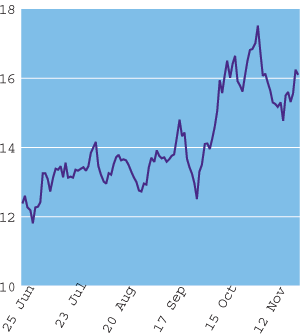
| Commerzbank share price ( € ) |
 |
| Source: Reuters |
By simultaneously announcing a disastrous set of results and successfully raising substantial straight equity capital on November 12, Commerzbank pulled off a trick that would barely have been conceivable six months ago for almost any issuer, let alone a German bank.
The results included a €2.05 billion pre-tax loss for the first nine months of 2003 and an unexpected €2.3 billion write-down. The write-down comes mainly from the falling value of large stakes in mortgage bank Eurohypo and fund manager Jupiter but importantly is not credit related.
The substantial goodwill reductions included in the write-down reduced core capital by €2 billion, taking the tier-one ratio down to 6.4% from 7.7%, necessitating the capital increase.
Third-quarter results were weak on other fronts too. Commerzbank reported a core operating loss after provisions of €73 million and analysts were unimpressed by the guidance on costs and revenue growth for 2004.
The bank also announced a net loss per share of €4.18 and a rather unattractive pre-tax return on equity of -23.7%.
Bad news no deterrent
Despite the bad news and the fact that most analysts do not see substantial upside unless there is an unexpectedly strong market rally, Commerzbank was able to attract plenty of buyers for its issue of 53.3 million shares, equivalent to 10% of previous outstanding shares and worth €760 million.
The deal had to be done at the time of the results, argue the bookrunners, in order to be as transparent as possible.
To the surprise of some in the market the issue attracted more than €3 billion of demand, leaving the book about four times covered, according to the bookrunners.
Investors find Commerzbank shares attractive for several reasons even though the bank is not a conventional beauty.
The first is that there is a feeling among some investors that having cleaned out its books with the write-downs and raised fresh capital, Commerzbank is an improving story.
The second is that the combined exercise has made it a more credible play on renewed German and eurozone growth.
According to Garth Leder, an analyst at Fox-Pitt Kelton, the fact that the capital increase brings Commerzbank’s market capitalization back to the €10 billion mark is a third factor. “Now that the market cap is near €10 billion, Commerzbank is moving back into the list of top 30 European banks and into the mainstream indices being tracked,” he says.
Other analysts believe that a fourth reason could be that the cleaner balance sheet gives the stock some upside by making Commerzbank a more viable and attractive takeover target as it should give suitors greater confidence in establishing a fair valuation.
Commerzbank is not exactly unacquainted with takeover rumours. A merger between Commerzbank and HVB is a possibility that many speculate about, and a number of foreign banks, including Citigroup, Credit Suisse, BNP Paribas and Royal Bank of Scotland, are all known to be interested in expanding in Germany.
Sandy Weill has discussed foreign ownership with the government, which is rumoured to have said any bank except Deutsche Bank would be a possibility.
The deal priced shortly after the results were announced at €14.25, just 2.3% below the day’s weighted average price and 6.9% below the previous day’s close. The pricing was tight relative to where the stock had been trading but below the tangible book price, making it reasonably cheap by some measures.
A broad distribution
Given the wide variety of reasons for interest in the deal, the bookrunners were able to achieve a broad distribution both geographically and in terms of investor type. According to Commerzbank, 25% of the deal went to accounts in Germany, 47% to the UK, 14% to the rest of Europe, 9% to the US and 4% to the Middle East and the Far East. About 39% of the deal went to tier-one long-only managers, 24% to second-tier and third-tier long-only managers, and 36% to hedge funds. About 43% of the total demand came from hedge funds, which is about average for many deals at the moment.
The deal leaves Commerzbank’s credit ratings unchanged and improves its tier 1 ratio to 6.9% or 7.2%, including hidden gains on equity holdings. It also gives the bank greater flexibility to dispose of non-core stakes and leaves room for up to €2 billion of hybrid capital.
Standard and Poor’s has left its ratings unchanged at A- and negative watch, reflecting the need for the bank to continue restructuring and improve revenue growth.