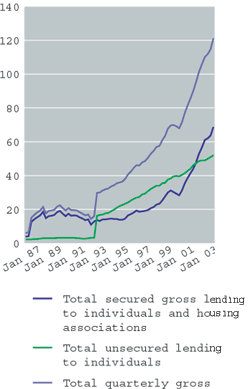
When it comes to debt, the British are the kings of binge. British debtors now owe the equivalent of UK GDP and their debts are much more sensitive to interest rate rises than US consumers’. Two-thirds of US borrowing is at fixed rates; almost 90% of secured UK household debt – mostly mortgages – is at variable rates. And UK rates have begun to rise.
Only the most pessimistic fear another housing crash, as in 1990-91, when the rest of the economy was dragged into recession. Still, the similarities between today and the 1988-89 period are striking. Then, as now, the housing market was booming, the economy looked set for a soft landing and there were rifts between the prime minister and the finance minister. Then, as now, house valuations were peaking at about 5.5 times average earnings, and it was a time of easy mortgages. And then as now homeowners were borrowing record amounts against the inflated value of their homes to pay for consumer goods. Mortgage equity withdrawal hit a 30-year high of 7% of post-tax income in mid-1988. It’s almost at that same level now.
| UK lending (£bn) |
 |
| Source: Bank of England |
The supposed redeeming difference between then and now is the much lower interest rates. Although UK households have almost twice as much debt today, their debt service payments consume 7% of disposable income, almost half the 1991 level. Interest rates would have to double from their current 3.75% for households to feel the same pain as in 1991. And as markets currently price in interest rates rising to no more than 5% by the end of 2004, there is little immediate likelihood of that. But such reasoning sounds perilously like the arguments deployed to justify higher corporate gearing only a few years ago. Assets with higher market values can only justify bigger debts if those assets can be sold at high prices. If everyone sells, prices crash. That is what happened to companies that overleveraged in the late 1990s and then had to sell assets in a hurry. It’s also what happened to UK homeowners in the late 1980s. And it is what could happen to homeowners again as interest rates rise.
Over 5% in the long run After all, most economists reckon that 5% is the natural rate of interest. So just as interest rates are now below the natural rate at the bottom of the business cycle, they will inevitably rise above it at the top – which will surely come over the lifetime of a 30-year mortgage.
Optimists ignore two other factors. The first is money illusion. In the 1980s, inflation eroded principal by half every 10 years. Now, lower inflation means it takes 35 years. So borrowers may have taken on more debt than they realize.
Secondly, over the past 15 years, financial liberalization has allowed banks to push out credit to borrowers with little thought for the consequences. Thanks to securitization, much of the credit risk has been passed on. This has encouraged lenders to extend credit to parts of the population that didn’t have access before. It has also encouraged other borrowers to take on even more debt.
Either way, banks don’t need to worry. Should the tide turn as it did in the late 1980s, they won’t be left holding the baby; over-indebted homeowners will.
breakingviews is Europe’s premier English-language online subscription commentary service, supplying the top investment banks, hedge funds, asset managers and corporations with timely insight into markets, economics, companies and business.
In addition to its online service, breakingviews supplies its market-moving commentary to a handful of prestigious daily newspapers. These print partners include the Wall Street Journal Europe, Gaceta de los Negocios, la Repubblica, NRC Handelsblad, l’Agefi, Kauppalehti and others.




