Issuer: Junto de Comunidades de Castilla-La Mancha
Size:€ 100 million
Lead managers: Banco Santander Central Hispano and Merrill Lynch
Date: Priced November 21 2003
| Castilla-La Mancha budget ebn |
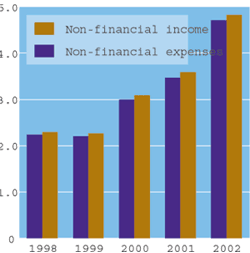 |
| Source: Castilla-La Mancha |
Spain’s 17 autonomous communities, the comunidades autónomas, haven’t yet tapped the investor base beyond their home jurisdiction as productively as some of their French, German, or Italian regional issuer counterparts. But the central Spanish region of Castilla-La Mancha is showing what can be done. At the end of November it priced a €100 million, 20-year, semi-annual, floating-rate bond, following on from a e100 million 10-year bond that was launched almost exactly a year ago.
After a successful joint pitch for last year’s deal, Banco Santander and Merrill Lynch teamed up again and won the mandate to lead manage the 20-year bond.
Last year’s bond priced at eight basis points over Euribor, this year’s came in at 11bp. That is broadly the same pricing that Castilla-La Mancha was achieving on the public bonds it issued between 1998 and 2001 through Banco de España (the central bank).
A wider market The difference has been Castilla-La Mancha’s successful targeting of a broader investor base. It marketed its 2002 and 2003 heavily to non-Spanish investors. Roadshows for 2003, done on a reverse enquiry basis, took in Luxembourg, Dublin, Frankfurt, and London.
“There are few Spanish issuers considering this type of paper, so it certainly has a quality premium,” says Clive Self, vice-president, debt markets, at Merrill Lynch. “A healthy domestic market for regional borrowers negates the necessity to access international investors. Castilla’s focus is therefore unusual and the response to the issue is a result of the scarcity of this kind of international note.”
The 10-year trade was five times oversubscribed last year, and there was some speculation about whether a 20-year deal – the longest ever from a Spanish region – could match that. In the event, demand was strong. “This is the longest public offering by a Spanish regional issuer,” says Self. “Structurally, the note is a 20-year semi-annual floater. It was several times oversubscribed at launch and an aggressive price was achieved.”
The Spanish regions are getting more control of their budgets. In 2000, they took charge of paying for education, and became responsible for healthcare in 2002. Both these areas were previously funded directly by central government. Castilla-La Mancha is using the bonds to fund its budget – which exceeded e6 billion in 2003 – with an emphasis on health and education projects and transport infrastructure.
“The real priority is to broaden the investor base,” says María Luisa Araujo Chamorro, Castilla-La Mancha’s finance minister. “Given our success, perhaps other Spanish regions will issue in this format, yes, but the fewer that do, the less competition there is for us. We know that the market values regular issuers, so you can rely on us for an issue of this size each year.”
While Castilla-La Mancha’s council of ministers must approve the size of each bond issue, the format is decided by the finance ministry.
The region is a good candidate to push the profile of the Spanish autonomous communities in the international capital markets. In 2002, its GDP growth was more than 2% higher than the average for the 16 other regions. Unemployment is below the national average. And Castilla-La Mancha has far less debt per capita than any other Spanish region – well under half the national average, at e440.
Its Aa2 (positive) rating from Moody’s reflects this robustness. Moody’s only rates higher nine other European regions, seven of them German or French.
Investors also like the region’s political stability. In May’s elections, president José Bono Martínez won a fifth consecutive term, with his socialist PSOE (Partido Socialista Obrero Español) winning 58% of the vote. That’s the widest winning margin in modern democratic Spanish history.
Having sold the region’s story in 2002, the issuers and their bankers spent more time this year explaining the ins and outs of the bond itself. “The investors the first time around were more interested in the region as a whole,” says Araujo Chamorro. “Now they are more interested in the issue.”
After a record year in 2002, European regional and municipal debt issuance levelled off in 2003. But many expect more growth in the next 12 months.
“Regional and municipal public sector issuers have benefited from the credit rally through the last few months,” says Self. “Spreads are very compelling to the issuers and investors are comfortable with the long maturities.”