
GLOBAL CAPITAL REALLOCATION will be a central theme in the foreign exchange markets for many quarters to come, at times eclipsing the fundamentals driving relative economic growth. That means a lower dollar, and big changes for some other currencies.
For some time, fundamental analysts have been writing about long-term themes such as capital flows and current account imbalances that would eventually move the big three currencies a great deal when markets finally noticed them. They have now.
Growth forecasts remain central to forex forecasts and capital allocation but the focus has shifted towards how fast countries are growing relative to their potential. And over the next year, this will be acutely relevant for the US.
For the US economy, after several false starts, it is finally safe to say that recovery is here for real. Growth in the third quarter was extraordinary, and probably unsustainable, as tax cuts and rebate payments drove consumers to a frenzied pace. But across the board, demand and output indicators are off their lows, and business spending is showing signs of taking over as a key support for the economy. Most notably, there are indications that the labour market has at long last stabilized.
But though weak growth is left behind, two factors will linger: the effects of the output gap (the difference between potential growth and actual growth) and the current account gap will overshadow the economy over the coming year.
Although there is no hard-and-fast rule to gauge potential output, our basic rule of thumb (trend productivity growth plus labour force growth) puts potential growth in the neighbourhood of 3.5%. Indeed, this estimate of potential growth is more conservative than other Wall Street estimates of 4% or more.
In the third quarter of 2003, the economy finally closed that gap for the first time in three years. And we forecast growth will average more than 4% year on year for the whole of 2004. But the effects of the negative output gap of the past three years will take time to reverse, and we expect trends that have characterized the economy over the past several years to continue until the second half of 2004.
First, inflation should continue to be very tame, perhaps edging even lower. Businesses will still have to search hard for pricing power, and keep an eye on costs. This translates into the second feature of the economy that we expect to linger: tepid hiring, and a measured – not explosive – recovery in business spending.
The other gap – the current account deficit, is hardly new but has finally gripped the market’s attention. This is almost entirely a result of the massive trade deficit, which we don’t expect to narrow soon, despite a continued decline in the dollar.
Certainly, improved growth in the eurozone and Japan should foster US export growth, but the US is recovering too and domestic consumption will keep the appetite for imports hearty. We expect the current account deficit to peak at 5.4% of GDP in the first quarter of next year, and for dollar weakness to start to affect the external balance more substantially by the end of 2004.
The need to finance that wide current account deficit with international capital inflows is the context dominating foreign exchange markets at present, and the force behind the decline in the dollar.
Until 2002, the need to finance the deficit was more than met by net private capital inflows. No longer. To the extent that official capital flows don’t fill the gap, the dollar will depreciate.
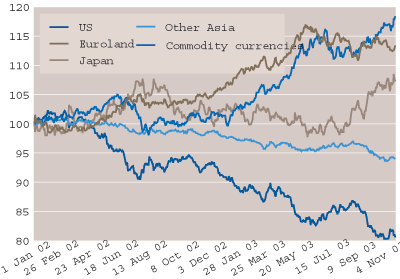
The second part of the dollar problem is the flip side of the exchange rate – the other world currencies that must, of necessity, rise as a group when the dollar falls. The exchange rate impact of dollar drops has been unevenly distributed. The euro and commodity currencies are up overall, but the yen fell in trade-weighted terms until recently, and other Asian currencies as a group are still sliding.
Where one currency falls, another must rise: this is one point every currency market participant learns, but one not always fully understood by policymakers. At present, for example, the “dollar problem” is central to exchange market policy, as well as to exchange market movements. But policymakers in different nations are focused on different aspects of that problem, which is a recipe for growing conflict with the potential to destabilize markets.
The difference, of course, is Asian central bank dollar buying. This asymmetric adjustment to dollar drops has proceeded fairly smoothly, with only a marginal impact on growth in the countries with rising currencies, and little evident damage to financial markets.
Now the US administration is trying to change the pattern, pushing for less intervention – and more currency movement – in Asia. This is already being seen in trade politics, as recent proposed US tariff increases on certain Chinese textile products demonstrate. Isolated protectionist measures or currency moves may take years before have they have a significant impact on the US current account deficit. But they may have unintended capital market effects, since the flows in question are huge.
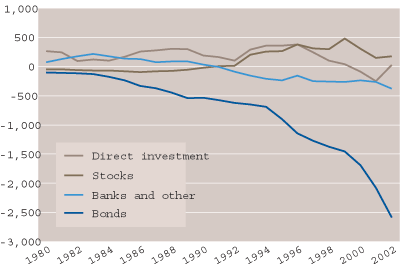
In 2002, when private capital inflows that had supported the dollar finally began to slacken, the dollar didn’t decline, because US outflows also dropped as US asset holders sold foreign securities and bank-lending flows shrank. In the first half of 2003, however, the dollar started to weaken as US capital outflows rebounded and the small increase in inflows was insufficient to offset the increase.
The result was a decline in total net non-reserve capital inflows to $382 billion at an annual rate, in contrast to $437 billion in 2002. This financed less than 70% of the current account deficit, leaving almost $200 billion (annualized) to be financed by increases in foreign official holdings of US assets – that is, by intervention.
Looking ahead, we don’t expect net non-official capital inflows to cover the current deficit for years to come. At this point, foreigners hold 43% of outstanding treasury market issuance, and about a third of outstanding US agency debt. This lopsided foreign ownership means that the dollar will be increasingly vulnerable to specific US bond concerns, and general bond market weakness. Foreign central banks cannot fund a quarter of the US current account deficit indefinitely. Private foreign asset holders are already very long dollar assets, and dollar drops will make them reluctant to boost exposure. Finally, US investors are stepping up exposure to foreign assets, a trend that could go a lot further.
This adds up to a negative outlook for the dollar, and we expect the dollar’s slide from its early 2002 peak eventually to mirror the trade-weighted magnitude of the late 1980s’ correction. This may seem like an extreme view, but that slide took several years, and had only limited effects on US financial markets. Critically, in the late 1980s we never saw the emergence of a negative feedback loop, where dollar drops pushed down US asset prices, and US asset price drops pushed down the dollar – the definition of a dollar crisis.
Euro on the offensive The down-and-up consolidation in the euro that began in June is over, and after a pause for reflection the euro is back on the offensive. This is in no small part a result of eurozone growth, which is coming on for real. We don’t expect euro gains to put that growth at risk; damage to exports should be more than offset by faster growth in eurozone export markets as a result of global recovery in growth. This suggests that policymakers will accept further euro gains with relative equanimity, though the European Central Bank might hold off on rate increases if euro gains accelerate sharply. We expect an average of €1.1850 to the dollar in the fourth quarter this year, and sustained gains after the first quarter of next year.
Sterling should also be a contender in 2004, as strength in the domestic economy is apparent across many indicators. The Bank of England has responded with a reduction in interest rate stimulus. Our outlook for interest rate increases is slightly less aggressive than that implied by interest rate futures, which are pricing in about 5% by the first quarter of 2004. Still, rising UK interest rates should increase the yield advantage against the other major economies. We expect the pound to gain towards $1.80 over the next year.
The currency spotlight is likely to remain on Asia, where most units look set for gains in 2004. For the yen, Japan’s massive intervention was never likely to work in the long term, given capital inflows; it hasn’t done so before, and the numbers have only got bigger. We think the Japanese authorities will tolerate gradual yen gains in the context of a weaker dollar. Particularly if Japanese equities continue to gain, we would expect the currency to rise to the ¥90 to ¥100 to the dollar suggested by underlying capital flows.
More truce than peace Elsewhere, talk will stay focused on China. US treasury secretary John Snow acknowledges that the US doesn’t expect the Chinese to break their currency peg “tomorrow”, and Chinese officials are digging in their heels. This sounds more like a truce than like peace. The Chinese trade surplus versus the US will almost surely continue to expand, and as these statistics combine with the run-up to US elections next year, the probability of policy surprises will increase. US pressure, as well as domestic concerns, will most likely push the Chinese to move to a basket peg within 12 months. We don’t expect a real currency float: China’s financial system is not ready for capital account convertibility.
The market’s ferocious appetite for commodity currencies will remain intact as these currencies offer both carry and growth trades. The gains in the Australian, New Zealand and Canadian dollars will come in varying degrees. We look for the Aussie dollar to perform the best, appreciating through $0.76 by the second half of next year. In Canada, we see modest gains approaching C$1.28 to the US dollar by the end of the first quarter of 2004.
If our outlook goes astray, we would like to predict the alternative path. These factors address critical assumptions we have made in our forecast, and what we would expect if those assumptions turn out to be wrong. Among the factors we will be watching are:
– a dollar crisis So far the dollar’s decline has been orderly, with only a moderate impact on the global economy and on financial markets. We assume that the decline will remain orderly. But if the dollar’s slide turns into a slump, sentiment could turn sour, with negative economic and market implications.
– a surge in US employment We have assumed that a listless labour market will keep the US economy, and the US consumer, on a solid footing but with moderate 3.5% to 4% growth for the next several quarters. Should job creation surge and the jobless rate drop to 5.7% by the end of 2003, Fed rate increases and a stronger dollar could re-emerge as key themes in the first half of next year.
– China We have assumed a change in the peg some time next year, but should the Chinese government delay this, some of the upward pressure we are assuming for the euro would ease.
– a slump in eurozone exports Despite a surging euro, we still expect modest growth in exports, as stronger global demand takes up the slack. But if single-currency strength hurts exporters more than we think, the recovery could get wobbly, and some European Central Bank policy reaction may be likely.
| Net US assets abroad ($bn) |
 |
| Source: IMF, BBH |
| Effective exchange rates (end 2001=100) |
 |
| Source: Datastream, BBH |
>


