 |
|
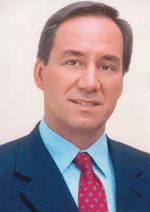
George Alogoskoufis
is in favour of Greece changing its economic policy mix |
With Greece scheduled to hold general elections next spring, the conservative New Democracy party currently has a solid lead in the polls. The party’s shadow finance minister, George Alogoskoufis (pictured), says Greece should change its economic policy mix to place greater emphasis on fiscal consolidation and the liberalization of certain markets to boost competitiveness and growth prospects. “The real picture of the Greek economy is not reflected in the GDP growth numbers. Special factors such as the preparations for the 2004 Olympic Games and the speeding up of older projects have boosted GDP,” Alogoskoufis tells Euromoney. “The budget deficit is widening, the public debt exceeds 100% of GDP, inflation is among the highest in the EU, and the economy’s international competitiveness is low, as evidenced by the large current account deficit and the rankings of international organizations. The public sector is still characterized by bureaucracy and corruption.”
Insisting that GDP growth, estimated at around 4% this year, is not a good indicator of underlying trends, Alogoskoufis points to Greece’s high unemployment rate. This stood at 10% at the end of 2002, the second highest in the EU, while the average EU unemployment rate was 7.7%. In 1980, the year before Greece joined in Emporiki Bank, where France’s Crédit Agricole has the right of first refusal. The post office, ELTA, is also slated for partial privatization and the government is seeking a strategic investor to buy Olympic Airlines, a spin-off and successor to debt-laden Olympic Airways. The state also wants to privatize 100% of Corfu Casino.
In addition to relatively heavy unemployment, Greece’s per capita GDP accounted for just 66.4% of the EU average last year compared with 70% in 1980.
Asked what should be done, Alogoskoufis takes a tough line. “As far as public finances are concerned,” he says, “the emphasis should be placed on fiscal consolidation by limiting primary spending growth in a three-year to four-year horizon.” He admits, though, that it is difficult to cut primary spending because a large part of it goes towards paying wages and pensions.
He notes too that trimming public investment spending to reduce the budget deficit is not a solution because it would hurt growth. But he says: “We need a new policy on public works where self-financing projects take centre stage.”
Alogoskoufis also favours the liberalization of transport markets, arguing that Greece should change its policy on subsidies to deficit-ridden state transport companies, such as the railways. He says subsidies would be better controlled and more transparent if they were offered straight from the budget, not indirectly. Today, state companies run deficits and get loans guaranteed by the state to finance them. These loans are usually called later, augmenting the public debt.
He favours a more cautious and gradualist approach to the liberalization of energy markets, such as electricity, because of their structure.
Alogoskoufis argues that greater fiscal consolidation along with the liberalization of some output and input markets, such as labour, would help lower inflation, improving the country’s international competitiveness.
He suggests the key to improving the economy’s international competitiveness is to upgrade the quality of its export products and services. To do so, the export organizations should be revamped and given greater responsibilities. “Italy should be the role model for Greece when it comes to new ideas and designs for products, and Ireland when it comes to corporate taxation and bureaucracy.”
If New Democracy’s lead is maintained, Alogoskoufis may get the chance to put his theories into practice next year.