Issuer: Islamic Development Bank
Size: $400 million
Bookrunner: Citigroup
July 29 2003
The Islamic Development Bank’s five-year fixed-rate $400 million debut Eurobond has taken Islamic finance another step forward. Not only does it further underscore the demand for such bonds among both Islamic and conventional institutions, it is the first time an Islamic bond, which has to be asset backed, has been backed by a pool of assets, paving the way for greater flexibility for shariah-compliant issuers.
Underlying issue Money has no intrinsic value in Islamic finance, so bonds have to represent a real underlying asset. Bahrain’s $250 million sukuk (shariah-compliant asset-backed bond) issued in May 2003 is backed by an ijara lease on the country’s airport; Malaysia’s $600 million global sukuk, launched in June 2002, is similarly backed by an ijara on a single piece of government property.
In contrast, the IDB’s debut issue is backed by a pool of ijara leases as well as murabaha and istina contracts spread across 15 countries. The ijara are leases that the bank has financed for development projects in member countries, such as the purchase of railway carriages for the Sudan Railways Corporation. The pool also includes the lease financed by the IDB for an A330-200 for Emirates, the Dubai-based airline [see Opportunity knocks on the Islamic front, this issue].
Under conservative shariah interpretations, only securities backed by ijara leases are tradable because they are truly backed by real assets. Murabaha contracts, in which a client makes payments to a bank for a good that the bank has bought for the client, and istina contracts, which are similar to project or trade financing deals, cannot be traded because they represent money owed, not tangible assets.
The IDB managed to include murabaha and istina assets in the pool by exploiting a new shariah board ruling that allows for sukuk based on a pool of assets to be tradable, as long as the majority of the assets are tradable. Some 69% of the assets backing this transaction are ijara.
Arranging such a complex and innovative deal for the first-time issuer took Citigroup 22 months. One of the most time-consuming tasks was in getting a rating for the IDB. It was able to earn an AAA rating from S&P and AA from Fitch, higher than any of its members, which include such states as Mauritania, Chad, and Togo.
The deal was priced to yield 3.78%, equal to 16bp over mid-swaps or 61bp over treasuries, and was increased from the planned $300 million.
The innovative structure did not please everyone, however. According to rivals, Citigroup had to extend the marketing period from two to three weeks because it had a tough time selling the deal to Middle East Islamic banks. Some of these had concerns that the transfer of assets to the SPV, Solidarity Trust Services, was not a true sale, while others were said to be critical that the debt was being sold at a discount (99.489%).
Islamic banks have also typically been more comfortable with floating rate structures.
“There was a transfer of beneficial ownership just as in the Malaysian deal,” says Saad Ashraf, the head of Citigroup’s global Islamic finance unit. “The deal is fully guaranteed and wrapped by the AAA IDB and wouldn’t have got the same rating as the issuer if the risk was not purely IDB risk.” According to Ashraf a true sale would also have been undesirable. “The IDB has preferred-creditor status with member countries. If there was a true sale of assets to the SPV then the deal would lose the special tax treatment associated with its preferred-creditor status.”
Just the beginning The IDB’s visit to the international debt capital market is to be the first of many. “The IDB intends to raise its funds from the international markets instead of its shareholders from now on,” says DM Qureshi, adviser to the IDB’s president. The IDB expects to increase its activities by about 7% annually over the next 10 years, which means that it expects to have to raise an additional $4 billion.
Achieving a wide balanced distribution was a key objective of the transaction. The issuer not only wanted to attain a healthy balance between Islamic and conventional investors but also to place its paper with similar accounts as itself, such as other MDBs. In the end 30% went to Islamic accounts, 40% to central banks, 10% to fund managers, 15% to conventional banks, 5% to retail. Geographically roughly 70% went to the Gulf, 17% to Asia, and 13% to Europe.
The IDB feels a responsibility to help promote Islamic finance. “The IDB feels it has to take a leadership role in helping Islamic finance to integrate with the global market,” says Qureshi. “As an institution mandated to do things in full compliance with shariah, it has a clear principle. It would much rather sacrifice business and profits than shariah.”
While the deal may have its critics, the success of the transaction and the high regard in which the IDB is held in the Islamic finance world could means that the securitization of a bundle of assets could become more standard practice in Islamic finance. This represents a further advance and could open up new opportunities for potential issuers and investors.
Distribution of IDB’s Eurobond
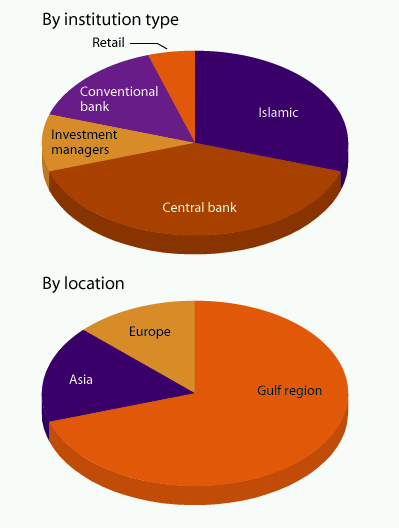
Source: Citigroup