Bond investors finally appear to be getting the message that exposure to commodities can be a useful hedge in a portfolio. And if they have invested in the right commodities, they could find themselves in an excellent position to profit from any forthcoming US interest rate rise.
The latest Commitment of Traders report from the US Commodity Futures Trading Commission (CFTC) shows that after years of shying away from this esoteric asset class, investors are in fact pushing capital into energy, base metals and precious metals in the greatest volumes since 1983.
It is not just speculative traders that are driving this trend, according to Deutsche Bank. “Speculators come in and out of the market but pension funds are now leaping in, and that is unlikely to reverse,” says Michael Lewis, the bank’s new head of commodities research.
Capital inflows into commodities have become so pronounced that concerns are mounting that a bubble is being created. “Speculative inflows do increase short-term volatility risks, but we are starting to see new pension fund structural money coming in,” says Lewis. But he adds: “It would be extreme to say we are seeing a commodities bubble.”
This is because even with price rises, several commodities still look cheap. Copper, for example, was recently at its lowest level since the 1930s in real terms, and its nominal value is now around $1,745 a tonne. This may be up on its recent 17-year low of $1,300, which it maintained from 1999 to 2002, but it is nowhere near its 1995 high of $3,780.
As long as these trends continue, firms such as Deutsche Bank will encourage investors to seek commodity exposure. “The bond sell-off is a timely reminder that diversification is very important,” says Lewis. “We are pushing that idea.”
Financial shocks But some commodities are more closely correlated to the financial shocks that investors are trying to hedge than others. Agricultural commodities such as wheat and corn are seasonal and their price depends on external factors such as harvest levels. Similarly, the oil price fluctuates in times of global political stress.
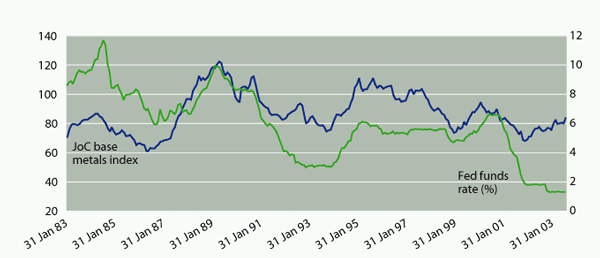
The housing and construction industries historically perform well at the early stages of an economic recovery, boosting demand for copper and nickel. “Base metals are a pure way of looking at what the commodities markets are pricing in for growth,” says Lewis.
Deutsche Bank has therefore identified base metals as a closely correlated indicator of US growth potential. When their value moves, business confidence and the Fed funds rate tend to move in the same direction two to four months later.
Pessimistic analysts That means that investors who think that the Federal Reserve will tighten monetary policy next spring, despite rising unemployment rates, should invest in base metals now. Indeed, further research from Deutsche Bank shows that analysts are generally proving to be overly pessimistic about new data releases.
The bank’s Macro Surprise Index shows that since around July this year the analyst consensus figures have consistently underestimated the rate of the US recovery. “There is some froth in commodities prices at the moment,” says Lewis. “However, this is justified by the upgrading in US growth prospects. The risk is that in October investors will think that maybe the US is not so strong and they will sell again.”
The other risk, at least for the handful of firms such as Deutsche Bank that are building up their commodities coverage, is that investors will take note of data such as this, appreciate that base metals are showing a path to a rise in US interest rates early next year, and simply use bond futures contracts to take advantage of that.
Base metals index vs Fed funds rate
Source: Deutsche bank, Commodities Futures Trading Commission