IT WAS ALL going so well. Russia’s economic development and trade ministry had upgraded the end-of-year GDP growth forecast twice to 5.7% and economists were even more ebullient. The stock market was flying, having reached analysts’ end-of-year forecast by June. And Russia had seen the first really big foreign investments since reforms started in 1991.
Then, on July 2, Russian police arrested Platon Lebedev, the man credited with rescuing Russia’s biggest oil company, Yukos, from bankruptcy in the wake of the 1998 crisis, and a nasty power struggle broke out between the liberal-market-oriented Kremlin factions and the unreformed old guard. The stock market immediately fell heavily, capital flight shot up again and the threat of renationalization appeared to hang over all of Russia’s leading companies.
Russia has put in a sparkling economic performance over the past two years, but the war between the two opposing factions for the long-term control of Russia’s development has been an unwelcome reminder that politically nothing much has changed. And while president Vladimir Putin can take the credit for the strong economic results, the blame for the political imbroglio also rests with him.
What had started as a routine dig at Yukos CEO Mikhail Khodorkovsky, Russia’s richest man, from his enemies in the Kremlin quickly spun out of control. Instead of prostrating himself, Khodorkovsky mustered his allies in the international business community and Washington to lobby on his behalf – a move that inflamed the situation further.
As the scandal widened it has become more complicated as everyone with an axe to grind has bundled in. But the most popular theory is that the two major Kremlin factions have gone to war in a battle for control over Russia’s development after the next presidential elections slated for March 2004 (see Euromoney cover story August 2003).
“It has become a fight to influence Putin’s second term in office,” says Sergei Markov, director of the Institute of Political Studies. “It is clear that he will win the elections, but what his policies will be and who will make up the team that will set them is still not clear.”
In one camp is big business and the oligarchs; in the other the unreformed KGB colonels, interior ministry officials and the security services – collectively known as the Siloviki, or “power people”, a political force left over from the communist era.
The Siloviki have been losing power steadily since Putin came to power and the terms of the debate have narrowed since Boris Yeltsin stepped down in 1999 – the start of Russia’s sustained economic recovery.
No quarrel over need for economic reform United Energy System’s CEO Anatoly Chubais pointed out earlier this year that no-one was arguing over the need to reform the economy. Four years of strong economic growth have convinced everyone of the need for change and the benefits of free-market capitalism. But there is still no agreement on precisely what this means in practical terms.
“The perception of a battle between pro-market and anti-market forces is incorrect. Both wings of the ‘party of power’ are using different methods to gain advantage over the other in order to establish a central role in the 2004-08 presidential administration,” says Chris Weafer, head of research at Alfa Bank. “But whatever its composition, that administration will follow an economic and reform agenda broadly similar to the one seen over the past three-and-a-half years, because that is what the situation clearly demands.”
What is most worrying about this fight is that Putin seems to have gone back on a historical promise that underpins the oligarchs’ confidence in Russia’s growth. Within two months of taking power, Putin called all Russia’s leading businessmen into the Kremlin in July 2000 for what has come to be called the “oligarch meeting” and struck a bargain: no nationalizations of their companies if the stealing stopped.
For most of the 1990s the oligarchs had sent cash abroad because of the threat of renationalization should the communists return to power. However, the oligarch meeting made explicit the promise of stability that was implied by Putin’s victory. Both sides in the current row understand that trying to undo this deal would lead to chaos.
“Most people in the Kremlin are against revisiting the privatization of 1995 as they realize that it is a Pandora’s box. To renationalize these companies would start such a huge fight for control that it would undo Putin’s main achievement – political and economic stability,” says Markov. “They also realize that although some KGB colonel might be more honest than the oligarchs, no-one believes he will be a better businessman.”
Several political heavyweights, such as prime minister Mikhail Kasyanov and economic development and trade minister German Gref, were quick to weigh into the fight on the side of the oligarchs, saying that there would be no renationalizations.
“There have been no changes in either the government’s or the president’s position on the issue and there is not going to be any revision,” Gref said within a few days of Lebedev’s arrest.
After the initial jitters the stock market stabilized, having dropped from a high of about 520 to 450, as it became clear that the attack was Yukos-specific and that the loans-for-shares privatizations of 1995-96 that created most of Russia’s blue-chip companies would not be revisited. However, the row rumbled on as Putin, the only one with the power to separate the battling factions, made only a few ambiguous statements.
What triggered off this row in the first place? The consensus is that Khodorkovsky’s biggest sin was to back the main Duma opposition parties with funding in the run-up to the December parliamentary elections.
Other oligarchs, such as Interros boss Vladimir Potanin, have made a big show of supporting the Unity/Fatherland-All Russia alliance, the Kremlin’s party of power, and publicly aligned themselves with the powers that be. By backing the opposition, Khodorkovsky stuck his political neck out. The other two oligarchs who have attempted this – Boris Berezovsky and Vladimir Gusinsky – are now living in self-imposed political exile abroad for their sins.
The row shows up the ambiguous nature of Putin’s rule and the inherent contradictions in the system of power that he has been building up. When he first came to power three years ago this led to divided opinions among Russia watchers. Putin’s rough handling of Berezovsky and Gusinsky (as well as the regional governors) led those looking at his political actions to dub him “Putin the dictator”, while those who focused on the radical tax reform – cutting income tax to a flat 13% rate – dubbed him “Putin the reformer”.
Much confusion followed, since these two Putins seem irreconcilable. In the absence of any major political scandal since 2000 the economic Putin has been lauded and huge foreign multinationals finally felt sufficiently confident about Russia’s future to take the plunge. Ironically, just as they set out from the shore the ugly political Putin rears his head again.
Political step too far The economic Putin supports the oligarchs and realizes that he needs the cooperation of big business if Russia is to double GDP by 2010, a goal that Putin set in his May state-of-the-nation speech. However, most agree that Khodorkovsky overstepped the mark, straying onto the political Putin’s turf.
“President Putin has clearly stated that his government needs to win a pro-Kremlin majority in the Duma December elections in order to help push the reform process,” says Weafer. “The fact that Yukos executives openly declared their support – including financial support – for some opposition parties both broke the May 2000 understanding and endangered Putin’s main political ambition for the December Duma elections.”
In contrast to Yeltsin’s running battle with the communist-dominated Duma of the 1990s, Putin commands a 53% majority in the Duma and has been using it to ram through the most radical economic reforms Russia has ever seen. Going into this winter’s elections, his key political goal is to maintain his grip as part of the wider system of “vertical power” he has built up since he took office.
Backing the opposition with his billions of dollars, Khodorkovsky would have found it easy to shave 4% or more off the pro-Kremlin parties’ share of the Duma and effectively thwart the Kremlin’s main political goal of dominating the legislature.
The oligarchs have largely finished fixing their companies, which are all now profitable and relatively efficient. They have plenty of money and they can easily raise more – Russia’s return to grace means the international capital markets are once again open to Russian companies. It is natural that their attention has turned to the long term and that they would start to politicize, since their main obstacle to further growth has become the state. At the same time they wanted to counter the Siloviki’s effort to undermine their position.
Over the past year the Siloviki have sponsored a series of bills, such as the law on mining and the law on nationalization, that are clearly intended to establish a legal framework for the redistribution of property. In July Nikolai Patrushev, the head of the Federal Securities Services (FSB), the successor to the KGB, went as far as to say that his agency needed more control over economic activity and privatizations in particular.
The ability to stall the Duma’s work would hand Khodorkovsky real political power. It would put him in the position to dictate terms to the Kremlin and maybe even to launch a presidential bid in 2008.
In practice, Khodorkovsky would not have been able to command the other half of the Duma in the way that the Kremlin commands its half. However, to weaken the Kremlin’s power at all is sufficient of a challenge to prompt a strong backlash.
“Khodorkovsky is coming under attack for the simple reason that he was caught not just trying to strip away the state’s remaining hydrocarbon assets and infrastructure, but more generally because – frustrated in this attempt – Yukos has resorted to literally buying up the Duma, paralyzing reform legislation and seeking to re-establish oligarchic ownership of the Russian government à la 1997,” says Eric Kraus, the head of strategy at Russian investment bank Sovlink. “Putin simply cannot tolerate this, except at the cost of surrendering any hope of accelerating and completing Russian reform.”
Khodorkovsky fuelled speculation that he has wider political ambitions earlier this year by announcing that he intended to step down as Yukos CEO in 2007 – a year before the next presidential elections are scheduled. Political analysts sketched out a hypothetical plan of action. He would, they speculated, gain control over a strong Duma faction in these elections, then get himself appointed prime minister before 2007. He would then use this as a platform to launch a presidential campaign in 2008 (in exactly the same way Putin used his position as prime minister in 1999 to win the presidential elections in 2000).
Putin now finds himself in an uncomfortable position. The economic Putin needs the oligarchs’ business skills to maintain strong economic growth. Indeed Russia needs to pick up the pace from the current 6% GDP growth to at least 7.2% if it is to double GDP by 2010. On the other hand, the political Putin won’t tolerate any encroachments on his power. Still, no-one is sure to what extent Putin was involved in this whole affair. Clearly, as a former KGB colonel, he has a lot of sympathy with the Siloviki, but he is not one of them.
Some say that he was persuaded to support the attack on Khodorkovsky by two deputies in the presidential administration, Viktor Ivanov and Igor Sechin. Both are cronies of Putin from his St Petersburg days and are thought to be core members of the Siloviki. Others say that he was caught unawares by the attack and now has his hands tied by his own lack of power. Regardless of his personal involvement, Putin is vulnerable in the months before the election and is a victim of the political system he has built up.
Putin’s system of vertical power has effectively removed power from the Duma and placed it directly in the president’s hands. He exercises that power through the apparatus of the presidential administration. The problem is that those that wield this unrestrained power are not a homogenous group and are far from being dominated by Putin or unswerving in their loyalty to him.
“[Putin’s vertical power] is an inherently unstable structure of government as the presidential administration is a parallel government, which exists outside the constitution,” says Peter Reddaway, a visiting professor at the London School of Economics. “Formally the Duma is the main body of power in Russia, but it is staggeringly corrupt and all the real power in Russia is in the presidential administration.”
In a parliamentary democracy the president’s (or prime minister’s) power is based on his popular appeal to the public. But though Putin is wildly popular, his power rests on his ability to take away the jobs of people in the presidential administration. However, in an election year the tables are reversed and he depends on the support of those exercising his power to keep his own job.
The power of this support was dramatically demonstrated during Yeltsin’s 1996 re-election campaign. Starting with close to nil public support, within six months a cabal of oligarchs and Siloviki managed to put him back in office with a comfortable majority.
“Putin in his heart sides with the Siloviki, but the oligarchs have tremendous resources and now there is a sharpening in the conflict between the two sides as they try to force Putin to back one or the other,” says Reddaway. “This comes to a head in election year as Putin is more vulnerable as he needs their support to get through the elections.”
The fact that the fight began at all shows that despite the strong economic growth political reform is lagging well behind economic reform.
Reddaway has argued that as Putin’s power is exercised outside the checks and balances imposed by the constitution, Putin is forced to balance the interests of the different factions and so has to work at the level of the “lowest common denominator”.
Desperate times for the Siloviki This would normally leave him in control and able to force through individual issues, but with the elections looming, the balance has been upset. As he needs the support of both factions Putin cannot afford to intercede in favour of one side or the other. The Siloviki are fighting particularly hard as this may be their last chance to grab control of policymaking; the oligarchs have been making steady gains over the Siloviki in recent years.
“The security services people were promoted by Putin following the power vacuum after Yeltsin, but they have done less well than they would have liked since. They see the attack on Khodorkovsky as their last chance and hope to force Putin to take a more populist line,” says Reddaway.
The oligarchs have grown stronger as they have coalesced under the banner of the Russian Union of Entrepreneurs and Industrialists, known by its Russian acronym RSPP, which they use as a forum to thrash out compromises among themselves before going to the president.
The Siloviki have Putin’s sympathies, but he is at best an ambiguous leader for them. They are further weakened by the fact that they have no shared ideology. Yeltsin’s team did everything it could to co-opt as many Siloviki as possible by offering political appointments and good jobs and they have remained “motivated by everything from imperialism to greed,” says Reddaway.
Building up the power of the Duma could bring Russia more stability, but the rampant corruption has debased the legislature and made it less than effective.
Reddaway cites one big industrial group (not Yukos) that recently commissioned a study to see which was the more efficient way of lobbying for its interests – buying votes in the Duma on an individual law-by-law basis, or funding the election campaign of a deputy to have a more permanent representative in the legislature. Between a quarter and a third of the Federation Council, the upper house of the Duma, represent one group or another.
“Even though Russia is not the world’s most corrupt country, it is among the most corrupt. The large scale of corruption is disrupting the economy, and eventually that leads to poverty,” says Georgy Satarov, president of the INDEM foundation, who recently completed a study on corruption for the World Bank.
The whole scandal surrounding Yukos has been a reality check for foreign investors and a reminder that despite much enhanced economic stability there are still significant political risks to doing business in Russia.
The system of vertical power is probably the quickest way of fixing Russia Inc and breaking the hold of the old apparatchiks embedded in their communist-era jobs, but the Yukos scandal has shown it is also an inherently unstable system of government.
And there is another worry: what would happen if the presidential cortège that speeds down Novy Arbat every day on its way to the Kremlin were to crash and Putin were to be killed? The presidential security outriders have already been involved in half a dozen crashes, a few of them fatal, over the past three years.
“It would immediately knock 15% to 30% off the stock market, but it wouldn’t be that bad as the constitution is clear on succession,” says Steven Jennings, the president of Renaissance Capital. “The problem is that there is no mechanism to elect a successor, nor any suitable candidate as successor on the radar.”
The constitution is clear: If a president dies, the prime minister takes over and new presidential elections must be held within three months. As Putin has efficiently squashed the free press it is likely that prime minister Kasyanov could put the state-control media machine into action and ensure a relatively smooth transition of power.
But Kasyanov is seen as a creature of the oligarchs – the general prosecutors office has criticised him for his public support of Yukos – and another, and probably extremely ugly, war would break out between the oligarchs and Siloviki over the succession.
Democracy in Russia is still not functioning properly. Yeltsin handpicked Putin to succeed him and unless Putin bolsters parliamentary authority at the expense of the presidential administration’s de facto power over the next four years – which he has hinted that he might attempt – this year’s war between the Siloviki and the oligarchs will pale in comparison to the all-out fight to be expected in 2008. This year it is only the power to set policy that is up for grabs, but in four years’ time the prize will be the presidency itself.
Kremlin controls 53% of Duma votes
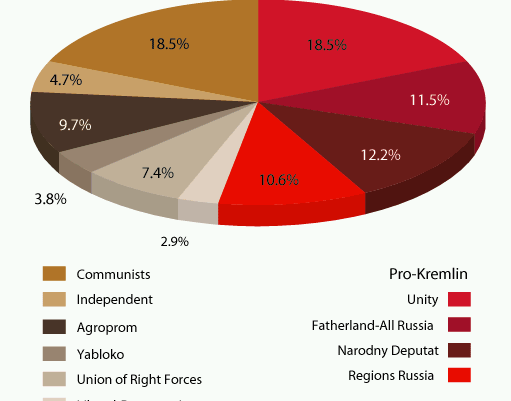
Source: State Duma
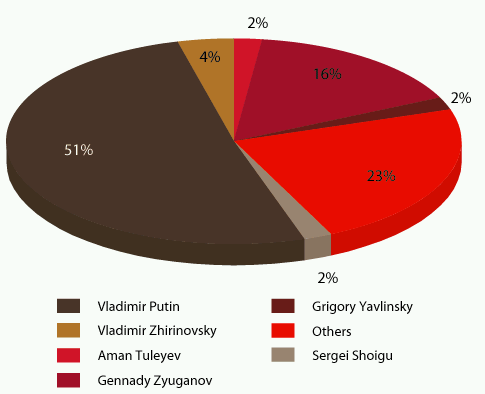
If the presidential elections were held today…
Source: Public Opinion Foundation