|
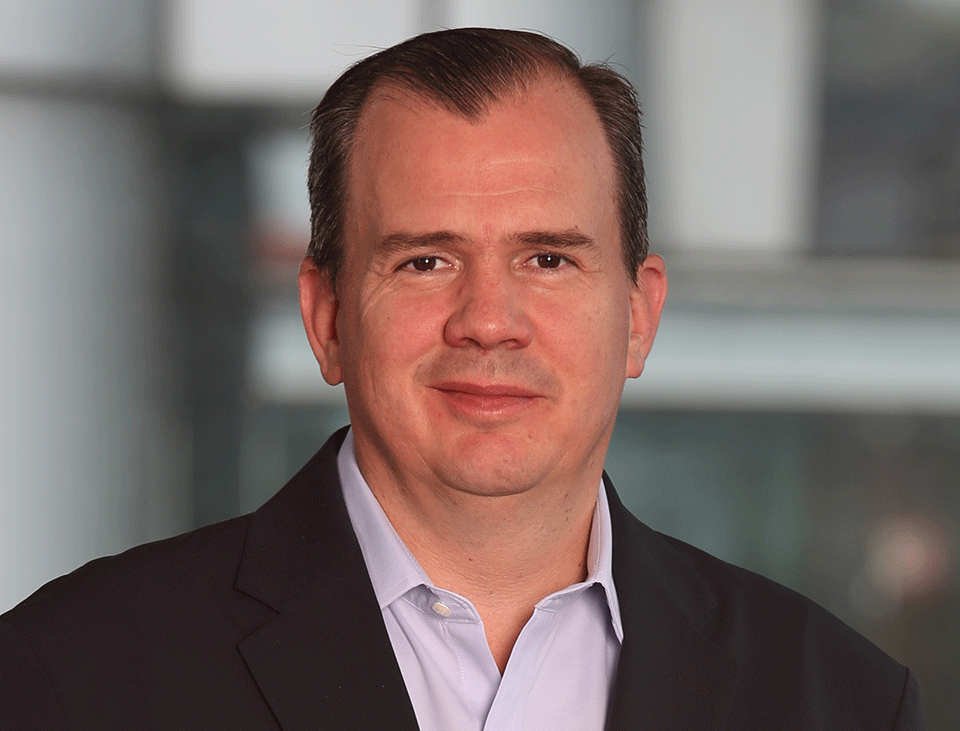
Raghuram Rajan, the new chief |
RAGHURAM RAJAN WAS in some ways a bold choice as the replacement for Ken Rogoff as the IMF’s chief economist. A 40-year-old Indian-born professor at the University of Chicago, he is perhaps best known for the book Saving Capitalism from the Capitalists, published this year.
The book, which Rajan wrote with fellow Chicago professor Luigi Zingales, is about how businessmen try to rig the markets in their favour, through political contacts and the capture of government regulation.
This is more or less what Joseph Stiglitz, former chief economist at the World Bank, said had happened to the IMF in his book Globalization and its Discontents. Stiglitz’s accusation that the IMF was in the pocket of Wall Street banks led to a public bust-up between him and Rajan’s predecessor.
Rajan does not come across as a rebel in the Stiglitz mould. In fact, he’s an Adam Smith-style free marketer through and through. But he has strong views on Iraq.
For those who haven’t read your book, is it fair to say that it’s about the dangers of big business capturing markets and government regulation? Not just business interests – it’s about the power of any special interests to capture regulation. It’s an old theme of the Chicago school.
The best force against the capture of markets by special interests is globalization itself, and the force of competition it brings. In some more closed societies, for example, it is the guys with good contacts in the political elite who flourish. Young entrepreneurs can’t get ahead. Competition from outside, in the form of foreign businesses, makes that society face up to its inefficiencies, so the society itself starts pressing for more reforms.
For example, in India’s protectionist past, you could only manufacture goods if you were well connected to the government. We had an antiquated car industry that only really manufactured one model – the Ambassador car. Then, in the 1990s, the market opened up to foreign businesses and the Ambassador model got wiped out.
But with foreign competition coming in, Indian companies started complaining that the foreign companies get a better cost of financing than them. So they started pushing for improved infrastructure, for improved corporate governance, so they could get cheaper finance. In other words, the force of competition from globalization helped break up the capture of the market.
Now, new independent Indian car companies have set up and are doing well.
Was the New Deal an example of market capture? We all have this view that there was this wonderful government rule by Franklin D Roosevelt. But he had a great suspicion of competition, so he said: “Let’s limit it, let’s fix prices, let’s allow cartelization.” He grandbagged his policy between big labour, big government and big business. The victims of this were competition, and outsiders.
Maybe it wasn’t that costly in the beginning. The economy was in the middle of the Depression, so innovation was not that important at that stage.
So you don’t think New Deal-style regulation appropriate in our present slump? It’s too late. The genie of competition has been let loose. We all have to compete just to stay where we are. And if you look at Japan’s economy, which has more of a government presence in market regulation, what we’ve seen is that in the process of protecting business it hasn’t allowed the necessary cleansing.
What is an example of recent market capture? There was something discussed recently in the US – college saving plans. You put money for your children into plans, and you get tax savings. Each state has this, and many states have one provider. Often, these providers charge pretty steep fees. They’re clearly monopoly providers.
Why do these monopolies exist? Someone pointed out that in a certain state, the state agrees to pay the monopoly company more money to “educate the investor”, which basically means send out pamphlets. Every pamphlet sent out has a photo of the state treasurer on it. So it’s basically a cosy deal between the local politician and the investment company.
It’s an example of how even in fairly aware economies like the US there is still that nexus between business interests and politicians.
Could the IMF’s largest shareholders capture it? There is certainly that argument. The board in theory has voting power which to some extent lies in the hands of a few countries. The US has 17%, Europe has a significant percentage, so it is a worry that the IMF just does what the big powers tell it.
But there’s some justification that the people who provide the money have a say in what’s done with it.
What if the IMF does what is in the political or financial interests of the big shareholders rather than the interests of the borrower countries? Does the management succumb to the interests of big powers or do they do what is right? My sense is that the people at the IMF are a very dedicated bunch who do care about the interests of the member countries they work with.
On some occasions, they could go against the dominant political party in borrower countries. That goes with the turf, if you want to do what’s best for the people in that country. If government is overspending, or is in the pocket of special interests, then the IMF might well tell them to get their finances in shape. That’s not going against the interests of the country, but against the interests of bad government.
Do I think the IMF is never influenced by political considerations? My answer is that there probably are occasions. Is it typically the case? No. Its management is convinced that the IMF should work in the interests of the country.
What do you say to the argument that the IMF has been or could be captured by Wall Street banks, and that this is why it made Asian countries liberalize capital accounts in the 1990s? I have no comment on the issue of capture by Wall Street banks. Should one postpone capital account convertibility until sound infrastructure is in place? A lot of people in the IMF would agree with that. You need to make sure you have infrastructural elements such as bankruptcy courts and proper government regulators in place. However, there is a chicken/egg problem – unless the country makes some commitment to liberalization and opening up, there may not be any improvement in infrastructure. The challenge is to make these things go hand in hand – that’s what seems to have happened in countries like Italy when they opened up to the euro.
An adviser to UK finance minister Gordon Brown recently suggested that the IMF should separate lending from surveillance. He claimed the two roles create a conflict of interest that could compromise the objectivity of IMF research. Not knowing the details of what the IMF procedure is at the moment, it’s hard to comment. But in general, the idea that you want to reduce conflicts of interest in the supervisor makes sense. You don’t want someone to deal with the recovery for a situation which they might have been responsible for. Then again, the person who has been there in the beginning may have superior information, and so be able to advise better. We might have to think of clever ways of reducing the impact of conflicts without splitting the IMF.
There are analogies here with commercial banks, where the work-out divisions are separate to the lending division. Maybe some of that is already going on at the IMF. Some of it naturally happens, because in crises, situations are immediately passed up to management for review.
The US has made it clear it wants the IMF to play an important role in Iraq. What role do you see? I have no comment on that. What I will say is that I actually think the idea that you can build a market democracy from outside is complete garbage. Look at the history of colonialism – the places where there are functioning market democracies are places which already have traditions of it, and where the ruled looked like the rulers, for example in Australia.
If the outside power doesn’t want to have a tremendous occupying force, they have to do deals – with this warlord, with that magnate – because they don’t have popular support. That enriches certain people, and makes it much harder for an open free market to emerge.
The problem with any outside power which doesn’t have any internal legitimacy is that you either have a huge occupying force, or you do deals with local magnates, either of which makes it very difficult to have a market democracy.
I’d like to be convinced that market democracy can be imposed from outside. But look at Japan or Germany – they were defeated powers, sick of their own governments, who were OK with the occupation, and willing to work for it. They didn’t have US soldiers getting shot every day.
They’re trying to create structures where there weren’t any before. It takes a long time and a tremendous amount of staying power and resource infusion. I’d like to see the test case work in Iraq. I hope it works, because it is very important. But it will take time.