
The pan-European asset management industry spends more than $9 billion every year managing and distributing product information, according to research by independent consulting firm SPB Marketing. Software company Activiti has created a product that it believes can help large fund managers to cut costs by up to $5 million by increasing the efficiency of the flow of information between firms and consultants and within the asset management firm itself.
Asset managers have seen a 70% increase in the number of data requests over the past three years. There are calls for client analyses, manager holdings analyses and performance-related data, to name a few. There has also been a 150% growth in invitations to tender for institutional business (requests for proposals) over the same period. One in four managers are unable to meet these information demands, according to the SPB survey of consultants and asset managers.
Activiti, which was created in April 2002, has developed a system to help asset managers and consultants communicate in a more standardized way. Joe Morant, co-founder and vice-president of business development at Activiti, says: “We’re trying to connect what consultants need with what asset managers have got.”
Activiti has developed a software system to aid the fund management industry in product management and distribution of information. The product, completed at the end of August, has been in test phase with three anonymous fund management firms for the past year.
The survey also found that consultants commonly feel that asset managers fail to develop products that are innovative or designed to meet clients’ specific requirements.
Forsaking feedback Less than one in five asset managers surveyed use consultant feedback to identify trends and develop new products. Win rates for new business from manager responses to requests for proposals, for managers with more than $600 billion of assets under management, was less than 30%. For managers handling between $83 billion and $599 billion of assets the win rate was under 20%.
Not surprisingly, the survey also found that managers would increase their chance of winning business if they took note of client needs and responded accordingly.
State Street Global Advisors, an indexation investment specialist manager, launched a new active gilt-strategy product in August in response to investor feedback. Rick Lacaille, UK CIO for SSgA, says the manager has tried to create a product that clients want rather than thinking, for example, that “we’re good at equities which may then become increasingly irrelevant”. Lacaille adds: “We need to be more solution-based rather than product-based.”
Joe Moody, senior investment manager in fixed income at SSgA, says: “We were getting anecdotal feedback from consultants and clients moving to passive saying ‘we’re just not happy with the way the market operates. We’re paying up for the active space but they’re not delivering’.”
SSgA has been using overlays to exploit global opportunities through currency and global bonds for sophisticated clients and central banks for the past few years.
Moody says that because of investors’ desire to meet their liabilities while having stable investment, the fixed-income team at SSgA began to think: “How do you get that on a gilt portfolio?” SSgA then developed a structure where extra alpha opportunities are overlaid on an underlying gilt portfolio. The product is active, rather than an enhanced index tracker, as it aims to outperform the benchmark by 75 basis points.
The new product invests in the UK Gilt All-Stock Index and, on top of that, it uses derivatives, that is overlays, to take bets in the global bond and currency markets as well as playing the gilt yield curve and relative value by switching out of gilts into swap-related products in order to add alpha.
The global bond and currency overlays give the investor exposure to the global fixed-income markets. Playing the yield curve and relative value diversifies investment in the UK government bond market.
The global bond and currency overlays aim to make up 60 basis points of the 75bp of outperformance by taking advantage of the differential in returns. The remaining 15bp will be achieved by taking advantage of the differentials in return of bonds across the yield curve and taking a limited opportunity to sell sterling gilts and buy swaps exposure.
The next step for SSgA is to develop a product that allows pension funds that know their liability profile to actually match it and then add alpha by investing across different asset classes. “The way forward is ‘what are my real liabilities?’,” says Moody. “Then you can construct a portfolio – we’re looking at a product to do it – match their liabilities and then look at all the sources of available alpha across the top,” he adds. “This [active gilt product] is something in between.”
Relative complexity of collecting data on a scale one to five
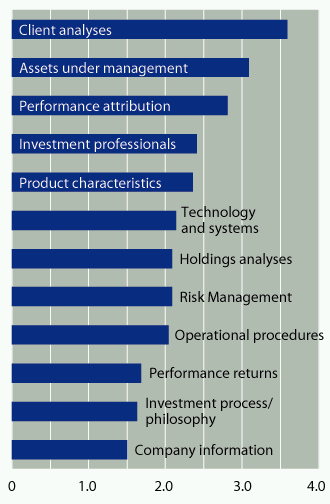
Source: Product management report by Activi and Russell/Mellon CAPS


