|
|
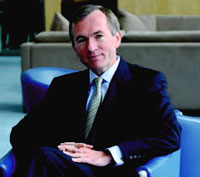
They must have wondered what they were doing wrong, or possibly right, to trigger this extra involvement from David Puth, the bank’s global manager of foreign exchange and commodities. Was he arriving to decide which resources to add in Europe, or which to cut? Was he planning to shake up the London management team?
Puth, who is also a managing director for the bank’s credit and rates division, was already well known in the London office, having spent one week out of four there for over a year. Now he is turning that travel pattern around.
Puth is quick to quell concerns that his arrival signals a change in direction. “We can shift resources at any time we see opportunities,” he says. “A move like mine takes time, and we are looking for opportunities to further invest in our European activities. But that does not represent a strategic shift. We are aggressively building in north America and Latin America while we maintain a strong presence in Asia.”
Central advantage Perhaps the main advantage of being based in London is that Puth can talk to colleagues and clients in Asia, Europe and the US on the same day. When it is 7am in New York, it is already 9pm in Tokyo, making phone calls involving both offices particularly tricky. “It is not unusual for any global head at JPMorgan to be based in London,” says Puth. “This gives me the ability to operate in all three centres in any working day.”
Puth became JPMorgan Chase’s global head of forex and commodities in May 2002. He first entered foreign exchange banking in 1980, to do trading and sales at Bank of New England. Before joining JPMorgan, he had been a vice-president in foreign exchange at Citibank. And he has been a member of the US Federal Reserve’s foreign exchange committee since 1990 and its chairman since 2000. From 1997 to 1999, he also served on the board of the Chicago Mercantile Exchange. In 1988 he joined what was to become JPMorgan Chase when he went to work for Chemical Bank in north America. So the merger between JP Morgan and Chase in 2001 was not the first Puth had experienced, although it was a transformational deal for the firm.
Puth doesn’t talk about “building” the bank’s businesses in a region or a product; he talks about “further building” it.
Now in London, he hopes to continue to manage JPMorgan’s forex operations in much the same way as he has since May 2002. “I like to think that I am supportive of our best people,” he says. “I try to be as attentive to our business as to our culture. We are able to attract and retain the best people… I try aggressively to have regional teams managing themselves as independently as possible, with a strong bias to operating with best practice across the centres and with total global coordination,” he adds.
Although a new strategy is not imminent, some new products might be. For example, the bank is looking at ways to create new products that link commodities and foreign exchange.
But even with product innovation and good price-making, Puth is aware that new factors determine competition in liquid markets. “I am notably more focused on what we are doing, but it is important to be aware of the competition,” he says. “There is no question from a credit and interest rates standpoint that I am very confident in our price-making capabilities. The biggest area of competition is in e-commerce.”