|
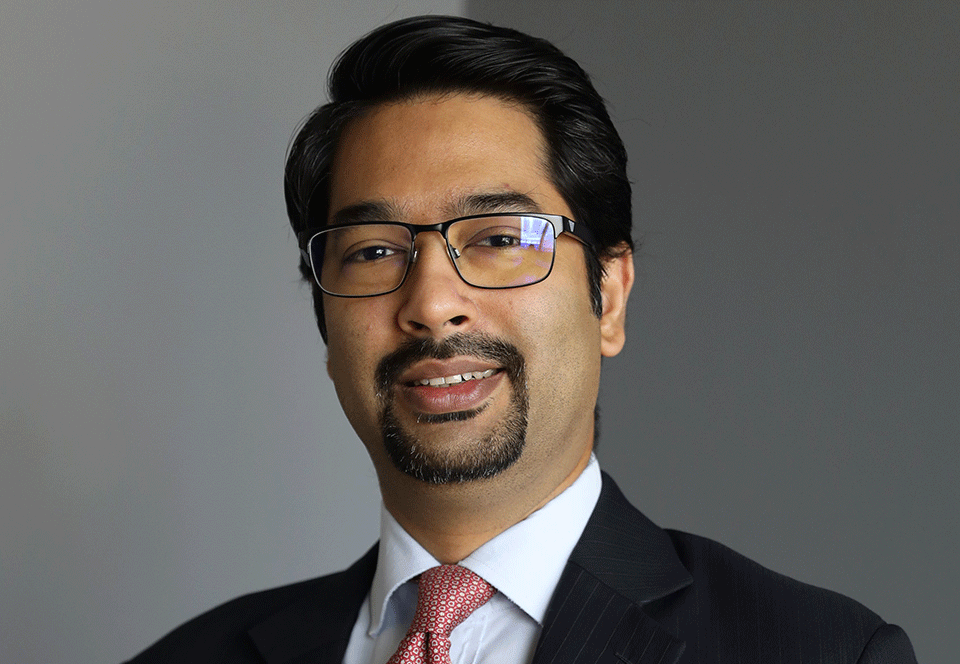
Iqbal Khan |
Any investigation into Islamic finance will lead you to Iqbal Khan. Everybody in this fast-growing sector insists you must meet the man who has headed the Islamic finance operations of two global banking giants – Citigroup and HSBC – and who was a driving force behind the first Islamic global bond earlier this year.
Getting time with the CEO of HSBC’s global Islamic finance arm is a challenge, though. The well-groomed and smooth-talking Khan seemed to have a third of the people at last month’s Islamic finance conference in Malaysia hanging around him, another third looking for him, and the last third moving on having met him.
“The office here said I would not have time to meet you,” says Khan in as friendly a way as possible, “but our PR manager in Dubai told me I had to.”
Now based in Dubai, where HSBC Amanah has its global headquarters, Khan spends much of his time travelling between Bahrain, Malaysia, London and New York. So much so that he seems a little out of touch with his new home town. He didn’t know, for example, about the city’s exciting underwater seafood restaurant that is accessible via submarine – something that sounds hard to miss when you have five young children, including seven-year-old twin boys. But for a busy man with a large family, finding time for underwater adventures can be difficult. What little free time he has he tries to spend with his family, who enjoy cycling and tennis.
Khan keeps busy. He sits on the boards of numerous industry bodies, including several at the Islamic Development Bank and the International Islamic Financial Market, as an adviser. He also helped establish the Harvard Islamic Finance Information Program, and is a trustee of the London Muslim Centre.
A sense of community
Khan’s extensive involvement and seemingly tireless commitment is fuelled by more than professional ambition. His attraction to the sector is not so much religious – although his Euromoney interview did interrupt him as he was praying – as it is about helping communities. “For me as a Muslim it’s great to be able to contribute something to the community. To help a Muslim finally get a mortgage is very rewarding.” Conventional interest-charging loans force Muslims either to go against their religion or to struggle to own homes or cars, a situation to which few banks or regulators offer a solution. Even in the Middle East real Islamic mortgages are problematic because of the reluctance of the authorities to allow banks to repossess the property of defaulters. After introducing one of the first Islamic mortgages in the West, Khan says he had Muslims in New York rushing up to thank him. “An old man came up to me outside a community centre and said: ‘God bless you. Thanks to you I finally have the opportunity to own a home. Thank you.’ It was very rewarding.”
Islamic finance professionals come across as eager to promote the industry as a whole as much as themselves and their own institutions but Khan takes a more cynical view: “They may seem like that now but you watch, it won’t last long.” As the industry grows and new players join in, Islamic finance is set to become as hard-driving and ultra-competitive as the mainstream banking industry in which Khan first cut his teeth as a foreign exchange dealer.
Khan grew up in Delhi and studied physics and chemistry, and then political science and international relations, at Aligarh Muslim University in the north Indian state of Uttar Pradesh before earning advanced management qualifications at Insead in France.
He worked in foreign exchange trading and treasury management at the Marine Midland Bank in New York before going on to Egyptian bank BCC (MiSR) in Cairo. He first got into Islamic finance in the late 1980s when, as regional director for the Middle East at Dean Witter Reynolds, he began working with people in the business. He joined the Islamic Investment Company of the Gulf, an Islamic investment bank based in Bahrain, as general manager, staying until 1997.
After a brief stint at Citigroup, Khan moved to HSBC Amanah as CEO in July 1998 and rates the ground-breaking $600 million global Islamic bond issue for the Malaysian sovereign in June this year as a definite career highlight.