Awards for Excellence 2002
The world’s best bank
Citigroup
It wasn’t hard choosing this year’s best bank. Glance down the list of global awards below and you’ll find that Citigroup wins seven out of 19, more than one-third. Its successes range from debt markets to cash management and foreign exchange, even to equity where it is the coming force that the established equity market leaders most fear. Watch out in M&A next year.
|
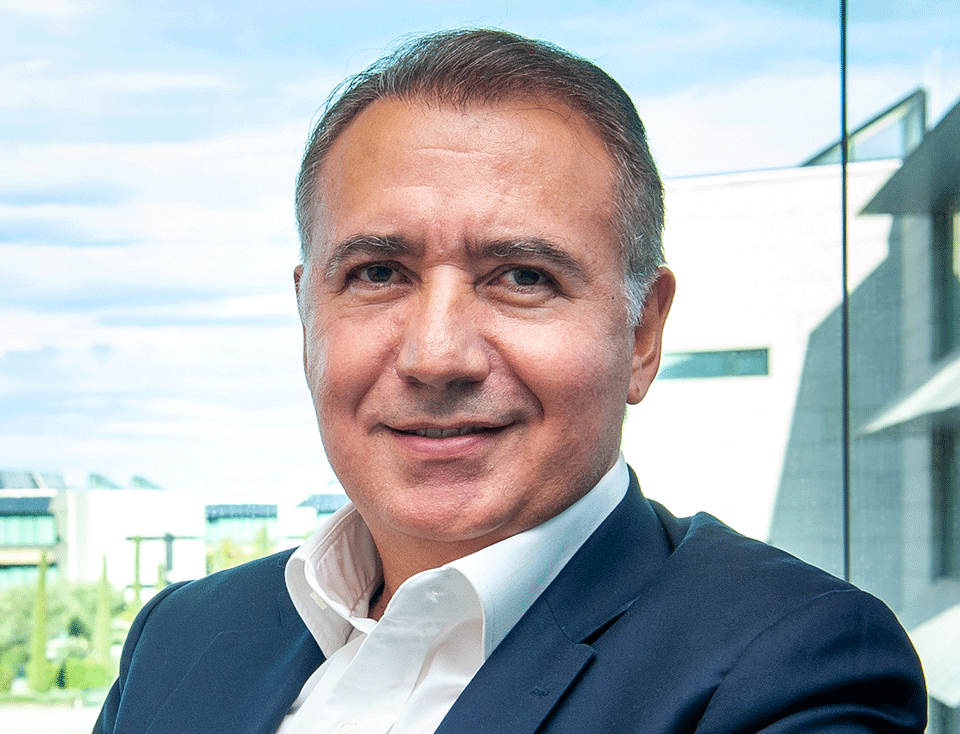
Sandy Weill and Michael Carpenter: from work in progress to winning model |
||||||
Does Citigroup owe its success simply to cross-selling from credit to other products at a time when liquidity is scarce and corporates are desperate for banks’ support?
Carpenter argues that it’s not that simple. “First of all no company will give any piece of business to you unless you are functionally excellent,” he says. “We believe we have to be excellent in debt, equity and M&A and then we will tend to win the ties as a key relationship bank. For example, Citibank had great relationships with the 2,500 biggest corporations in the world but in European corporate debt it was about 18th and occasionally a co-manager. Salomon Smith Barney had the fixed-income expertise but without the European presence of Citibank or Schroders. Combined we are a much more compelling choice for bookrunner assignments and we are now number two in European corporate debt.”
Going to the next level
The challenge for all the universal banks, including Deutsche Bank and JPMorgan, has been to expand those kinds of debt successes to other markets such as equity. Citigroup’s market share is growing – in global equity underwriting from 8% to 12% by the end of 2001 – and it has been growing again this year. Carpenter says: “If you are a CEO who is going to do a secondary equity offer, if you give it to a monoline investment bank, you may or may not get good execution but you get nothing else back. As long as the CEO considers a firm with broader capability can also execute that deal well – and we wouldn’t be gaining market share otherwise – then giving that deal to us adds something to the totality of the relationship.”
It may sound a bit fuzzy but this is the thinking behind Citigroup’s corporate and investment banking strategy: not so much to cross-sell but to gain the position of being the most trusted principal financial adviser for its target clients. Carpenter says: “Going to the next level is not so much about numbers and market share, it means becoming the organization that customers first look to for advice on their most critical issues – whether those be treasury issues, forex or M&A. Remember that we can be product indifferent.”
What if anything could trip Citigroup up? Is it too large to be manageable? Are its risks controllable? Carpenter believes size has evident advantages. “Financial services is still the most fragmented industry I know,” he says. “Each of the product areas is consolidating and has enormous economies of scale.” Citigroup claims to be the low-cost producer in these markets. Controlling expenses is a Sandy Weill hallmark. “We realized at the end of 2000 that the bubble was bursting and markets were going to revert to a historical trend line, so we adjusted our costs to that new market reality,” says Carpenter.
Credit losses have been substantial and surprising in Argentina, though Citigroup’s vast net income has swallowed even these. On his patch Carpenter notes: “Credit is a scarce resource and rarely profitable to extend, so it’s only something you do for your best relationships and in the past 12 months CEOs have finally understood that. We have a good underwriting process, good portfolio management and strong workout capability.”
Peter Lee
Most improved bank
Bank of America
At a financial services conference in March an investor asked Ken Lewis whether he was considering making any acquisitions. Lewis, who had become CEO 11 months previously, gave a quick-witted response: “We’ve just eaten. We’re not hungry.”
That was just what investors wanted to hear. Today’s Bank of America is the result of a series of smaller acquisitions and larger mergers undertaken in the 1990s by the old NationsBank, under former CEO Hugh McColl. The emphasis was on empire building, with three big acquisitions completed in the space of two years: Boatman’s Bancshares in 1996, Barnett Banks in 1997 and BankAmerica in 1998. The bank also ventured into full-service investment banking by acquiring Montgomery Securities in 1997; within two years most of its rainmakers had left. Successful integration and customer service came a poor second to the pursuit of size. “From late 1998 to 2000 we were working on putting the banks together,” says Lewis. “Then we made the decision to be customer-centric.” As a result, says Prudential Securities analyst Mike Mayo, “the company destroyed more shareholder value [economic value analysis] between late 1998 and early 2001 than any other US bank”.
Much has changed in the past 18 months. “Under the umbrella of focus and discipline we have put the customer at the centre of what we do,” explains Lewis. Bank of America boasts the best-performing share price over its peers since the start of 2001.
On the consumer side, which accounts for two-thirds of the banks profits, “brand awareness has improved, customer satisfaction scores are up, and turnover rates are falling,” says Lewis.
Its wholesale activities have also improved markedly. The investment bank has a great deal of momentum, with its share of investment-banking fees in the US rising from 3.9% in 1999 to 5.9% last year. That figure so far this year stands at 6.4%. The chief driver of this growth is its fixed-income business, where the bank has successfully used its position as a top-three arranger of syndicated lending to push into the high-grade debt markets, where it finished as a top-four underwriter in the US last year. High-yield has not been as successful, though it is growing steadily.
Though not a top-tier equities or M&A player, the firm is rising up the league tables. It’s still building those franchises at a time when competitors are scaling back and salary expectations are less.
As to the future, aside from continuing to focus on customer service Lewis points to three areas which he’d like to grow. “We want to add to our branch distribution system, adding 200 branches a year for the next several years, starting in 2003,” he says. “We’d also like to increase the number of private-client brokers. We have just under 1,000 now, but could easily use 5,000. But we’ll grow that carefully. And we’re always looking for opportunities in the investment bank, especially in Europe where we’d like to add 200 people or so each year.”
Antony Currie
The world’s best investment bank
UBS Warburg
UBS Warburg was a strong contender in each of this year’s global awards for excellence in the major product areas, equity, debt, risk management, foreign exchange, and mergers and acquisitions. In each case, to its frustration, there was always another firm with slightly stronger credentials – but these were, in most cases, close decisions. UBS Warburg wins this year’s best investment bank award because of its strength across the board, its strong momentum in the key US market and a management discipline that has helped it avoid the credit losses and reputational hits that other investment banks have suffered.
Its list of keynote transactions includes, unsurprisingly, plenty from Europe, many from Asia where it has long been a force and more and more from the US, where its acquisition of PaineWebber in November 2000 has been a significant milestone. In a global investment banking market long dominated by US firms, UBS Warburg has built the capacity to break that hegemony.
In the equity capital markets, UBS Warburg scored a notable success with the $2 billion IPO of reinsurer Converium in December 2001 and it led the $1.3 billion rights issue for ICI last year that was crucial to returning the chemicals company’s balance sheet to health.
In the US last year it led the second-largest ever secondary and follow-on equity offering of $3.3 billion for Sprint. The company was sufficiently impressed to invite the firm back for a $3.7 billion concurrent equity and convertible offering in August. It led ADR and convertible issues for Korea Telecom and became the first foreign firm to lead an IPO for a Japanese company with the $500 million offering for Matsui Securities. In emerging Europe it placed key straight equity and convertible offerings for Yukos.
Across the board, its equity research continues to win plaudits at a time when many of its competitors are facing questions about their analysts’ integrity.
The firm did not bend its investment banking business to the new economy in 1999 and 2000. “Research is run by the equity department for the benefit of investors. We never got pressured. We never had the $20 million analyst who became a TV star,” says Costas. “And we consider that while institutional investors have many sources of research across the Street, our private clients often have only us.”
In the US, UBS Warburg advised Devon Energy on its $8.1 billion acquisition of Mitchell Energy&Development and Anderson Exploration and arranged the associated $6 billion term loan and bond financing. It acted as sole adviser to Allianz on its e24.5 billion ($23 billion) acquisition of Dresdner and advised Vodafone on its $2.6 billion tender offer for a controlling stake in Japan Telecom last September.
In the debt market it has led key deals for resurgent agency and sovereign issuers, such as the World Bank – for which it was top underwriter in 2001 – Italy and Freddie Mac and also led large corporate deals across a range of currencies for Ford Motor, Philip Morris, GE Capital and Réseau Ferre de France.
The firm has come a long way from the early days of the SBC/UBS merger in November 1998 when, amid bitter infighting and surprise losses relating to LTCM, its future seemed uncertain. It has even been reported that UBS chairman Marcel Ospel considered selling his investment banking business. It’s unlikely that thought has crossed his mind since the acquisition of PaineWebber.
John Costas, a rare UBS survivor and now CEO of UBS Warburg, sums up the recent history. “We learned a lot from the UBS/SBC merger. We had to compete as the underdogs. And all we first thought of was how to make a profit. But we completed the first three years of our business plan in 12 months and produced $1 billion of pre-tax bottom line. A group of us then sat down with Marcel Ospel and concluded that whoever gets global coverage of three key groups, institutional clients, private clients and corporate clients, under one umbrella in all three time zones, wins the game. We needed investment banking in the US and private client in the US. And since PaineWebber we haven’t looked back.
I honestly think we got the last seat on the bus.”
It’s that combination of private banking – PaineWebber’s private-client base was much smaller but much wealthier on average than Merrill Lynch’s – and investment banking that may hold the key to UBS Warburg’s future success. “There’s a growing convergence between what the increasingly sophisticated core affluent require and what institutional investors require,” says Costas. “Given what investment banks have to spend on technology and other resources it’s well to be able to spread that across two investor communities.”
That’s the vision: for now being a successful investment bank requires strong risk management and cost control. UBS Warburg has shown both. It was criticized for not lending to Echostar during the $25.8 billion acquisition of Hughes Electronics from General Motors. But the refusal to buy investment banking business with cheap or injudicious credit extension now looks smart as other firms pay the price through credit losses.
Peter Lee
The world’s most improved investment bank
Barclays Capital
Barclays Capital has made obvious and significant strides in its core debt markets businesses in recent years. In the Eurobond market it wasn’t even in the top 10 three years ago and in euro-denominated bonds it barely made the top 20 back in 1999. Today it ranks in the top three in Eurobonds, euro-denominated bonds and in the key battleground of euro corporate bonds, behind universal banking giants Deutsche Bank and Schroder Salomon Smith Barney.
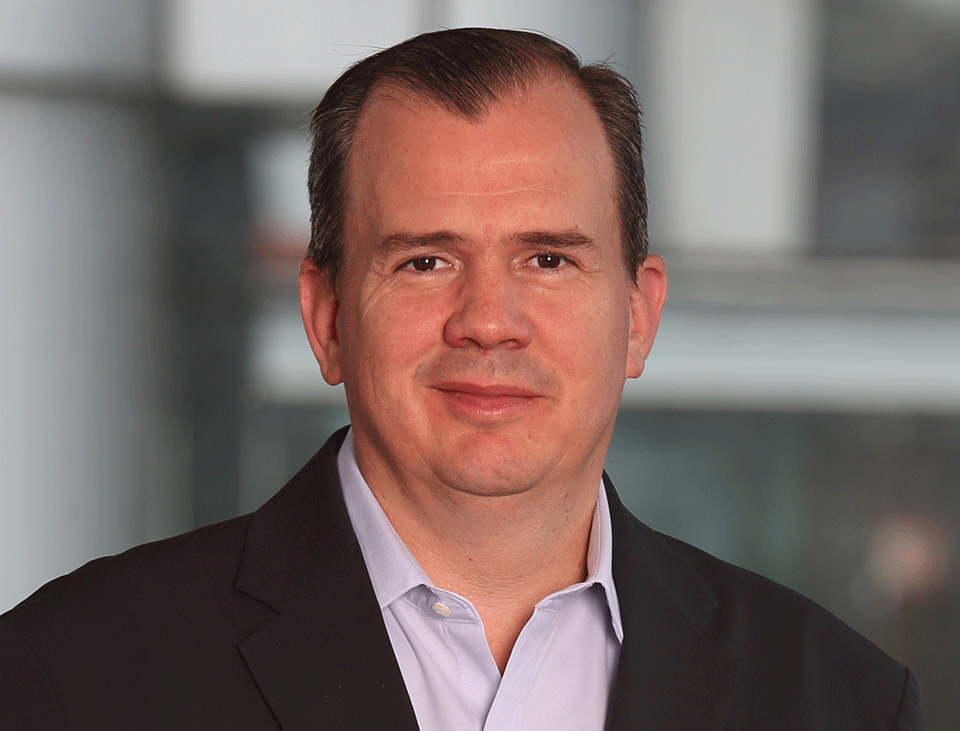
| Bob Diamond | ||||||
But does that qualify it as the most improved investment bank, when it doesn’t even have an M&A franchise or a conventional equities business? Euromoney believes that it does for two reasons. First, Barclays Capital is more than just a niche debt house. It has strong risk management franchises, including an expertise in equity derivatives and convertible bonds as well as in commodities. Secondly, the ideal model for the investment bank is no longer certain. It may well be that, by accident or design, the Barclays Capital model is the one that will be vindicated by the market shift taking place around us. Swedish/Swiss engineering group ABB probably didn’t care that Barclays Capital doesn’t rank in the M&A or equity league tables when it turned to the firm earlier this year. Battered by the scandal over undisclosed pension payments to departing senior executives, uncertainties over asbestosis exposure and the performance of its financial services arm, suffering from credit rating downgrades, ABB was in a downward spiral. Investors were losing faith. “We’ve developed a model that integrates risk management and debt markets,” says Bob Diamond, CEO of Barclays Capital, “This model has proven especially effective for clients like ABB, where a syndicated loan, and bond refinancing and some risk management techniques allowed them to resolve a liquidity issue.”
ABB sold a $968 million convertible bond and a dual tranche benchmark Eurobond, both with Barclays Capital as lead manager. Barclays Capital has become used to doing large corporate bonds in Europe, such as the e7.3 billion ($6.9 billion) debut for German utility E.ON, the largest European corporate bond in 2002 and the largest ever outside the telecom sector. But to execute a key convertible for a troubled, restructuring company such as ABB was particularly impressive for a firm that got out of equities five years ago.
“We’re positioned very strongly in convertibles,” says Diamond “and in equity derivatives. Indeed you’ll find a number of firms making good money in niche equity markets. Clearly we won’t get into the IPO business. But is equity new issues the high-margin investment banking business it once was? We simply don’t know what the equity new-issue model will be in future.”
Clearly Barclays Capital has benefited from large market shifts. The creation of the euro capital market to balance the dollar market has broken the grip of the US investment banks. The decline in equity and M&A markets has left it untouched while distracting its US rivals and many of its European ones. Meanwhile the firm operates on a manageable scale. “At the traditional firm the products are all siloed. Here it’s more instinctive for people to cross-sell risk management and financing,” Diamond says.
Amid such uncertainty around the industry, hiring has been easier than Diamond could have hoped for. “We pay or A-players on performance, not guarantees,” he says. Keeping hold of them will partly depend on how the perceived winners and losers in investment banking shape up if and when M&A and equity markets revive. Diamond concludes: “You have to start with the belief that the investment banking model is changing.”
Peter Lee
|
Goldman Sachs: keeps pitching good M&A ideas to clients through the lean times |
||||||
The world’s best M&A house
Goldman Sachs
Not even Goldman Sachs, which wins the best M&A house award, claims to have had a good time of it this year. Announcing a fall in profit on the same period 12 months ago, it cited M&A volumes that were continuing to fall, the result of a reluctance among CEOs to put their necks on the line for little perceived upside. What’s indisputable, however, is that in thin markets Goldman continues to take more than its fair share of whatever business is up for grabs. And it does so on a global basis. No other house does business across more territories and with a greater variety of corporates and financial institutions than Goldman. “Everyone has had it tough but we’ve tried to develop a good game plan and to execute it well every day,” says Jack Levy, global head of M&A at the firm. “We try to be well organized around industries and to be in front of our clients with good ideas as often as possible.”
In its home market, that strategy seems to be working. Goldman bagged a massive 36% market share of deals completed over the past 12 months. The 18% slice of the pie that goes to Merrill Lynch – its closest competitor – looks pretty meagre by comparison. It’s worth noting though that Merrill has done more of its business on the bid side of the table than has Goldman both in the US and in Europe, where the trend is even more pronounced.
Levy acknowledges that historically the bank has had a bias towards the sell side but says that has been steadily changing. “We believe it’s critical to be a strong adviser to bidders and to targets,” he says.
In the past 12 months the bank has advised on some of the most adventurous-sized transactions: Comcast’s merger with AT&T, Phillips Petroleum’s tie-up with Conoco, the sale of Hughes to EchoStar and HP’s much debated merger with Compaq. Cross-border, clients included Vivendi Universal on the acquisition of USA Networks and American Waterworks, which was sold to German utility RWE.
Goldman is the top house for announced M&A in Asia. Over the past year it has advised clients based in 11 Asian countries and has completed 11 transactions valued at over $1 billion – more than any other house has managed. Significant achievements include working with China Mobile on its acquisition of a number of regional mobile phone companies, a spending spree that cost it $10.3 billion in total.
In the key market of Japan, it consistently does more business than local bank Nomura. Last year it advised Vodafone on the purchase of Japan Telecom and J Phone for a total of $6.4 billion.
Jennifer Morris
The world’s best debt house
Citigroup/Salomon Smith Barney
Even the creators of the Citigroup/ Salomon Smith Barney combine must be pleasantly surprised by the extent to which the firm has dominated global debt markets over the past 12 months.
Across the board in bond issuance – from investment-grade credit to emerging-market debt and asset-backed securities – Citi is leaving other firms trailing in its wake. And with a global syndicated loan business second only to JPMorgan’s, the bank has proved beyond all doubt that in the current market environment size matters in the debt markets.
“They are the 800-pound gorilla in the business,” says one capital markets competitor. “It feels as if they are involved in three out of every four deals at the moment. They are very powerful and right now they are dominant.”
In international bond issuance, Citi had a phenomenal market share of over 10% in 2001, compared with 8.5% for its nearest challenger, Deutsche Bank. This year the gap has closed between the two leaders, with Citi on 9.27% against Deutsche’s 9.22% at the beginning of June. But these two are way ahead of the third-placed bank, JPMorgan, with 7.86%.
In the US syndicated loan market, JPMorgan is dominant – with an astonishing 31.75% market share for the first four months of the year. Behind Morgan, Citi and Bank of America tie, with market shares of some 17% each.
But in the international syndicated lending business Citi is outstripping Morgan – ranking third in Euromarket loans, behind Barclays and Deutsche and also third in Asia market loans, behind Mizuho and Tokyo-Mitsubishi.
Citi is particularly powerful in more than the vanilla bond and loan businesses. It has developed leadership across the board – in project finance, securitization and emerging markets.
It is strong in the US and Europe. It has an impressive secondary trading platform. And its Nikko Salomon Smith Barney operation provides penetration in the Japanese market that its main competitors lack.
Other firms may have the edge in certain areas of the debt business: JPMorgan in US loans, Deutsche Bank in euro-denominated bonds, for instance. But for all-round strength across the whole range of debt products Citi has no equal.
“Two years ago a lot of our competitors were happy to dismiss the validity of our model,” says Tom Maheras, vice-chairman and global head of fixed income. “But we have really drawn together all the pieces of the fixed-income business – in cash and derivatives, bonds and loans, structured transactions and flow business – and we have the breadth, depth and capitalization to sustain it.”
It is not just on the primary market that Citi has brought its strength to bear over the past 18 months or so. The firm has also shown impressive progress on the secondary side, which Maheras regards as particularly important.
“We have probably gained more on the secondary side than on primary this year,” he says. “On the primary side we have been consolidating the gains we made last year. But without getting to the top of the pile on the secondary side, those gains can’t be sustained.”
According to Maheras, the firm’s recent success in fixed income comes from strategic decisions taken at the time of the merger. “We made a couple of bets on fixed income when the world was on fire with interest in equities and M&A.
“Some firm opted not to continue investing in fixed income. But we made a decision to do so, we increased our investment rather than disinvesting, and we are now seeing the results of that decision.”
Nick Evans
The world’s most improved debt house
BNP Paribas
The award for most improved debt house had plenty of contenders this year, but BNP Paribas tipped the balance across the board. This is thanks to its strong showing in the corporate credit market in Europe (where it ranks third behind Deutsche Bank and Citicorp/Salomon Smith Barney), its growing strength in structured credit and credit derivatives, and the increasingly attractive synergies emerging from the merger of BNP and Paribas.
“BNP Paribas is now a much more powerful player than people thought it might have been,” says David Ovenden, the firm’s global head of credit. “We are firing on more and more cylinders, but we still have less developed franchises to work on.”
Like all the European houses, BNP Paribas faces an uphill struggle in the US debt market. Only Deutsche and UBS have made any real headway against the US bulge-bracket firms in the past year.
For the European firms, the key priority in the past two years has been to secure competitive advantage on their own turf – especially in the fast-developing European corporate credit market.
This year’s evidence suggests that they are succeeding. Universal banks have profited at the expense of the pure investment banks. And the decision to combine BNP and Paribas, which prompted criticism, now looks wise.
BNP Paribas has improved its profile in the European syndicated loan market over the past two years and the bank’s loan and bond divisions are increasingly working together on financings and client coverage, although Ovenden concedes that “there is always room for improvement”.
Structured credit is also booming, under the leadership of ex-Merrill Lyncher Michael Donahue and credit derivatives head Farid Amellal. And in securitization, BNP Paribas is working to broaden its business beyond areas where it is already dominant, notably Italy and France.
But it is in European corporate credit that the firm has made its mark. BNP Paribas ranks third for all euro-denominated bonds, second for corporate bonds in euros and first in triple-B corporate bonds – the fastest-growing and most lucrative area of the market.
Besides its leadership in European corporate deals, the firm has also led euro issues for a wide range of borrowers from Asia, Australia, North America and emerging markets such as Russia, Lebanon, Turkey and South Africa.
“We have worked hard to secure our base in Europe, which is critical,” says Ovenden. “We probably have the most profitable European corporate business and we didn’t have the luxury of subsidizing from a very big, profitable pot in the US our forays into other markets.”
Nick Evans
The world’s best credit bond house
Deutsche Bank
Deutsche Bank dominates the European credit market. But it is for the progress that it has made in credit markets outside Europe over the past 12 months, as much as for its all-round strength in Europe, that the bank wins the credit bond house award this year.
In North America, Deutsche has used its powerful structured credit and credit derivatives business to lead its drive into the US credit market generally and begin challenging the bulge-bracket firms on their home turf.
Although there is still some way to go, it has made impressive progress in asset-backed securities in particular – having hired a team from CSFB – and is gradually making its way up the league table for vanilla debt new issuance in the US market.
Over the past 18 months, Deutsche has led a domestic US or global US dollar transaction for 12 out of the top 15 most active, highest-volume corporate issuers in the US. In 2001, it won first-time bookrunning assignments in US dollars for 25 North American issuers, compared with just seven in 2000.
By its own calculations – combining a mix of business areas comprising structured credit, primary ABS, primary and secondary corporate debt, and secondary ABS – Deutsche has risen over the past year from twelfth position to fifth in the US.
“For the first couple of years, structured credit drove our business in the US but now we are coming on very strongly on the vanilla credit side,” says Anshu Jain, head of global markets at Deutsche Bank. “Over the next 12 months I would like to see us in the top three credit houses in the US and I am pretty confident that we can get there.”
The strategy in Japan has been the same. Use the structured credit business, and other high-margin areas such as distressed debt, to establish a profitable base and expand into vanilla products.
That tactic seems to be paying off. According to Jain, Deutsche ranks third behind Nomura and Nikko Salomon Smith Barney in the domestic Japanese credit market.
In non-Japan Asia, the tack has been different. There, Deutsche has targeted the local currency debt markets – on both the structured and vanilla sides.
“The international debt issuance market from Asia only consists of a limited amount of sovereign issuance,” says Jain. “The real action has been, and will continue to be, in local-currency debt.”
But it is in Europe, where the global credit market has shown the most dramatic growth over the past two years, that Deutsche has drawn clear. Its role in the development of the European credit market has been immense – whether in lead managing bonds for corporate and other credit issuers or in structured areas such as credit derivatives and collateralized debt obligations (CDOs).
Deutsche has been involved in structuring and marketing several CDOs for leading fund managers such as Axa and Pimco in Europe in recent months. In the credit derivatives business more broadly, Deutsche and JPMorgan Chase are way ahead of the competition.
Deutsche heads the tables for debt issuance in euros by a margin, while it has progressed two places up the league table of lead managers of dollar straights – from tenth last year to eighth this.
How long the dominance of the universal banks in the credit business will last is open to question. Many people believe that as soon as credit stops being a scarce commodity again the investment banks will come back strongly as competitors.
But Jain is confident that his bank has a model that works. “You can’t just rely on clout in this business,” he says. “You need to ally expertise with balance-sheet strength. But we think that the dominance of the firms that achieve that alliance is a long-term phenomenon.”
Nick Evans
The world’s best emerging-market debt house
Citigroup/Salomon Smith Barney
The combination of Citibank and Salomon Smith Barney has created a bank with deep links in all emerging-market countries – especially where it owns big local banks, such as Banamex in Mexico or Handlowy in Poland – and a local presence and product platform that no other firm can match.
In loans, in liability management, in external bond issues, in local-currency debt financings, for sovereign and corporate clients alike, Citi’s franchise is unrivalled – in Latin America, in central and eastern Europe, in the Middle East, in Africa and in Asia.
“We try to think very broadly about our customers’ liability needs rather than just coming in and pitching a bond issue,” says Mike Corbat, who co-heads the firm’s emerging-market capital markets business with Phil Bennett.
Bennett adds: “Before the merger we were the classic investment bank that just dropped in every once in a while. Now we have the ability to leverage our local base and our daily client coverage.”
In terms of international bond issuance, Citi has been prominent across the board over the past year. In Latin America, it has led landmark sovereign transactions and liability management exercises for Chile, Colombia, Mexico and Peru.
In eastern Europe, it has led benchmark sovereign deals for Hungary, Poland and Romania. It also jointly led Bulgaria’s exchange offer with JPMorgan and has featured strongly in the Russian corporate market with deals for Sibneft and Gazprom.
In Asia, it jointly led the blowout $2.4 billion offering for Petronas alongside Morgan Stanley. It has been closely involved with Turkey’s international financing strategy following the currency crisis last year. And, in South Africa, it is starting to emerge as an active lead manager of public and private sector international bond issues after a slow start.
Local currency financing is also a strong point, especially in Asia where Citi is prominent in the three main markets – Hong Kong dollars, Singapore dollars and New Taiwanese dollars – and will be involved in the opening up of new currency sectors soon.
In eastern Europe, Citi is active in the region’s domestic markets. It was selected by Poland to manage both the euro leg of its two-tranche financing, along with CSFB, and the dollar leg, alongside JP Morgan.
Nick Evans
The world’s best asset-backed house
Citigroup/Salomon Smith Barney
In the international asset-backed markets, Citigroup/Salomon Smith Barney has emerged as the clear leader over the past two years. In the breadth of its business, its track record of innovative deals, its structuring, distribution and trading strengths, and its global franchise, Citi is the firm to beat.
|
Citibank: placed some big bets on fixed income while its rivals were obsessed with equities and M&A |
||||||
“Compared with our competitors, this was one of the first product areas where we started to think about the business globally,” says Jeffrey Perlowitz, who co-heads the firm’s global securitized markets business alongside Mark Tsesarsky. “We have a world-class multi-seller conduit business and a very strong term business, both of which have had an active global presence over the years. That has allowed us to offer products and ideas to clients that our competitors cannot match.”
Europe has been a key driver of growth and will continue to be. Last year’s landmark deal was the £2 billion whole-business securitization for Glas Cymru (Welsh Water) which Citi arranged – and which is commonly regarded as one of the most pioneering securitizations to date.
That template was repeated again this year when Citi sneaked in ahead of CSFB to make a securitization-backed £2 billion offer for Southern Water.
In the UK mortgage-backed markets, Citi has played the leading role in groundbreaking master trust securitization structures for the two jumbo issuers – Abbey National and, more recently, HBOS.
It has led global MBS deals for Commonwealth Bank of Australia and ANZ. It has arranged UK property deals for clients such as Canary Wharf. It orchestrated the innovative Telereal financing for BT. It has been active in Italy – with a car loan deal for Fiat, a record-breaking MBS deal for Banca Popolare di Milano and a national lottery repackaging.
It teamed up with Morgan Stanley to put together the first whole-business securitization in Germany, it has transacted novel vendor finance securitizations and it packaged a e2.6 billion ($2.4 billion) securitization of housing loans for the State of Lower Austria.
Nick Evans
The world’s best short-term debt house
Goldman Sachs
In the past 12 months the world’s largest short-term debt market, the US commercial paper market, has shrunk considerably as the credit ratings of many corporate issuers fell. Most US money market funds are bound by strict investment guidelines that limit the amount they can invest in lower-rated names.
Goldman Sachs, the leading dealer in the US market – closely pursued by Lehman Brothers and Merrill Lynch – responded to this in several ways. First, it kept issuers closely informed of the messages its salesforce was receiving from investors, advising companies to seek other sources of liquidity, including turning to back-up credit bank credit lines whenever they came close to straining the capacity of CP investors. From time to time, the firm might position commercial paper on its books that it believed it would be able to distribute later. And the firm worked on alternative sources of liquidity for clients facing difficulties, notably in the asset backed, Euro-commercial paper and MTN markets.
AT&T provides one example. Once a AA-rated A1/P1 issuer with $20 billion of US commercial paper outstanding, the US telecom company underwent a corporate restructuring, including the spin-off of Lucent, that inevitably cut its credit ratings to the point where it could not possibly sustain $20 billion in outstandings. Goldman Sachs advised it to diversify its short-term funding to European and Asian investors by setting up a $6 billion E-CP programme.
From the start of 2001 the company had anticipated that it wouldn’t be able to sustain its previous level of outstandings on its likely new credit rating. Goldman visited the company in April to discuss an E-CP programme that it proceeded to set up in June. It did a lot of issuing in July, August and September. In fact, AT&T sold $2.25 billion of E-CP in the first three days and had outstandings of up to $5.6 billion by the end of September.
One of the keys to the success of this and other programmes has been Goldman’s specialist investor marketing group, which works closely with the credit department of key investors in the run-up to the launch of a new programme to make sure the name is acceptable. The firm’s strong credit research, as highlighted in Euromoney’s credit research poll in April, is a help here.
Goldman has also worked with other large issuers, such as Ford Motor, which have switched large volumes of short-term funding from traditional commercial paper markets to the fast-growing asset-backed segment.
The firm has also distributed large volumes of one-year notes off MTN programmes. Money-market investors that have shortened the term for holding weaker credits to one month or less have sought one-year notes of stronger issuers to balance their portfolios. The firm has also devised extendible MTNs for credit under pressure, such as car companies, whereby investors purchase one-year notes that are puttable monthly. If the notes are not put, the coupon steps up. “These notes meet the credit and maturity parameters of investors with an incentive to roll over to the issuer’s desired maturity,” says John Delaney, executive director at Goldman Sachs.
Nick Evans
World’s best project finance house
Citigroup
In 2001 Citigroup was the top global arranger of project finance loans, the top global bookrunner of project finance bonds, and the top financial adviser on project finance deals. That’s the first time that any bank has ranked first in all three tables.
Citigroup has always been a major force in project finance, and now stands as the only US bank still in the business after Bank of America pulled out in February. And it is also one of the few banks left in the business that has sizable operations in Europe, the US, Latin America and Asia. The only other two banks with a claim to that scope are CSFB and Société Générale. “Competition is much more fragmented than it used to be,” says Chris Beale, global head of project finance at Citigroup. “While some have pulled back from regions or sectors, we’ve maintained it as a core business.”
In 2001 Citigroup raised $62 billion of capital in public and private markets for 107 projects in 37 countries. In addition, the bank acted as adviser on another 83 deals in 40 countries worth more than $70 billion.
In terms of capital raising, Citi worked on some of the most important deals of the year. One was the largest European deal, the e3.2 billion fixed-rate bond for Welsh Water. Another was the $3.9 billion Chad-Cameroon oil pipeline deal, the largest oil gas deal of the year – Citi was also the sole financial adviser on the deal. Citi has a dominant position in the telecom sector, working on deals in over 20 countries, and in the US power market, where the bank has raised more than $12 billion in 12 different transactions.
Among all the deals done, one which Beale picks out as important is also one of the smaller deals: a $80 million (equivalent) deal for Safaricom of Kenya. Last June Safaricom, one of two national mobile phone operators in Kenya, raised 70% of the proceeds in Kenyan shillings: KSh1.1 billion ($51.1 million) was raised in a bond issue, with a euro-denominated loan making up the rest. It’s the first local currency project finance bond that has the backing of an export credit agency, in this case the Belgian Office National de Ducroire.
“This deal is an indication of the way the market is moving,” says Beale. “With each economic or currency crisis which hits emerging-market countries the devaluations get larger and larger, so it makes sense to limit exposure by raising more capital in local currencies. Local currency bond and loan deals with medium-term maturities are more frequent.” Citi is well placed to take advantage of this trend because of its physical presence in 102 countries.
Antony Currie
The world’s best equity house
Merrill Lynch
The world’s best equity-linked house
Merrill Lynch
Merrill Lynch wins the award for best equities house in recognition of its broad and deep franchise across the product, in IPOs, secondary offerings, sales and trading. In convertibles the firm continues to be the market leader: it still dominates as underwriter in the US, and is a major force in Europe and Asia.
|
Merrill Lynch: still dominant in equity, equity- linked and equity derivatives, despite Spitzer |
||||||
There are many in the markets who feel that Merrill Lynch ought not to receive any equities award this year. The broker has, after all, just paid $100 million to settle its battle with New York attorney general Eliot Spitzer, who alleges that Merrill’s equity research analysts covering internet stocks were co-opted or corrupted into issuing false recommendations because of their investment-banking ties. Euromoney considered excluding Merrill Lynch as a result but decided not for several reasons. First, the allegations dealt with events that took place two years ago. Second, Spitzer said he was fighting for individual investors, even though none of them will receive anything from the $100 million Merrill paid – it goes into state coffers. Our awards deal primarily with corporate and institutional clients, and they don’t appear to have reacted adversely to Merrill as a result of the allegations. Third, and most important, Merrill Lynch is not alone in being investigated; most of the major investment banks, and several smaller ones, are being probed by Spitzer for exactly the same reasons, and some have tried – and failed – to settle quietly. Merrill is simply the poster child for an industry-wide problem that corporates, institutional investors – and journalists – have known about for years.
The Spitzer investigation is not all Merrill Lynch has had to deal with in the past 12 months. The firm was forced out of its New York headquarters after the attack on the World Trade Centre. By the time the equity market reopened the following week, Merrill was operating effectively out of the Jersey City office of Herzog Heine Geduld, the Nasdaq market maker it bought two years ago. Once the new-issue market found its feet Merrill was one of the first and largest underwriters: it led some of the first deals, all secondaries, after the attacks in the US (a $68 million 144a deal for Allied Capital), in Europe $105 million (for Cadbury Schweppes), and Asia (a $782 million offering for Singapore Telecom). In the US, in one week at the start of October, the firm lead managed nine secondary and convertible offerings, six of them in the space of 24 hours.
In a year when equity issuance continues to be sluggish, equity trading takes on even more importance. In the US Merrill is the largest trader of New York Stock Exchange and Nasdaq stocks, according to Autex. It’s also the largest trader in Europe and Asia. “Commitment to trading is fundamental to the strength of the business, and we have been increasing our market share over the last few years,” says global co-head Jeff Edwards. “Committing capital and making markets allows our research analysts to have more leverage with institutional investors. And investors want more for their money. Increasingly investors are looking at capital markets ideas to help get liquidity for single stocks. We’ve done a number of transactions where we have built a book to sell a large holding for an investor.” A recent deal was earlier this year when Merrill sold e350 million ($329 million) of a US investor’s stake in Porsche, equivalent to about 7% of the company’s outstanding stock.
Merrill finished third in the IPO league table last year, and this year has underwritten deals for a diverse group of companies, including one of the year’s largest IPOs, the $2.3 billion spin-off from Nestlé of healthcare company Alcon. Merrill was co-lead for one of the year’s most successful IPOs, the $158 million deal for Jetblue; sole lead on one of the few internet deals, Netflix’s $82.5 million IPO; and sole lead on the largest Reit offering for years, the $450 million deal for Heritage Property.
Merrill Lynch’s secondary offering platform has remained strong. One of the best examples of this is in Japan. In May the Japanese government awarded Merrill the mandate to lead manage its $2.3 billion add-on for Japan Tobacco – Goldman Sachs had led the last deal – and that was while Spitzer and Merrill Lynch were still at odds in the US.
Merrill remains the dominant player in equity-linked securities. It is the top underwriter in the US, with a market share in excess of 22%. Merrill’s signature deal in the past 12 months was undoubtedly the $3.75 billion convertible for General Motors in March, the second-largest convertible ever.
Elsewhere, Merrill led the largest Italian convertible ever, a $2.2 billion exchangeable into General Motors stock for Fiat, as well as the largest convertible for a Korean issuer when it launched a $1.3 billion deal for Korea Telecom in December.
In another demonstration of its prowess in combining equity, equity-linked and equity derivatives, it won a competitive tender to work for two Italian banks, Fondazione Cassa di Risparmio di Verona and Fondazione Cassa di Risparmio di Torino. For regulatory reasons, both had to reduce their stakes in Italy’s largest bank, UniCredito Italiano.
Merrill’s solution was threefold. First, the two banks would sell call options to Merrill equivalent to about 4.5% of UniCredito’s ordinary share capital, and thus with a notional value of e1.1 billion ($1 billion). At the same time Merrill launched an accelerated tender offer of UniCredito shares worth e393 million to hedge its options exposure. It sold the block in 17 minutes in a Friday afternoon.
Next Merrill entered into a swap agreement with Mediobanca and then structured and launched a e900 million Mediobanca-UniCredito exchangeable convertible bond incorporating the call options. “We leveraged the entire equities floor to do that deal,” says Ermotti. “This is the type of transaction that leverages the strengths of our equities and banking platforms and separates us from our competitors. It required relationships, creativity, boldness, expertise and, most of all, teamwork.”
Antony Currie
The world’s most improved equity house
Citigroup
Bankers need to be much more sure of themselves these days if they want to take an internet company public – especially one that doesn’t make any money. But that is precisely what Citigroup was preparing to do in February for online payments firm Paypal. One extra sticking point was that the firm faced lawsuits for potential copyright infringement. Then, one day before the scheduled launch, Paypal’s major competitor upped the ante by seeking a cease-and-desist order. “We stuck with our due diligence, held the book together, and managed to price the deal at the mid-point of the range,” says Rick Bartlett, head of US equity capital markets at Citigroup. “It’s now the best-performing IPO of the year, and is up over 100%.”
It’s unlikely that Citigroup would have been able to pull that off had it been the same firm as two or three years ago. Now, though, the equity division at Salomon – or Citigroup, as it is now known – has a much more confident air about it. And so it should. After gradually creeping up into the top four last year, the firm stands at the top of the US IPO league table. The $5 billion spin-off of Travelers from joint parent Citigroup helped enormously but Citi is still in the top three even if the deal is excluded. It also ranks top three for all equity and equity-linked issuance globally over the 12-month period from May 2001 to April 2002.
The economic environment has certainly helped Citi’s rise, explains global co-head of equities Arthur Hyde: “The tough equity markets have moved us to the top of the line, as they play to our strength in providing multi-product turnkey solutions to capital structure problems.” It’s no surprise, then, that Citi has also moved up the rankings in convertible bonds, placing third in the period May 1 2001 to April 30 2002.
Another factor in Citi’s favour is that is was not so caught out by the downturn. “We’re maniacal on costs,” says Hyde.
“But there’s no sense of panic due to current market conditions because we were behind the competition and needed to build up.”
They were lucky with timing there, as well. Citi was one of the main beneficiaries of the fallout from the mergers in summer 2000, especially of the merger of CSFB and DLJ – Citigroup set up an informal recruitment centre in a hotel a couple of blocks from DLJ’s midtown headquarters. Meshing bankers hired from various organizations together with those from the Salomon-Smith Barney merger has made for what Hyde calls “an eclectic culture”.
Citi is now concentrating on getting clients to do repeat business,” says global co-head Robert DiFazio. “And that’s the tough one. Clients know it’s competitive, and we know that we don’t own any of our clients.” One example they are particularly proud of is the string of deals for insurer the Willis Group. Citi led the IPO last June, as well as follow-ons in November and May. “We priced the IPO at $13, the first follow-on at $2 and the second at $30,” says Bartlett. It’s not just the repeat business that Bartlett and his bosses are so proud of but also the fact that the client was KKR, a well-known private-equity firm and a tough client for any bank. Nor is KKR the only private-equity firm to use Citi. “We’ve done 16 IPOs for nine different LBO firms since the start of 2001,” says Bartlett. “They’re not interested in whether we have a balance sheet when it comes to doing their IPO. All they care about is execution.”
Some of that execution strength comes from Citi’s trading expertise. Both Salomon and Smith Barney were good equity trading houses, and now Citi is the second-largest broker-dealer for all equities trading in the US, second in Europe and third in Asia for the 12 months ending April 2002, according to Autex.
Antony Currie
The world’s best risk management house
Deutsche Bank
Deutsche Bank wins the risk management award again this year for the skill with which it has brought structured solutions to corporate and investing customers around the world, such as the $40 billion package of swaps, options and other instruments with which it restructured FleetBoston’s interest rate hedging portfolio in 2001. This was one of Euromoney’s deals of the year, profiled in the February 2002 edition.
“One of the key factors that differentiates us from the competition is the strength and vigour of our structuring franchises,” says Anshu Jain, head of global markets at Deutsche Bank. “We have 200 people at managing director level in a function that is neither sales, trading, nor research but an amalgam of all three. These are organized in interest rate, forex and credit structuring groups that also incorporate tax, accounting and industry skills.”
Such skills are much in demand at a time of unprecedented uncertainty and volatility in financial markets. “Our entire derivative business is based on risk avoidance techniques for corporate and investing clients,” says Jain. “If spot markets eventually move in line with implied forwards then the need to hedge declines. But if you look back six months to what forward markets were telling us, they were saying that Libor was going to rise by 100bp, that credit spreads would tighten and the emerging-market crisis would go away. None of these has happened. The world has been behaving in a fat-tail fashion. Our customers are faced with a global crisis a week.”
Jain contends that this has left many institutions with highly sensitive risk-management problems that they would rather speak about to one of his structuring teams than to a generalist corporate coverage officer at another firm who might then have to pull together various of its businesses to understand them. “So if a senior officer at a bank or insurance company comes to us because of worries about Basle II, he can speak to someone who understands the asset/liability management issues, credit risk and the bank capital market.”
Deutsche has set up a number of new teams and desks to look at links across traditional asset classes: credit and interest rates is one obvious one. “We have a lot of BBB-rated and A-rated corporates with risk management problems for which we are executing interest rate transactions that are predicated on credit,” says Jain.
The firm has also increasingly become known for its equity derivatives and risk management skills. Its strategic equity transaction group concentrates on five key areas: employee share option programmes, balance sheet management, M&A related hedging, structured equity-linked transactions and monetizations.
It has concluded several keynote deals including a monetization for Carrefour of its stake in non-listed GMB and a recycling of Novartis shares through a dual tranche Deutsche Bank/Novartis exchangeable bond.
Peter Lee
The world’s best credit derivatives house
JPMorgan
JP Morgan has played a pioneering role in the credit derivatives market from the start – through its landmark BISTRO synthetic securitization, single-name credit default swap (CDS) products and the first widely syndicated credit-linked notes.
Through RiskMetrics, the risk management modelling system that was originally part of JP Morgan and later floated as a separate company, it was also at the forefront of the development of a common risk management methodology for bank risk managers.
Along with Deutsche and Goldman Sachs, JP Morgan was also instrumental in the recent launch of Creditgrades, a new credit modelling system based on equity and credit analysis that was recently unveiled by RiskMetrics.
And Blythe Masters, a managing director in Morgan’s New York office, chairs the ISDA Credit Derivatives Market Practices Committee – dubbed the G6 – which has done much to standardize the market through documentation, settlement and end-user guidelines.
“We are keen to improve the transparency, liquidity and visibility of the market,” says Andy Brindle, global head of credit derivatives. “We are seeing a transition away from the CDS market being viewed as a structured product, ‘buyer beware’ type of market into one that trades regularly and with deep liquidity.”
JPMorgan operates its credit derivatives business on a truly global scale, with trading desks in New York, London, Hong Kong and Tokyo and multiple distribution centres in north America, Europe and Asia.
It has been a leader in the CDO business, both synthetic and cash, it has the biggest business in exotic credit derivatives and it pioneered – along with US fund manager David L Babcock – the first fully managed version of the synthetic arbitrage CDO in 2001.
The firm has also been an early entrant into the new market for collateralized fund obligations – CDOs backed by fund-of-fund hedge fund managers such as Investcorp and Man.
One major development during the past year was the hiring of Stephen Stonberg, who had set up the hugely successful repackaging business at Deutsche Bank, and a team of colleagues to form a new Risk Transformation Group.
Through the repackaging activities group based in London, JPMorgan claims it can now offer virtually any type of risk product to any type of end user – particularly funded investors that cannot buy derivative products such as fund managers and private banks.
It recently launched the JECI product – a credit index instrument that is available in swap and note form and enables investors to invest in a diversified credit portfolio.
“On the distribution side, we are seeing increased interest from private banks in getting involved in structured credit,” says Stonberg.
JP Morgan will not divulge how much money it makes out of credit derivatives. “The margins are attractive, but they are diminishing,” says Brindle. “As we move towards greater visibility, transparency and liquidity, the margins will go down and the market will lose some its attractiveness as far as new entrants are concerned.
“But we are perfectly comfortable with that. Our goal is not to remain a big part of a small market – we are happy to be a smaller part of an enormous market.”
Nick Evans
The world’s best foreign exchange house
Citigroup
Before the results of this year’s Euromoney foreign exchange poll were known, Richard Moore, head of forex at Citigroup, told Euromoney that he thought the bank’s overall market share had probably risen in the previous 12 months. It probably came as no surprise to him, or anyone else in the industry, that he turned out to be right.
That Citigroup has held the most market share in all but one of the 23 years the Euromoney poll has been running proves it is a tough rival to beat. Voted best in the main forex trading centres around the world, Citi lost out this year only to strong domestic banks in Frankfurt, Paris and Toronto. With the exception of coming second to HSBC in Hong Kong, there is nowhere, geographically, that Citigroup is not top in forex. And out of a total of 26 single currencies polled, Citigroup was also best in no less than 23.
Moore attributes Citigroup’s continued success to the bank’s overall status as a universal bank – strong in many areas. This gives the forex business the opportunity to capitalize on other business transactions within the bank, as well as to operate as a gateway for forex-specific clients to the broad range of products that Citigroup offers. “We’re fortunate to operate on a powerful corporate platform, with strong product partners throughout the bank,” he says. “As a forex business, we’re in a unique position.”
One of the biggest changes for CitiFX in the past year has been an increased focus on the leveraged investment markets; servicing hedge funds is not one of Citigroup’s traditional strengths in foreign exchange. The key, says Moore, is in establishing partnerships, and in providing the range of services that a true partnership should provide, from price delivery, through to the approach to credit and how to tailor research products. “We’re in the early stages, but we’re making good progress,” he adds.
CitiFX does have a long-standing presence among corporate clients, which it has maintained during the past year, though it has suffered a loss of market share among real money accounts in Europe owing to staff turnover. Moore has little reason to worry, however. Despite slipping from first to third in this year’s poll for market share among institutional investors, the bank rose from second to first as these clients’ key relationship bank.
Relationships are important, and each year CitiFX surveys its clients about their needs before building its business plan. Continuity and consistency in the level of service it provides are its main aim. Voted number one for “most innovative business approach”, Moore explains that this is because of the level of customization the bank is able to provide. Customizing products and services by customer segment has become standard practice, though he is also proud of CitiFX’s ability to provide the necessary resources to respond to individual client requests too.
One client that has been particularly pleased by Citigroup’s services is UK media company Carlton Communications. Earlier this year, it had a complex forex exposure linked to equity and interest rates positions that was putting too much risk on its balance sheet. Citigroup provided the best solution by reducing the value at risk, with 97% confidence, by three-quarters at no expected cost. “The work that Citigroup did was outstanding,” says Charles van der Welle, Carlton’s group treasurer. “The bank used its risk advisory group to analyze a complex problem and then coordinated different product areas to find a logical solution. This holistic approach to problem solving is a major factor behind Citigroup remaining top of the tree.”
Tessa Oakley
The world’s best at custody
State Street
In tough market conditions fund managers start to count their pennies more carefully. When the returns are no longer flying as high as before, there’s an obvious need to find ways and means to save precious basis points any way they can.
|
State Street: As its fund manager clients seek ways to cut costs State Street is enjoying a bumper year while positioning itself as more than just a custodian |
||||||
It’s in this environment that custodians, well some at least, have been thriving, as their fund manager clients turn to them in their search for greater efficiency in their back and middle offices. “There is an interesting phenomenon at work,” says Ron Logue, president and chief operating officer of State Street – this year’s best at global custody. “In down markets like this our business picks up. The investment management community investigates alternatives to how it operates because there is a greater need.”
Logue says State Street is enjoying a bumper year for business. “We have sold more business in the first six months of this year than any other year,” he says. This trend is set to continue with little prospect of a strong recovery for the markets. State Street is receiving record numbers of RFPs and demands for presentations.
State Street, has, of course, long been a big name in custody, alongside major rivals such as Bank of New York and JPMorgan (formerly Chase). Indeed those three dominate the tables of assets under custody.
BNY is rated the largest, with around $6.9 trillion, JPMorgan has $6.5 trillion and State Street $6.3 trillion. Citibank is next nearest but some way back with $5 trillion.
However State Street likes to set itself apart from the competition and wants to be seen as more than just a custodian. As fund managers look to outsource more of their non-core business, they look to the securities services providers to take on ever greater workloads and Logue says State Street is set up to do this. “They want help in integrating their investment operation,” he says. “They are acquiring, or being acquired, or merging with other operations. They want to integrate for reasons of economy of scale. They are trying to get into new markets, they are trying to improve their investment products and they want people to take those headaches away from them.”
State Street is certainly scoring well among clients, according to leading industry surveys. Euromoney’s sister magazine Global Investor rates it above the other largest custodians in this year’s annual poll, overtaking JPMorgan, its closest competitor.
Julian Marshall
The world’s best at cash management and payments
Citibank
Citibank lands this year’s award as the best at cash management after holding off the challenge of a handful of other banks. Certainly Deutsche Bank will feel itself to be the closest competitor and Euromoney’s first cash management poll, in late 2001, showed that to be the case with those two banks way out in front of the rest.
Little has happened in the interim to alter that balance of power. Although HSBC, ABN Amro and JPMorgan can all make good cases for themselves in certain local and regional markets, on a global scale they still have some catching up to do.
Cash management is a highly competitive market. Up to one-third of corporates will look to review and then possibly change their cash managers every couple of years.
Obviously price will always be a factor in their decision-making but corporate treasurers are also looking for a cash manager that can devise payment and collection products, back them up with good client service, offer a global network and be up to speed in the latest technology, particularly the internet.
The key for Citibank’s progress, Ann Cairns, chief operating officer at Citibank, says, is being able to offer clients a worldwide service. “The marketplace is moving to much more of a global model,” she says. “The bigger corporations are centralizing their businesses and so you need to be able to deal with global institutions in all parts of the world. As cash management providers this is causing a big change for banks, particularly traditional banks that have operated in a home market.”
Citibank moved to meet this new trend early with the formation of its e-business division out of its former cash and trade business and its old e-Citi operation. “That gave us an incredible jump on the market and allowed us to win a lot of new clients,” says Cairns.
Most of all she says treasurers and CFOs want to be able to see in real time what their liquidity position is across the world. “They will want to know what their bank accounts have in them in the major currencies around the world. They want to be able to move money around and to pool it.”
In particular she singles out Citi’s e-billing system, which she says has a unique scope. “We are the only ones who have systems running in every part of the world,” says Cairns. “We have as clients a soft drinks company in Asia, BP use us in North America, we have a huge technology company in Europe that is going live with us.”
Citibank is also proud of the mandates it has won from Reuters, Federal Express, EDS and Coca-Cola in Europe, illustrating its increasing presence in the region.
Jennifer Morris
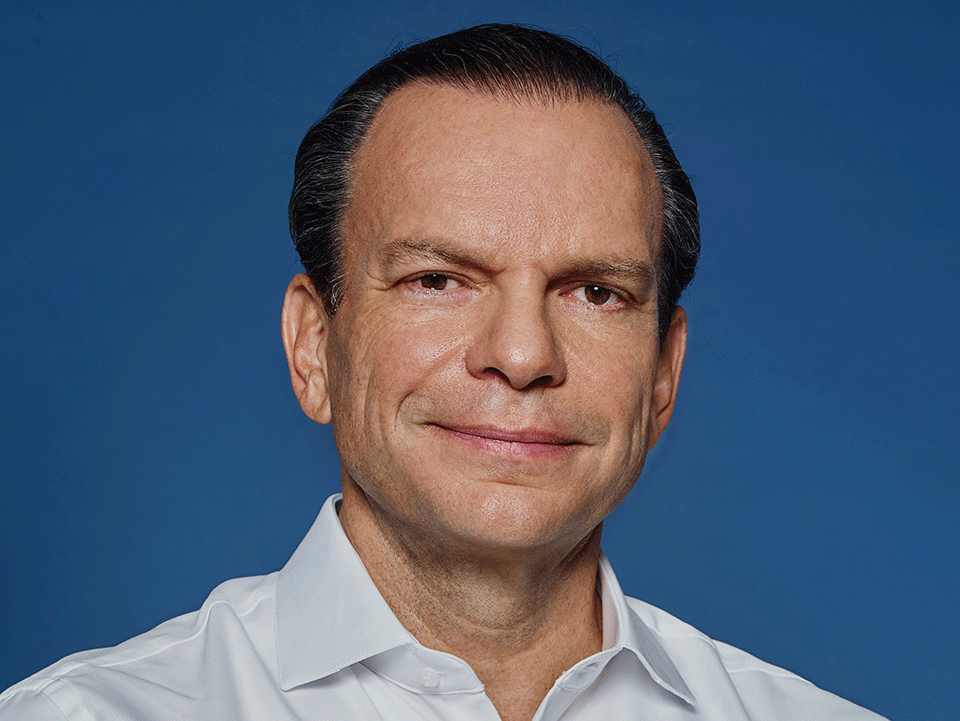
| John Costas | ||||||
Lifetime achievement award
John Costas,
CEO, UBS Warburg
John Costas is the winner of this year’s PricewaterhouseCoopers’ lifetime achievement award. It reflects his leading role in driving UBS Warburg, where he is now CEO, from being a second-tier global player in investment banking to this year’s best investment bank. His early career in the bond division at CSFB in New York progressed incredibly smoothly. He rose from trainee to co-head of global fixed income. Starting in sales, he progressed to running global distribution and then took a big step up to also running risk management and capital markets at the start of the 1990s. It had all gone without a hitch. Maybe it was too smooth.
Then, at the age of 39, he took a big risk, quitting an established franchise to see if he could build a business at UBS. “I take great personal satisfaction from taking what was a niche player in certain markets to a fixed-income platform that can be mentioned in the same breath as the businesses of other leading bulge bracket houses,” he says. Not that it was easy. In the first 18 months pure fear of failure drove him on. “I was startled by how much work there was to be done and how much I had taken for granted at CSFB. If you’d asked me after six months, over the second bottle of beer I’d probably have told you that I’d made a mistake,” he recalls.
Bear market trader
But he survived and thrived. He describes himself as something of a bear market trader – he does not match the highest performers in a boom but stands up well in a down market. Good years for him were 1994, 1997 and 1998. That resilience helped during the merger of UBS and SBC Warburg. “It was predominantly a Swiss domestic merger and not really about investment banking but it was the first big step to achieving global scale,” he recalls. “And it provided us with a lot of experience. I hadn’t been through a big merger but was able to hook up with a team including Marcus Granziol and David Solo who had been through the SBC and Warburg and O’Connor mergers and were quite ahead of the curve on how to make them work.”
The merger provided a context to redesign the fixed-income business. Costas cut staff from 2,000 to 1,000 and doubled the P&L, exiting certain businesses in the process. It was a tough time but by the first quarter of 1999 he had begun to see signs that the fixed-income business had generated true critical mass. He was then given additional responsibility for building up corporate finance and investment banking in the US. It was to be a test of whether the management skills he had honed in fixed income could apply in areas where he had less technical knowledge. “I see a lot of common elements in successful management – the ability to identify the variables that can make or break a business, to prioritize them, take decisions on them, and to do that day-in, day-out. It takes a lot of mental effort.”
As long ago as the third quarter of 1996 Costas had suggested to his former UBS bosses that they should acquire PaineWebber, based on his belief in a convergence of behaviour between institutional and high-net-worth investors and in the need for scale. Morgan Stanley’s merger with Dean Witter made him positively religious in this belief. In 1999 and 2000 he raised the same idea inside UBS Warburg and with UBS chairman Marcel Ospel. When that deal came off in November 2000 he headed the integration committee alongside PaineWebber CEO Joseph Grano.
The lessons of the UBS/SBC merger stood him in good stead. “Jack Welch has said that he wishes he’d always been bolder and acted quicker in mergers. There’s a tremendous negative inertia and unless you take key decisions quickly that inertia severely impacts the returns. In 90 days we executed the PaineWebber merger: we retained every piece we aspired to retain and enjoyed some positive surprises.” He adds that, in mergers, “great execution can overcome poor strategy, but great strategy can never overcome poor execution.”
It’s been a key piece in the puzzle for UBS Warburg. “I joked with the PaineWebber people that, in the months before the merger, when we paid a lot of attention to measuring this, we were enjoying faster brand name recognition growth than them with the US investing public. They had gone from 92% to 93% while we had gone from 2% to 4%.” Following the acquisition, the UBS Warburg name was recognized by 40% of US investors.
Exploring ways to benefit from links between the investment bank and the private bank occupies a lot of Costas’s thinking. “Cross-selling is always hard to master, but I think that with certain brands you can rotate customers across an organization. Success is when the private bank trusts us to introduce its most valued clients to the investment bank and vice versa.”
Meanwhile he has developed a new outlook since riding the established franchise of CSFB. “Most senior people at this firm thrive on change management. Though the overall strategic direction is not up for debate, every business and every piece is. There are no sacred cows here. Marcus Granziol was the architect of this form of open debate and we still foster it. The management committee [of nine] meets every two weeks and has some very lively discussions. We regularly pull this firm apart and put it back together again in a stronger way.” Businesses are regularly reviewed for possible exit or investment.
An example is foreign exchange. Two years ago it was a trading and derivatives centred business with little distribution and a transaction processing cost problem. Today it has 70% electronic distribution at a fraction of the previous processing cost and UBS Warburg just chased Citigroup to within a whisker on the Euromoney annual foreign exchange poll.
Peter Lee