Author: Philip Eade
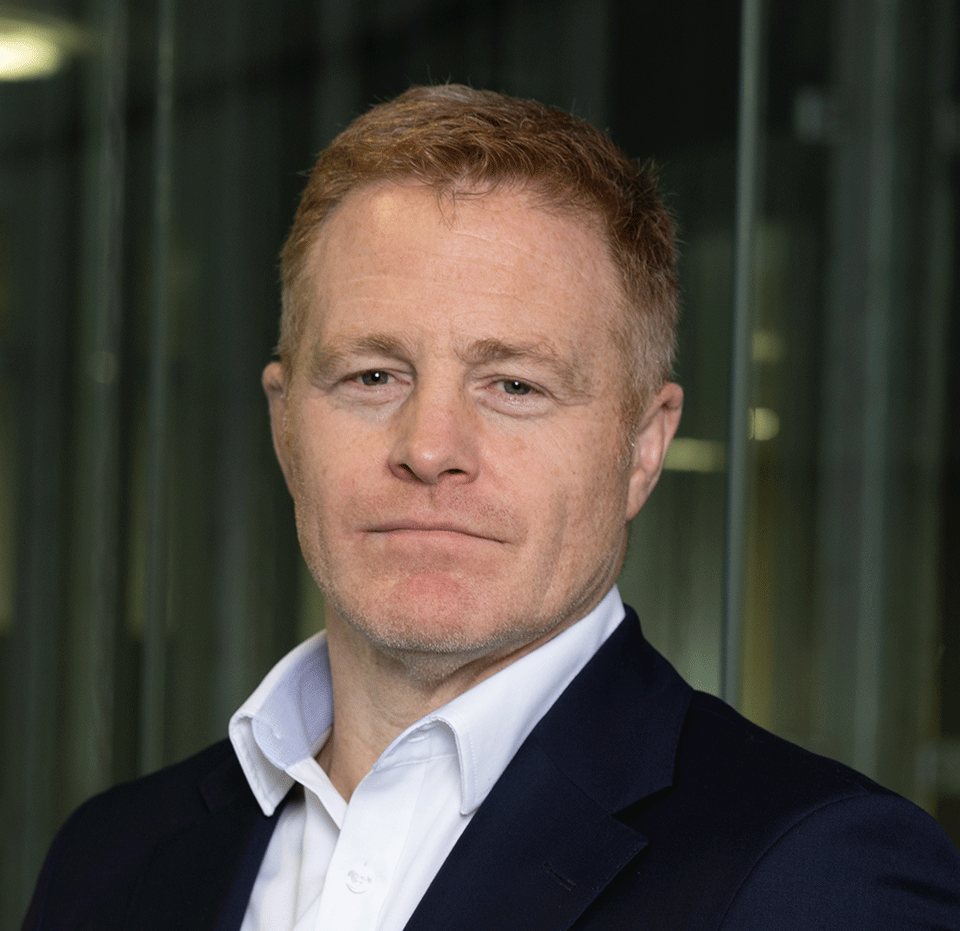
It would be hard to think of someone more likely to enjoy his gardening leave than Andrew Ashbury. The aVable former head of syndicate at Nomura, who starts a new job at Daiwa in August, is a gardening nut, and revels in any kind of outdoor toil. Trying to reach him by telephone in July was well-nigh impossible since he was locked to the controls of a JCB, digging a swimming pool at his new home in Bedfordshire. “I could hire someone,” he says, “but I’d far rather do it myself.”
Ashbury has always had masses of straightforward enthusiasm – it helps explain why he is so popular in the syndicate market. He was born in 1961 in Sandton, an area then rural but now very much part of Johannesburg. He grew up a keen all-round athlete and competed for the South African schools show-jumping team. At the University of Natal, he started the college radio station on which he featured as a disc jockey. He was also one of the few members of the conservative agriculture faculty who openly opposed apartheid.
After university, Ashbury was called up into the army, but asked that he be allowed to teach in the rural homelands. When this request was refused, he decided to quit the country, travelling in Israel and then Europe. Eventually he arrived in London, where he started work with a gardening company. As winter approached he moved to a temporary job at UBS, Wling prospectuses in the library for the syndication department.
The job was monotonous, but Ashbury quickly impressed with his good cheer and eYciency. After his three-week stint, he was hired by the syndicate team to help with reconciling underwriting fees by lead managers in the old fee structure. By 1987 he was on the trading desk and in 1989 started a book of Ecu arbitrage swaps – then a very undeveloped market and one of the first of the asset trading group.
In 1990, by which time Ashbury was already a pleasantly boisterous and well-known Wgure in the market, Nomura hired him as part of its eVort to increase its exposure on new-issue trading. “He was always very good at ideas generation,” remembers a colleague from those early days, “at identifying the right issuers at the right maturity at the right time. But probably his biggest asset is the way he gets on with issuers worldwide – they particularly admire his straight-talking approach and honesty.”
In 1992, Ashbury moved to Swiss Bank Corporation but within eight months was poached back by Takumi Shibata at Nomura. Ashbury was appointed head of syndicate in 1996. In the years that followed, Nomura was the only Japanese Wrm that did not pull out of the syndicate market, gained a good track record in eastern Europe, had some success in the dollar sector and always maintained a strong position in yen.
It will puzzle some that Ashbury has now chosen to go to Daiwa, which has no syndicate business to speak of, but, as he says: “There are very few greenWeld sites in this business where you get the option to build from scratch. I also just felt I needed a change.”
Ashbury had also recently lost some of his management responsibilities to Sid Prasad, Nomura’s head of fixed-income capital markets. “They thought I was very good at the business side,” Ashbury recalls, ” but they perhaps didn’t rate me so highly as a manager. I actually think that I’m a very good manager. I was criticized for being one of the team, but to me that’s a strong point. If you take yourself above that, you lose respect. I’ve always liked to be hands on and fully involved. You can’t take decisions on risk if you’re cooped up all day long taking decisions on personnel and administration.” Another potent factor, he adds, was the “enthusiasm I encountered at my interview at Daiwa, which reminded me of when I first joined Nomura”.