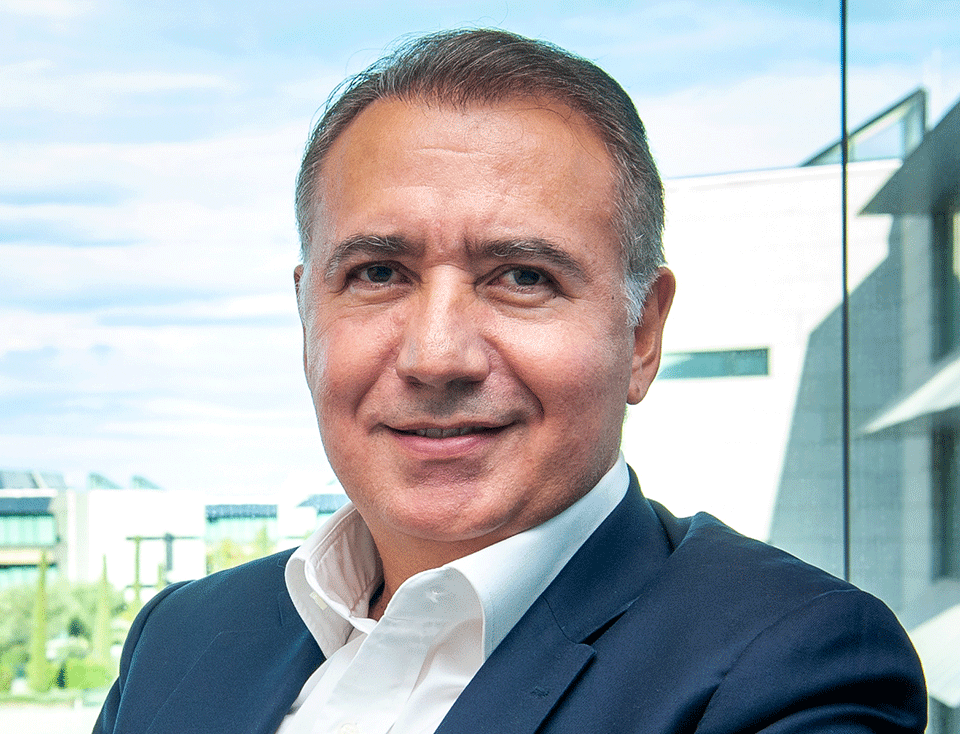
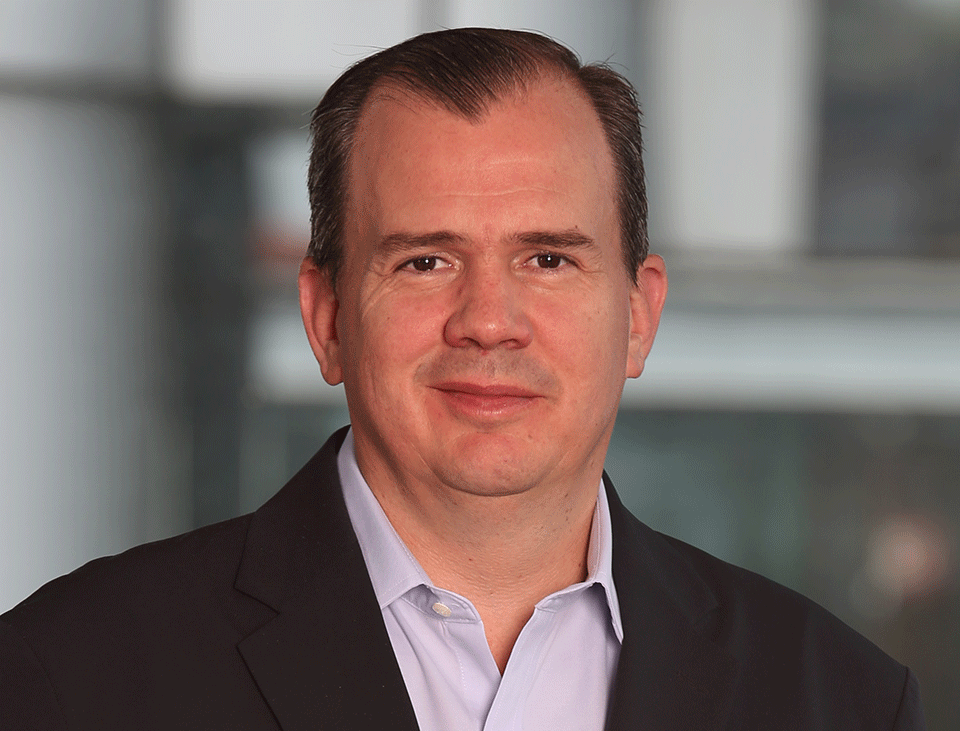
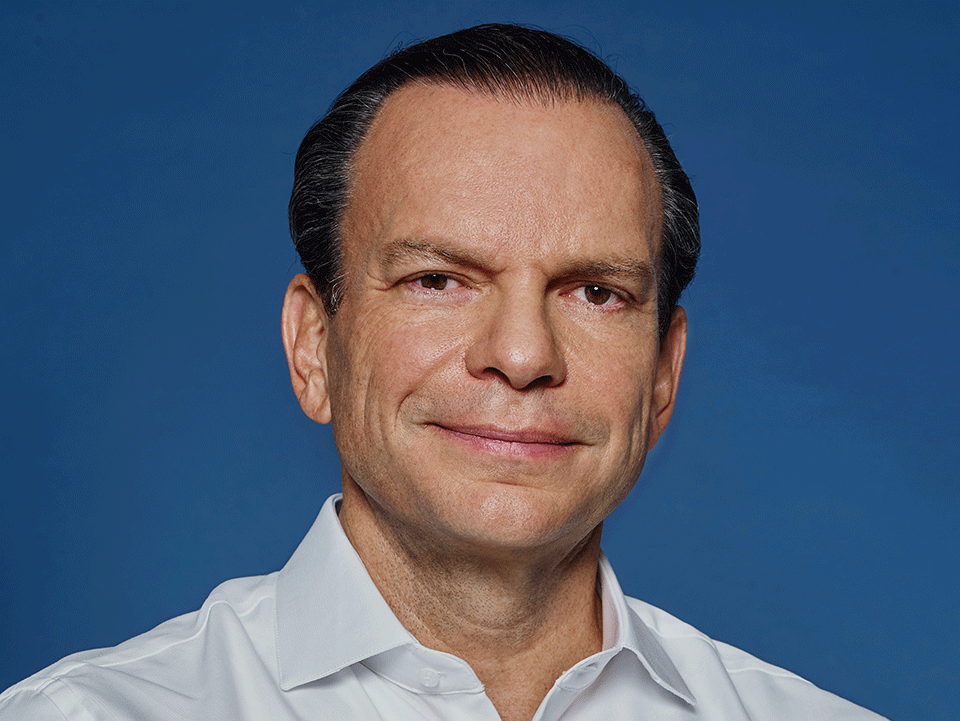
It is Thursday March 11 and the press conference to announce the EBRD’s financial losses is about to start. Deputy vice president David Hexter, who has overall responsibility for financial institutions and who sat on the board of the now-defunct Russian bank Tokobank, is sitting next to the bank’s vice president of finance Steven Kaempfer.
What happens next says as much about the EBRD’s attitude towards the concept of public accountability as it does about the mistakes made in its Russian portfolio – Tokobank started to go wrong only three months after the EBRD invested in it.
Kaempfer, who joined EBRD from Credit Suisse at the start of the year, plays the big leader tasked with fielding awkward questions from the press about the bank’s losses. Looking important and ministerial he faces down a coterie of journalists assembled in one of the bank’s conference rooms. But as the meeting progresses it becomes less and less clear whether Kaempfer is answering the questions or whether he is he just a mouthpiece for Hexter, flamboyantly dressed in a purple shirt, who is sitting close by. As every question lands, Hexter scribbles furiously in a notebook, rips out the page and hands it to Kaempfer who glances at it and carries on talking. Under his breath Hexter offers Kaempfer helpful tips such as “give them this figure” or “we can’t comment on that”.
Hexter’s willingess to answer questions – albeit by proxy – contrasted with his attitude to questions put directly by Euromoney later. We requested separate interviews with both Hexter and Kaempfer but on the scheduled day a press officer calls up to say they would only do it together. The final interview gets underway 15 minutes late and Hexter doesn’t appear for another 20 minutes. On this occasion the two men swap roles. Now Hexter is the big leader and Kaempfer is his minder, attempting to smooth Hexter’s passage through difficult questions. Kaempfer starts off by taking it upon himself to ask Hexter the questions about Russia he was unable to answer prior to Hexter’s arrival. Finally we put it to Hexter that due to the Russian problems he should have considered resigning. He suggests, bizarrely, that Kaempfer should answer the question on his behalf.
When pressed he says: “We were trying to exercise our mandate to work in Russia with good intent. The explosion that took place in the Russian financial system was clearly not the responsibility of the European bank.”
No choice but to lend
He adds: “The difference between the private and the public sector is that the private sector has complete discretion over the markets it works in. I had no choice but to figure out to the best of my ability what to do in Russia. Any equity investment in Russia [in a bank] would have failed at this point in time. A lot of private sector investment failed.”
Hexter says: I picked up in November and December of 1997 that things weren’t looking very good and the last transaction we booked was a small equity investment in Inkombank which we did conscious at the time that there were serious conversations going on with a strategic investor. The actual amount [of the investment] was small. In fact the board had approved a sizeable loan to Inkombank of about $60 million which I took the decision in early 1998 not to sign because I was concerned about the general stresses and strains…The only other transaction processed in 1998 which was likewise not signed was a loan to SBS Agro also for $60 million. That did go before the board and was approved [in early 1998 for the reduced amount of $30 million] but around about May I realized the writing was on the wall.”
He adds: “Outside of Russia we do not have a single late payment or past due interest on our loan book to banks.” Outside Russia the EBRD has 114 loan operations with banks at an average size of €12.4 million and 62 equity investments. Hexter says the EBRD has earned €250 million in capital gains on equity in banks far greater than any specific provisions.
Maybe so but market observers say that the EBRD was among the last to recognize the parlous state of Russian banks and was still active long after everyone else knew the game was up. Tokobank in which the EBRD had a 9.6% stake and on whose board Hexter sat as a director until April 1998 collapsed even before August 17 when Russia declared a moratorium on its domestic debts. Tokobank is especially controversial because the EBRD had a put option on its shares (which it tried but failed to exercise) that western commercial bank lenders say they did not know about. They complain that the EBRD signalled to them its commitment to Tokobank by the equity purchase while all the time having an escape clause.
Then there is Inkombank. The EBRD paid $6.6 million for a 2.3% stake in the bank as late as early 1998. The bank was not what it seemed, having built up a vast derivatives portfolio the EBRD did not pick up. Hexter accepts that the huge derivative position – forward exchange contracts and options at end 1997 amounted to $45 billion, nine times the banks’ assets and 100 times its capital – was not caught during due diligence.
“I cannot give you figures on Inkombank’s financial status, as we need to respect confidentiality,” says Hexter. “However, I would not refute the figures you have for Inkombank’s FX forwards and options exposure for end 1997. These positions were concealed from us by management at the time of the small equity investment. The loan for €54 million that was approved in December 1997 was the loan that I subsequently took the decision not to sign. Although the bank’s FX positions were not made available to us until around May, there was clearly a problem and I did not want to provide any commitment until we had been provided with genuine transparency over the bank’s status. Kurt Geiger was appointed to Inkombank’s Supervisory Council in May 1998.”
Requests for an interview with Geiger who is a co-director of the financial institutions team, were not met. In general EBRD officials were shielded from Euromoney‘s questions by an obstructive press policy that appears designed to hamper any investigation of the bank’s activities.
However by speaking to board directors and resident officers, both beyond the purview of the press department, as well as former employees, Euromoney was able to build up a picture of what happened.
In the early days at the EBRD, big swinging dick investment bankers fought with multilateral veterans over the way forward. Strutting around in red suspenders, blowing cigar smoke over their colleagues’ bowls of muesli, the bankers even tried to have the word development taken out of the EBRD’s name. The developmentalists, many of them experts in such things as infrastructure provision and government planning, were outraged. How, they asked, could investment bankers, never a breed noted for their charitable works, raise basic living standards in chaotic eastern Europe, post Berlin Wall, where often the most rudimentary market economy did not exist?
Their logic may have been faultless – Russian living standards have dropped dramatically since the fall of communism – but the developmentalists lost the battle. Under the presidency of Jacques de Larosière, despite his own public sector background, the investment bankers held sway.
Then came the push into Russia urged on by G7 shareholders who feared that instability in the former communist giant could lead to nuclear war. The message came down to bank officers that increased lending in Russia was needed. So that’s what the investment bankers went and did, in the aggressive style of the profession. “Working at the EBRD was like being self-employed with $5 billion of capital behind you,” says a former employee.
Bad deals versus good deeds
As the EBRD picks over its tattered Russian portfolio, which accounts for 26% of the bank’s total disbursed outstanding loans and equity investments of €5.8 billion, questions are being asked about what went wrong. Russia accounts for 53% of total provisions of €908.9 million which itself is 16% of total disbursements. Some €553.1 million of these provisions were taken on last year, 57.7% in respect of Russia.
The heaviest losses were suffered lending to financial institutions, accounting for around 35% of the total Russian portfolio, and favoured as a way of reaching small and medium enterprises. But it’s the sector that investment bankers are most familiar with and where they could have been expected to make the least mistakes. They failed as the investments in Inkombank and Tokobank prove.
“We are back to 1991. It’s back to square one,” declares Karen Shepherd, board director for the US, about the EBRD’s Russia policies. The US is the largest shareholder in the EBRD with 10% but heavily outnumbered by the European Union countries which collectively have 55%. Shepherd, a former congresswoman, says the lessons of the EBRD’s difficulties in Russia are that simply throwing money at the problems doesn’t solve them. She is critical of the EBRD’s record in the Russian banking sector.
“Russia is such an important country for all of the shareholders because of its nuclear capacity, the potential market and it’s huge upside and downside importance. You couldn’t just ignore it,” she says in defending why the EBRD pushed into Russia. “But the big lesson from the Russian crisis, the mallet that hit us over over the head is that [the transition] is not easy. It’s [certainly] not going to be over in 10 or 15 years, and may not be over in 50 years.”
“The other big mallet is that money alone doesn’t solve the problem…it’s a question of changing hearts and minds, changing incentives, changing institutions, and weeding out the response to life that we in the west see as corruption.”
Lending to the wrong banks
Says Shepherd: “The US supported the Russian lending to banks because you can’t have a market economy without a sound banking system…but what could have been done better was insisting that the banks deal with the real economy [lending to businesses rather than investing in Russian treasury bills, GKOs, on which the government eventually defaulted]. They were not lending to the real economy. If we had to pinpoint a pressure point that we didn’t apply hard enough it was that in the banks EBRD had equity in [Tokobank, Inkombank and Avtobank], there were people on the board urging that to happen [lending to the real economy] but it wasn’t enforced and paid attention to [sufficiently]. There was also way too much connected lending.”
Referring to the Financial Institutions Development Project run jointly by the EBRD and World Bank to provide technical assistance to a core group of 40 Russian banks and now suspended, Shepherd says: “Neither organization was tough enough about what the banks did. There is no question about it.”
EBRD officers maintain that their loans to Russian banks were earmarked for on-lending to small and medium enterprises (SME) and closely monitored. Says Hexter: “Funds lent to banks for on lending to SMEs are disbursed against specific sub-loan approvals or disbursements and the repayment terms are matched. These funds are not fungible and cannot be redirected.” But a former employee says: “Credit lines are normally tied to SME lending but money is fungible. It can always be redirected.”
Some critics have accused the EBRD of naivety in its deal making. One story illustrating EBRD innocence is of a banker, with no Russian experience, arriving in Moscow for the first time and staying in a top hotel. “And can you believe it, a woman knocked on my bedroom door in the middle of the night,” he complained to colleagues the next day. Says a market observer: “Many Russian companies and banks saw the EBRD as effectively replacing the state authorities as their financing arm. At the same time the Russian government was making a noise at shareholder level [of the EBRD] for increased funds.”
The EBRD’s director for Belgium, Luxembourg and Slovenia, Bernard Snoy, admits that the bank was taken in by skilful Russian presentation. “In January of last year [1998] we invited Sergei Dubinin [central bank governor of Russia when the crisis hit] to make a speech to the board and he didn’t make such a bad impression. Many of these people are very smart and they talked our language,” says Snoy. Snoy says Dubinin gave a talk that implied he was tightening the regulation of banks and weeding out those institutions that did not comply. Following the August crisis it became apparent that banking regulation in Russia was woefully inadequate.
Going overboard on Russia
Snoy says it was the G7 countries that really pushed to expand the EBRD’s activities in Russia while some smaller countries such as Belgium advised caution. “In 1997 and 1998 we thought the bank was going too much overboard in emphasizing Russia and the CIS countries at the expense of the accession [to the European Union] countries. It was the G7 that was pushing the bank in that direction.” Back in 1995 Russia’s share of total annual commitments was 20%. This rose to 37% in 1996 and stayed high at 32% in 1997 only falling back to 23% last year when the crisis struck.
Snoy says he does not believe individual bank officers should be held responsible for the mistakes in Russia and points out that overall lending to and investing in financial institutions has been successful. He also says the board has tried to emphasise that volume of lending is not the criterion of success.
“We are not sure the troops [the bank’s employees] have got the message,” he says. “They are not judged by the volume of lending but by its transition impact.”
But former employees of the bank are adamant that volume was taken as their measure of success and that the financial institutions sector under Hexter was regarded as the star performer because of its rapid growth. Hexter, a former career banker with Citibank whose last job there was divisional executive for Citibank central and eastern Europe, joined the EBRD in April 1992 as head of financial institutions (so he cannot be accused of lack of regional knowledge), then consisting of only four professionals.
Under his leadership the sector rapidly began putting on assets until today it accounts for 35% of the bank’s portfolio up from 13% at the end of 1992. Hexter was made a deputy vice president in the banking department (the operational and most influential part of the bank) in 1995 largely due to his achievements with financial institutions.
There is no doubt that Hexter was focussed, results oriented and efficient in building up financial institutions but those that know him also reveal his shrewd understanding of the Byzantine politics inside a multilateral. On being elevated to deputy vice president, Hexter appointed three people as co-directors to replace him, an arrangement that has produced predictable clashes of ego. Hexter says this flat structure was the best way to organize such a large department.
Other sector teams quickly became jealous of financial institutions’ success which they said was only possible because of the tailored approach that could be taken in lending to banks. They also complained that financial institutions tried to muscle in on their deals, offering to “co-operate” with the country teams on transactions only to effectively take them over at a later stage. Hexter denies this saying relationships between teams are good.
The financial institutions sector was an investment banker’s paradise – rolling out deals in a way that could not be matched by other sectors. “The other sector teams thought financial institutions was a cookie cutter business, just repeating deals, while their jobs were a lot more difficult and complicated,” says one source. Supporters of the financial institutions’ approach say it won through by identifying the top players in every country and then finding western co-investors rather than wasting time marketing to western investors when they had no projects identified. Former employees say that finding suitable projects in any sector in Russia was a major task which made the pressure to lend even more of a burden.
“The EBRD was criticized when it was created for a lack of volume so in response it became volume driven,” says a former employee. “There was pressure to increase volumes.”
In large part this anxiousness flowed from the failures of Jacques Attali, the EBRD’s first president when the bank was set up in 1991, whose lavish spending was heavily criticized. The bank had to be seen to be doing more than just laying marble at its London headquarters. The need to do something about Russia, which dwarfed all other countries in both economic and political importance, added to the sense of urgency.
The next president Jacques de Larosière solved the problem of battling development and investment bankers by reorganizing along matrix lines with all operations answering to former first vice-president, Ron Freeman, an investment banker. Freeman who is now co-CEO of Salomon Smith Barney in Europe was not available for interview for this story.
The drive into Russia created ripples throughout the bank. One of the EBRD’s most ardent critics is former country team leader for the Czech and Slovak Republics, Jiri Huebner, now managing director of the Prague Stock Exchange. He says the emphasis on Russia was to the detriment of other areas. He also argues that if the EBRD wanted to have transition impact it had to go much further along the equity route (currently 20% of the portfolio is in equity investments). But finding and evaluating equity projects took time and did not produce the headline results of lending to financial institutions.
Now he fears that last year’s losses will make the EBRD even more risk averse and hence ineffective. “The bank’s economists have always believed that in terms of transition value the EBRD should concentrate on the financial sector…on one level I agree with them but on another level there is no guarantee that if you provide resources to a bank it will then provide resources in the best form to the most desirable people. Financial institutions were emphasized because they could generate volume quickly.”
But was the analysis done well enough? “Russia is the least transparent market. To do a proper analysis you would need to hire a detective agency, and in fact I have used that kind of help to find out about peoples’ backgrounds,” says Huebner.
“Russia was like a separate political goal and resources were thrown at it and policies bent towards Russia. It was easier to get a Russian project approved [than for other countries]. Loans for short term working capital were available for Russia when central European countries couldn’t get this kind of finance. It came from the top. They wanted to generate volume for Russia.”
The real difficulty for the EBRD was that it got saddled with opposite aims – to assist transition in risky countries while at the same time making a profit. Its mandate was to focus on the private sector which now accounts for 68% of the portfolio (the mandate is to have at least 60% in the private sector) but it was only supposed to be a trailblazer, taking small equity stakes in projects or doing loans without sovereign guarantees as a way of encouraging other investors.
With these conflicting objectives, the EBRD has ended up in an absurd situation. When markets are booming the EBRD’s role becomes peripheral with borrowers able to raise funds on their own and quibbling about the terms the bank can offer them. But when the market crashes the EBRD is criticized by western investors for leading them into dangerous ventures and is also unable to sort out difficulties due to its lack of majority control. It also starts losing money – €261.2 million last year due to heavy and without doubt conservative provisioning, but nevertheless a figure that is nearly eight times declared profits (some profits may have gone into reserves) for the previous five years. On one view the EBRD should vacate its middle position and either become a fully-fledged venture capital fund, seeking profits and insisting on control of enterprises, or revert to being totally development orientated and give up its focus on profits.
The EBRD’s predicament is well illustrated by the Tokobank debacle. The EBRD was attracted to Tokobank because officers believed it was a rare example of a wholesale commercial bank actually lending money to business. They wanted to invest in Tokobank with a partner but no one could be found so they went in alone in 1994. But Tokobank never delivered. It lost money in 1995, 1996 and 1997, there were constant management changes – some supported by EBRD – and tensions among the shareholders.
Says the EBRD’s resident representative in Moscow, Neil Parison, who joined from Coopers and Lybrand in October 1997: “The view pre-crisis was that Tokobank was almost the only medium to large Russian bank engaged in real banking, making loans to corporate clients for more than a year to clients who were not shareholders. We wanted to support this but the downside is that when you are one of the first [taking equity in a Russian bank] there is extreme risk.”
“Tokobank had three presidents in four years and there were tensions among the shareholders. Some shareholders wanted big dividends and cheap loans at the same time.”
Says Hexter who sat on Tokobank’s board: “We picked up that things were wrong about three months after we invested, in the sense of not being happy with the financial performance…Understanding is not the issue. The point is that when you are a minority financial investor in an equity situation your ability to influence is very largely determined by the extent that your co-shareholders have common values and the ability of management to understand these values. We understood the problems very quickly in each of these cases [Tokobank and Inkombank] but we had limited input in terms of what we were able to do about it.”
But a former EBRD employee says that Tokobank was especially clever among Russian banks at selling itself to the EBRD. “They got hold of the song [lending to the private sector] and started to sing it. There is an established tradition in Russia of showing visitors what they want to see.”
Of the Tokobank saga this source says: “When you sit on the board as a minority shareholder you have to be willing to fight. The EBRD didn’t fight or walk out. When things started to look bizarre the EBRD was relieved by reassuring words. The EBRD compromised its name there.” Says Hexter: “We have a developmental role so we don’t throw in the towel as soon as problems emerge.”
But the EBRD did have a put option on its Tokobank shares which it tried to exercise on July 3 1998 but which was not accepted by either the management or the courts. Market observers say that the attempt to exercise this option hit confidence in the Russian banking sector at a critical time just before the August crisis. Commercial banks that lent money to Tokobank are upset that they didn’t know about its existence and they would like the EBRD to play a leading role in ongoing bankruptcy proceedings.
Says Hexter: “The put option was in the public domain at the time of the investment [in Tokobank]. With the benefit of hindsight it should have been disclosed in the annual report and we regret that it wasn’t. It’s the responsibility of the management and their auditors although they are not legally compelled but I accept that it should have been disclosed.” Hexter says that as a shareholder not a creditor it is inappropriate for it to play a role in the creditors committee.
Ignoring the signals
The financial institutions group also stands accused of not using information available in other parts of the EBRD when coming to lending decisions. For all the protests of the team that they made the best of a bad job, it seems that in another section of the bank – the treasury – officers not only realized the risks in Russia but also acted upon them. Among the treasury’s holdings was a small portion of Russian GKOs – about $20 million out of a €8.8 billion treasury portfolio – which matured in spring 1998 and were not renewed – well before the August crisis.
“We decided that the numbers [the high interest rates and the government’s ability to pay] would not add up. We took a conscious decision to get out early last year,” says treasurer Marcus Fedder. The EBRD’s treasury is noted for making a positive contribution to the bank’s bottom line – 20% before provisions in 1998 – and for being innovative, especially in its borrowings in emerging market currencies, such as in new Taiwanese dollars and South African rand, which it swaps mostly into dollars and euros.
Even so the news that the EBRD’s treasury had once held a GKO position came as shock to the rating agency Standard & Poor’s which gives the bank a triple-A credit rating. S&P staff who visited the bank for an annual review in May 1998 did not learn about the position. They only found out about it at a special meeting to discuss the Russian crisis in September. Sovereign ratings director Helena Hessel says: “We were somewhat shocked that they had exposure to GKOs even though the amount was very small. We were surprised because we had assumed that in managing their portfolio they didn’t invest in such risky securities. These things can add up with $5 million here and $10 million there.”
When this point was put to Fedder he rang Hessel and she was then persuaded to try to withdraw her remarks which were made in a conversation of which we have a shorthand note. “We have been absolutely transparent vis a vis the rating agencies regarding treasury investments,” says Fedder. There is no suggestion that EBRD deliberately concealed the information only that S&P was not initially aware of it.
Generally, however, the rating agencies are satisfied that the bank’s finances justify its top rating. They point out that the banks’ paid-in capital is €5,084 million, that there is a strong OECD component of shareholders, provisioning policies are highly conservative, the bank is not affected by the Russian moratorium if borrowers wish to repay, and that it is highly liquid with the treasury maintaining liquidity of around 90% of the next three years’ net cash requirements. “It has the benefit of being a young bank, it is very liquid with a tremendous amount of cash,” says Jonathan Schiffer, a senior credit officer with Moody’s Investors Service.
It is also true that the EBRD’s track record of lending through Russian banks is not one of total failure. One highly successful project is the Russia small business loan which has channelled money to 25,000 entrepreneurs via banks and is currently being reorganized as a microfinance bank in which the EBRD will have a major stake. And not all the loans to Russian banks have gone bad, those to state banks Sberbank and Vneshtorgbank are likely to be repaid. The irony is that these loans were criticized internally at the time because of the preference for dealing with the private sector.
All the same, big mistakes were made – Hexter acknowledges as much – and in a private bank, with which the EBRD’s investment bankers used to liked to compare themselves, someone would have to take responsibility. At the EBRD there is constant fudging about who is responsible and much hiding behind the cloak of collegiate action.
New chief Köhler seems unlikely to implement fundamental reforms in the way the bank operates or to discipline individuals responsible for the Russian debacle. He has said on a number of occasions that he doesn’t think it is helpful to look for scapegoats over the Russia crisis. This seems like a fair-minded way to start one’s term as the head of a new organization – launching a witch-hunt is probably not desirable – but it also has the effect of not facing up to fundamental weaknesses in policy.
Without doubt Köhler has not arrived at the EBRD in the best of circumstances and his task ahead is a difficult one. First there was the damaging row over who should succeed Jacques de Larosière with the French government wanting to park Banque de France governor Jean-Claude Trichet in the presidency for four years before his replacing Wim Duisenberg of Holland as head of the European Central Bank. The refusal of the German government to go along with this ruse appears to mark the end of excessive French influence at the EBRD but the bank was left without a permanent president for nine months, spanning the most critical time in Russia, while the issue was debated. The EBRD’s reputation was severely tarnished.
Germany came up with Köhler who enjoys a close relationship with former German chancellor Helmut Kohl and as a former senior official in the German finance ministry was the country’s top civil servant at G7 meetings. He also played a part in the drafting of the Maastricht Treaty. Köhler’s personal history gives him a lot of sentimental attachment to the EBRD job. He was born in German-occupied Poland in 1943, the son of a soldier, and was still a baby when his family escaped to eastern Germany away from advancing Soviet troops. Köhler’s family escaped to the west in 1953 after nearly 10 years in the Russian-occupied zone.
Köhler has already made a favourable impression on EBRD board directors and bank officers. They say he has a good sense of humour, is able to laugh at himself (though no-one can remember an actual example), encourages different opinions but is intolerant with those without opinions, yet moves debates along quickly and gets to the point.
Köhler accepted the job as EBRD president last June with a start-date of September 1. In between Russia collapsed and with it his job description changed overnight. “I was not so happy about that but this is how things go and it doesn’t frighten me,” says Köhler who is the first German to be head of a multilateral organization for many decades. “I am now very much concerned with the medium term strategy.” This medium term strategy consists of renewed and increasing focus on SMEs, institution building, corporate governance, equity investments and infrastructure development. The emphasis on building up the financial sector will remain.
Says former vice president for finance at the EBRD, Bart le Blanc, who is now director of international finance for Caisse des Dépôts et Consignations in Paris: “The problem for SME financing is that you need to work with local banks because monitoring it from the headquarters in London is neither efficient nor effective. The only way to do it is with local partners.”
Defending the EBRD’s record, he says: “If the EBRD never took any provisions or losses you might wonder whether it was serving its purpose. It’s supposed to be front running.”
All the same it seems likely that the investment bankers who have enjoyed so much freedom over the past few years will be on a tighter leash under Köhler.
“I want our activities to be more strategically driven and not so much volume driven,” says Köhler. “It’s not that I am against volume but I want to be sure that our bankers, our philosophy, our activities [fit in with] a broader strategy for our investments. Projects will be strategically driven rather than just investing in an opportunistic way…We will remain very active in the financial sector …but we have to look more carefully and more intensively at how our investments in the financial sector really contribute to a financial sector in our countries of operation that will serve the needs of the people, the real economy and the small and medium enterprises.”
On the private sector investment banks in Russia, Köhler says: “If you look to the financial crisis – the GKO trade – I am sure I will not insult private banks from the western world, but they are part of the business. This enlargement of trade in state paper was not only done by Russians. I am wondering if there was not once a moment when western bankers thought, could this be sustainable? At least I would say there was not enough of this thinking.”
Says Köhler of the EBRD’s own losses: “We don’t want these to be repeated. But we have to be clear the EBRD is a transition bank. That means our objective is to generate transition impact. This is our main priority. We can do this – in the context of a medium/long-term perspective which is necessary to really cope with transition – only on the basis of financial viability.”
One of the criticisms of the EBRD’s role in Russia is that bankers based in London were unable to keep close enough tabs on what was going on on the ground. Köhler wants to give the EBRD’s local offices greater power to talk to potential business partners and increased responsibilities for managing the existing portfolio. The Moscow office has responded to this by recruiting new bankers to monitor its investments. Resident representative Neil Parison is also allowed to talk to the press.
But even with his new ideas, his caution and his diplomatic approach, Köhler may yet find that the Russian setback has ruptured the EBRD in a more permanent way quite apart from the losses. The fact is that Russia and other CIS countries such as Belarus, Georgia, Kazakhstan, Kyrgyzstan, Moldova and Ukraine have all fallen so far behind economically that they are in a completely different league from countries negotiating EU accession such as Estonia, Hungary, Poland and Slovenia which have weathered the emerging market storm successfully. No other regional multilateral has to contend with such huge divergences among its borrower countries. Russia is 50 years away from full transition, Poland could make it in only a few years.
Right now a row is brewing inside the EBRD that will bring these differences to the fore. There are moves inside the EBRD to change the flat rate of lending to sovereign borrowers, currently at 1% over Libor as at the World Bank, and to change provisioning policy so that it is less conservative for quality borrowers and frees up resources. Better credits would be able to get funds cheaper while lesser ones would pay more so removing any subsidy in EBRD sovereign loans.
This proposal has not yet been debated by the board. The idea has been raised before in early 1997 when only the advanced borrowing countries were in favour. Now, it seems as if some EU member countries will support it. The US fears they are looking to the EBRD for funds to raise environmental standards and make other improvements that will hasten access to the EU. The US doesn’t want the EBRD’s resources used in this way and is strongly opposed to changes in either provisioning policy or flat rate loan pricing.
For the US, Russia remains the big issue in eastern Europe, not EU enlargement. In solving this Köhler may find himself engaged in something akin to the banana war.