April Fool’s Day was expected to be a landmark day for Thailand’s embattled business community as the newly designated bankruptcy court came into being in Bangkok. The court was scheduled to open its doors after months of wrangling finally resulted in a revised bankruptcy bill being approved by the country’s House of Representatives.
The new legislation is considered one of the most crucial of 11 new economic reform bills currently going through the Thai parliament and is seen by many investors and bankers as the key to the country’s economic recovery.
Cautious optimism
Opinions remain divided on whether Thailand has hit the bottom, or is even starting its long climb back to recovery. But there is nevertheless an air of cautious optimism beginning to creep into many bar-room conversations between the expatriate managers in town.
“It’s a jigsaw puzzle and we are beginning to see 70% of it now,” said Philip Adkins, head of research at Seamico Securities. Direct investment seems to be leading the way, with a “staggering” number of foreign companies setting up business in the kingdom, he observes. That enthusiasm has yet to filter into the stock market, however. The index is hovering around the 360 point level – down from around 750 at the beginning of 1997. Daily volumes are a meagre Bt4 billion ($110 million) to Bt6 billion, some 40% of which is attributable to foreign investors.
Although the signals from analysts are still mixed, they are tinged with an underlying desire to be positive. The happy-go-lucky trait that has long characterized the Thai people now seems to be rubbing off on the foreign brokers and analysts. The “land of smiles” is beginning to smile again.
“From a market perspective I am very positive,” said Douglas Cairns, chief investment officer of Nakornthon Schroder Asset Management. “First-quarter results are due out later this month [March] and some of them are going to be quite nasty, particularly some of the banks, which might make for a bit of volatility, but the background infrastructure to aid recovery is being put in place. It still looks like we are just about reaching the bottom and bouncing along the bottom, but there are no real signs of recovery yet.”
Adkins identifies the economic reform legislation as a key component of recovery: “The programme of legislation is one step in the right direction, but only one step. The doom-mongers are saying it will take for ever and a day for things to happen, but that is not really true. A lot of companies have already been restructured but they were in pretty good shape to begin with. Now there are the ones that are more difficult to restructure and a lot of those have intransigent managers and old-fashioned shareholders.” He predicts that many “dinosaurs” will die over the next few years.
“An enormous number of companies have already bought into Thailand,” says Adkins. “And if you look at that it’s almost impossible to believe Thailand is not going to recover sooner rather than later.” He puts a timeframe of six to nine months on recovery. Initially that will happen slowly, but the pace will accelerate rapidly over the next few years.
He points to the automotive sector as one area of potentially high growth, with General Motors and Chrysler among those gearing up for exports and earning the country valuable foreign dollars.
But there is less sign of indirect investment. “The equity investors have had their eye taken off the ball with other things to look at such as Latin America,” says Adkins. “Even regionally, Thailand is pretty small as an investment area and they will wait until they see concrete proof of recovery.” Adkins expects to see recovery, probably in the fourth quarter of this year, at which point he forecasts some strong upward movement on the Thai stock index. In the shorter term, the market is likely to be fairly quiet until uncertainty lifts over the passage of further financial reform legislation. The mid-April Songkran holiday will also keep trading subdued.
Long-term interest
“Since the announcement of the bankruptcy laws, the market has been gradually picking up and banks have actually outperformed the market,” says Cairns. “There is more interest coming into the stock market now. Some of the foreign money coming in is from long-term investment fund managers, more so than short-term hedge fund managers.”
Another bright sign is growing consumer and business confidence. “The challenge was 1998,” said Tim Kirby, personal banking manager at HSBC in Bangkok. “It was an environment that nobody was used to and nobody in Thailand had experienced for a long time. The worst is over and we are looking to a bright future. We are assessing our eligibility criteria for business all the time based on where we were, where we are and we think we will be.”
He adds: “Things seem to be more stable. The pointers seem to be towards improvement rather than worsening. Things are as they are now but people are looking for upturns even as early as halfway through this year. Things are going to be a damn sight better than they were last year. The economists are all singing from the same hymn sheet on where we were last year and the change this year. It might not be a growth year, but certainly better than last year,” he added.”
Kirby too points to the inimitable optimism of the Thai people: “The Thai culture is not that way inclined. They live for today, and today was better than yesterday. From what the eye sees in Thailand there is still a lot of activity. Where in other countries the shutters are down and the streets are dusty, Silom [Road – an important Bangkok thoroughfare] is still hectic.”
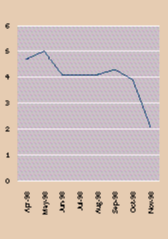
| Inflation is heading downwards … |
 |
| … and the baht is stabilizing against the dollar |
|
|
Source: Datastream/ICV |
Thailand’s recession has also made for hectic times for many restructuring consultants and lawyers, but it is a long slow process with plenty more troubled companies still to tackle. Eryck Su, an associate in the investment banking department of Bankers Trust in Bangkok, says: “Things are moving quite slowly, but there are many changes that have been under way that are helping Thailand to recover.” He is less optimistic about the pace of change, adding: “Corporate restructuring is still a bit too slow and until that mess clears out there is still a while to go.”
Problems are recognized
On the investment-banking side there are definite signs that things are bottoming out, Su says. “Six to eight months back if you asked the same question it would have been more difficult to answer. The banks have not resolved much of their loan problem, but I thing everyone knows it is there and it is greater than the banks presented to the market.”
Bank non-performing loans are reported at around 40% to 50% of the sector’s assets, but many feel the reality could be worse than that. Cairns believes that the way bad loans are classified may be masking the true level of non-performing loans. “Everyone understands by now exactly what the worst case is,” says Adkins, who believes non-performing loans have peaked and will come down by the end of the year. “Some are saying they are already starting to reduce,” he adds.
“Banks have been in a very difficult position and have had to recapitalize or be worked over by the state,” says Adkins. Some 65% to 75% of the problems have been dealt with, however, he reckons.
One of the most concrete ways Thailand is acting to clean up its banking sector is by encouraging foreign investment. Already a handful of foreign banks have injected fresh capital into the system. To date the most high-profile deal has been the takeover by ABN Amro of Bank of Asia. The government is now looking to sell Bangkok Metropolitan Bank and Siam City Bank, both of which were nationalized last year amid mounting bad-loan problems.
“There are very positive signs, but the local banks are still hamstrung and the foreigners are more used to opening up credit and will free up liquidity,” said Adkins, who believes interest rates will come down further as a result.
With the market still lacklustre and foreign investors remaining cautious, new issues are still thin on the ground. Equity issues are likely to lag new bond issues. Domestic bond issues are starting to trickle through, however, and a number of state enterprises are starting to look abroad for new debt issues.
The Electricity Generating Authority of Thailand (Egat) is planning to issue sometime around the middle of the year, possibly with another World Bank-backed issue similar to the one it issued last year. That deal, in October, was for $300 million and as a result of the World Bank guarantee was priced at only 285 basis points over treasuries.
Su at Bankers Trust believes that a number of Asian issuers are looking at testing the euro-denominated bond market this year. Investor perceptions will count for a lot in such issues. “The perception is that Thailand is better than its neighbours,” Su says. “But the investors are still very cautious and only looking at sovereign names.” Meanwhile, senior Thai bankers expect the new bankruptcy legislation to shave 20bp off the spread on existing Thai sovereign bonds in the US.
But many Thai issuers are turning to the domestic markets instead, where money is cheaper and demand for the right issuers is remarkably strong. “For the short term there seems to be a lot of interest from mutual funds and insurance funds,” says Su. “They have a lot of money and they do not have enough places to invest it.”
With interbank rates at around 2% to 3% – and a consensus that they will stay at around that level as the government continues to inject more money into the economy – there is a definite move towards higher-yielding sources of investment.
But the practical impact of the new bankruptcy legislation remains to be seen, particularly in the light of Senate amendments that set the minimum threshold levels at double the levels originally proposed. Debts will need to exceed Bt1 million for individual bankruptcy and 2 million baht for corporates. In addition, bankruptcy status will now be lifted after three years instead of the 10 years that was proposed originally. Other proposed changes recommending immunity from prosecution for financial guarantors were dropped by the Senate at the 11th hour of the bill’s passage.
The Bank of Thailand hopes that the legislation will spur new bank lending to business by giving banks the confidence that they will be able to recover future bad debts. But with non-performing loans standing at Bt2.7 trillion at the end of last year, Bt1.7 trillion of which was owed to banks taken over by the government, the overhang is likely to take some considerable time to deal with.
The central bank is now working on plans to privatize Siam City Bank and Bangkok Metropolitan Bank, along with Radhanasin Bank, created last year to absorb the performing assets of the 56 troubled finance companies closed last year by the government. Morgan Stanley is advising on the sale of the first two, and Warburg Dillon Read on the Radhanasin disposal.
The bank sales, along with the bankruptcy law and a Bt53 billion spending package, were key components of Thailand’s seventh letter of intent, agreed with the IMF in March.
A letter to Camdessus
In a letter to IMF managing director Michael Camdessus, finance minister Tarrin Nimmanahaeminda and Bank of Thailand governor Chatu Mongol Sonakul, said: “We are pleased to inform you that considerable progress continues to be made in our economic reform programme, both by way of policy implementation and economic outcomes. Reflecting the supportive stance of monetary and fiscal policies, output has stabilized in large parts of the economy, inflation has fallen sharply, and the external position has strengthened further. Growing confidence has allowed interest rates to fall below pre-crisis levels without compromising exchange-rate stability. These are significant achievements, especially when viewed against the background of unsettled emerging markets and economic weakness in many of our trading partners.”
Real GDP growth is forecast at 1% for this year, against minus 8% last year. Inflation is expected to be 2%, compared with 8% for 1998.
The general mood in Bangkok is that things cannot get any worse than they were last year, and indeed there might be some light at the end of the tunnel. “In the meantime, the real economy and the banking sector have a lot of difficulties ahead, but people are looking for positive news,” says Cairns.




