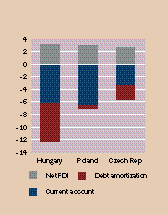
| Central Europe: net external financing requirements 1999 requirements |
 |
| Source: Independent Strategy |
It’s not just the tragic events in Kosovo that are hitting the economies and financial assets of central Europe. The current state of the European Union isn’t helping either. It’s ironic that, just as central Europe’s reorientation towards the EU once underpinned its post-communist revival, it’s now proving to be its nemesis. Slow growth in the EU this year means big external financing gaps for Poland and Hungary. Germany, which accounts for around 30% of the region’s exports, is crucial. But the collapse of demand from Russia, which accounts for another 5% to 8% of exports, doesn’t help.
Poland and Hungary both face the prospect of a current-account deficit above 6% of GDP this year. And Hungary is expected to run a 4.5% of GDP budget deficit to boot.
The last time Hungary developed such a twin deficit crisis – in 1994 and 1995 – the government had to impose a suffocating austerity programme. Then, industrial production growth collapsed, real wages contracted 10% and the equity market lost 40% of its value in dollar terms. A similar crisis has hit the Czech Republic more recently.
Yet current-account deficits are only part of the problem. Hungary and the Czech Republic each have sizeable long-term debt amortizations coming due. Sure, 50% to 70% of this is related to official lending and trade finance, which has a good chance of being rolled over. But that still leaves a big funding gap.
Foreign direct investment inflows are unlikely to fill it. First, as the bulk of the major privatizations have already taken place, there’s not much left to sell. Second, attracting plentiful strategic investment is all very well when growth is strong. But the high expansion rates achieved since 1993 are not sustainable without further structural reforms.
Net external financing requirements for Poland and Hungary, even after rollovers, will be between 3% and 5% of GDP. In a world where investor risk-aversion remains high, that won’t be easy to finance. Bank lending to all emerging markets has slowed sharply since the Russian crisis. And in some cases it has reversed. A third factor is the poor profitability of listed companies, especially in Poland and the Czech Republic.
Fourth, the reform of EU institutions (or lack of it) stands firmly in the way of enlargement. And the measures in the EU’s Agenda 2000, of which reform of the Common Agriculture Policy (CAP) is key, have been less than radical.
The French don’t want to upset their electorate ahead of the European parliamentary elections in May 1999 by agreeing to comprehensive CAP reform. And that’s left little room for agreement during Germany’s EU presidency. So sentiment towards the prospects of central European countries joining the EU will deteriorate further.
The implications of all this for central European financial assets are clear. Bigger external deficits mean higher real interest rates and weaker currencies. Slower economic growth means poorer corporate profits. In a region where equity markets are by no means cheap, that’s bad news.
On the other hand, concerns about imminent Eurobond default in Romania, one of the weakest of the central European states, are overdone. The world cannot afford to make an example of Romania, even if government creditors are fed up with taking the hit.
Romania’s role in the Balkans conflict, as the largest pro-western state in the vicinity (with a 350km border with Serbia), is of vital strategic interest. Nato already has 50,000 troops stationed around Serbia, with more to come. The last thing the west wants is a breakdown of relations with the Romanian government. This could easily happen if the anti-western, pro-Serbian nationalists of the Romanian far left were to return to power following further economic deterioration.
It wouldn’t take much. Romanian real GDP contracted by 7.3% last year after shrinking by 6.6% in 1997. Official unemployment has doubled to 12% since the end of 1996. Widespread and often violent strike action, instigated mainly by militant coalminers, intensified this winter.
With an election due in 2000, things need to get a whole lot better – and fast. Defaulting on a Eurobond would obstruct any turnround and could even precipitate early elections.
Romania has around $2.8 billion in principal and interest payments on its foreign debt in 1999, worth 7.4% of GDP. But it also has a massive current-account deficit to finance. At $3billion, this was equivalent to almost 8% of GDP in 1998.
So the country needs to find a total of at least $5.3 billion in external funding. Foreign-exchange reserves at the central bank are only $1.5 billion, with a further $1 billion in gold reserves. But there are several potential sources apart from the IMF – the World Bank, the EU, privatization receipts and private-sector loans – that could fill the gap.
In the near term, Romania has two international bonds maturing in the second quarter of this year – a ¥52 billion ($430 million) samurai bond due on May 28 and a $250 million Eurobond maturing on June 25. Adding various interest payments, Romania has around $750 million to pay over the next three months. That’s equivalent to 2% of GDP and half of the central bank’s (non-gold) foreign-exchange reserves, but it’s probably manageable.
So concern about a Eurobond default rests more upon Paris Club rhetoric than economics. The west needs Romania to be stable and cooperative. The best way to secure that outcome is to support the current administration. And that means encouraging reforms and maintaining the country’s access to global capital markets.
David Roche is president of Independent Strategy, a research firm based in London. www.instrategy.com