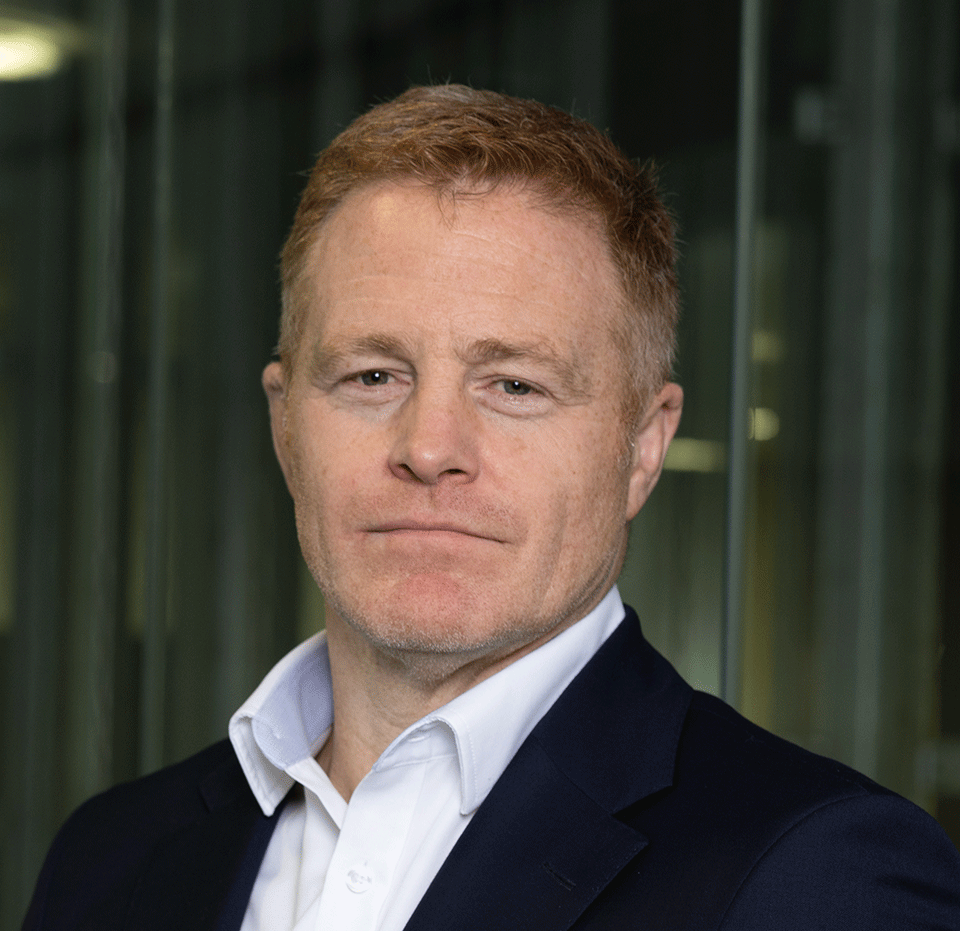
A well-trodden path leads from Eton College through Oxford University to the City of London. Christopher Mackenzie followed it, adding McKinsey, JP Morgan and Schroders. That conjures up a picture of institutional orthodoxy, but Mackenzie says he has always felt somewhat outside the formidable British establishment.
“I’m half-German and half-British,” he says. “That made it pretty unpleasant being at school in the late 1960s and early 1970s when people would reinforce upon you the fact that you were different. It becomes something that you start to believe, and so you look for ways of achieving your objectives on a very individual basis, rather than relying on the establishment.”
In June he joined private-equity firm Clayton, Dubilier & Rice (CDR) as a partner and head of European operations. “I have the opportunity to do everything I enjoy doing,” he says. “Identify acquisitions, close deals, work with management to bring about change in companies and, hopefully, make money for the investors, the partners and myself.”
The move to CDR follows more than four years as head of business development at GE Capital Europe, during which time Mackenzie built an in-house M&A team to rival any at the leading investment banks. He oversaw more than 80 acquisitions that increased GE Capital’s European asset base from $5 billion in 1993 to $35 billion today.
Mackenzie became aware of the excitement of deal-making and investment banking at an early age. “My most formative childhood experience was of my mother sitting on the end of my bed and telling me what stocks and shares to buy,” he recalls. His mother was “an extraordinary woman”, he says, the daughter of a German newspaper proprietor who flew fighter aircraft for the British during World War II. “I’m sure she would have been an extraordinarily successful businesswoman, but that was not what the wife of a diplomat did in the 1950s,” says Mackenzie.
As a 21-year-old straight out of Oxford, Mackenzie tried Hong Kong. “The bright colours, new smells and new foods: it was very invigorating,” he recalls. “There was an electric energy flowing through the community. And it was focused on business, but with no establishment to judge you by anything other than your ability and your accomplishments.”
He found himself inside another venerable institution, Swire, an old British trading company. But he wanted to get into investment banking, preferably in Japan. He progressed there via international business school Insead, and consultancy McKinsey, whose Tokyo office he joined in 1982. The head of McKinsey’s Japanese business was Kenichi Ohmae, who Mackenzie describes as a genius: “Working for him got me the inside track on Japan.”
In 1985 Mackenzie made the move into banking, joining JP Morgan where he was a founder member of Roberto Mendoza’s M&A team. But three years later, when Morgan started to reassess its Asian business, he felt it was time to move on. “Win Bischoff [chairman of Schroders] had been asking me for some time to develop an investment-banking business for Schroders in Japan,” he recalls. “With Win’s support, I took a team from Morgan and we did exactly that.” Mackenzie discovered his real satisfaction: building businesses. It was what attracted him to GE Capital, and now to CDR.
In 1993 having been based in Japan for 10 years, Mackenzie returned to Europe for several reasons: “I had two children who were coming up to school age and I wanted them schooled in England. But I also thought that the best and most interesting years [for Japan] were behind us.”
Mackenzie believes Japan’s ailing banking system lies at the heart of its economic problems:”Unfortunately the spirit of national consensus isn’t there any more. Getting the public to back bank bail-outs isn’t going to happen.”
Moving to GE Capital was a liberating experience: “I also got to work for a second genius,” he says, referring to Gary Wendt, chairman and chief executive of GE Capital Services. “Ken Ohmae taught me how to organize my thoughts. Gary Wendt taught me judgement. From both of them I learnt you have to discipline your use of time to focus on the few critical issues that will make a difference.”
Mackenzie is an enthusiastic supporter of Emu, although he stresses the need for people to maintain their cultural identity. In many ways he considered himself a European before it became fashionable to think of oneself that way. Of his school peer group he recalls: “They didn’t understand that it was a good thing to be able to speak French and German and Spanish and to be able to relate to different cultures. They were very complacent – the English way was the best way – and that arrogance closed their minds. I feel that there is something new to learn every day.” James Rutter