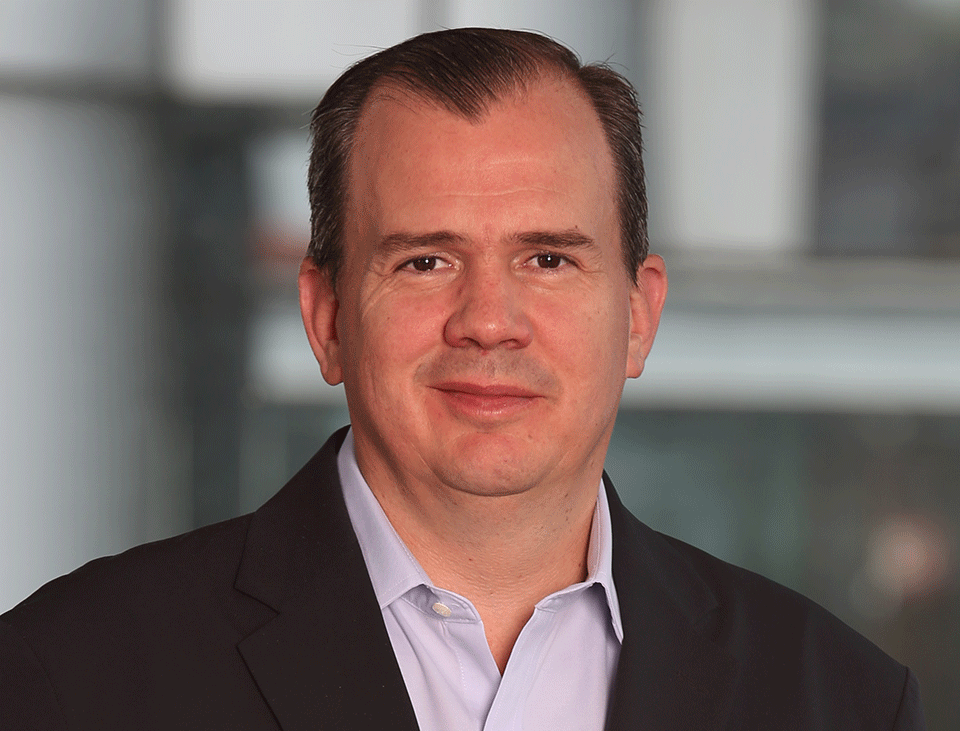
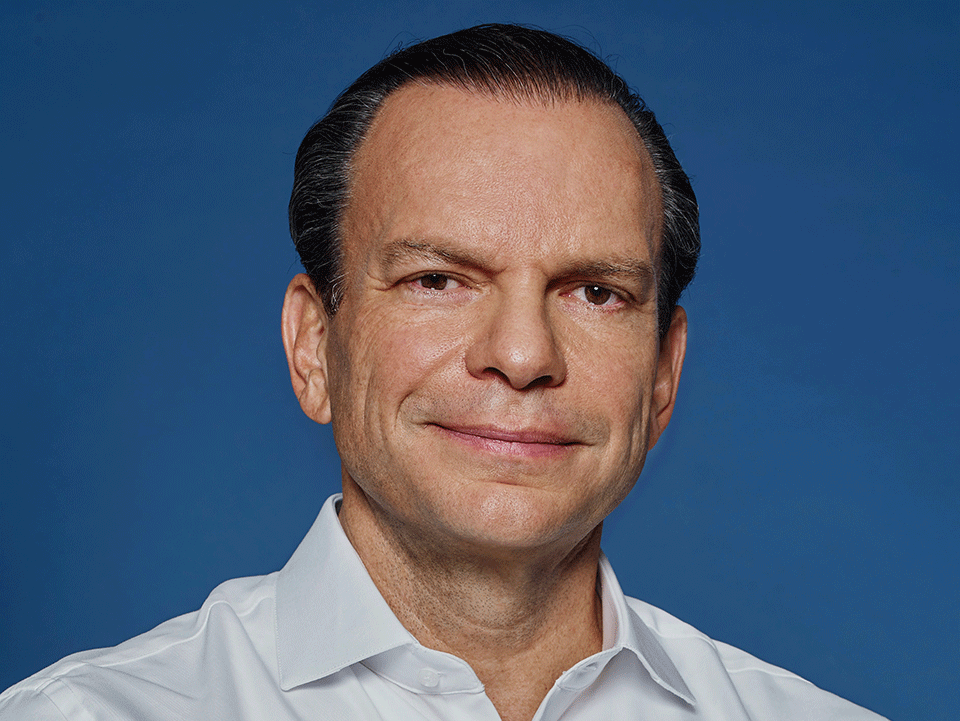
On the evening of April 14, the chairman of Nomura Securities, Masashi Suzuki, summoned Junichi Ujiie to his office on the second floor of Nomura’s headquarters in Nihonbashi. Out of the blue, Suzuki offered Ujiie – a relatively junior managing director, who only 10 months earlier had returned to Tokyo after seven years in the US – the position of president of the company. “You’re the only one who can do this,” said Suzuki.
Suzuki believed Ujiie was the only person who could rescue Nomura from the brink of disaster. A month earlier, on March 14, Nomura’s then-president, Hideo Sakamaki had been forced to resign after the company admitted making illegal payments of ¥50 million to sokaiya, gangster-linked groups who threaten to upset companies’ annual shareholders’ meetings. Nomura had been found guilty of a similar offence in 1991.
Over the next four weeks, matters had got worse. Major clients – from Tokyo Electric to Calpers – began to cut ties with Nomura. The ministry of finance (MoF) threatened to punish Nomura by stopping it doing business for as long as six months. And more serious allegations began to emerge: for example, that Nomura had run a set of VIP accounts for senior politicians and bureaucrats, which were effectively used to pay bribes.
Ujiie was Nomura’s last chance, Suzuki believed. If Nomura did not take drastic steps, it risked, at the very least, losing its position as Japan’s number one broker, which it had held since the 1960s. It might even be closed down, or go bust. Ujiie had been out of the country when the offences had taken place, so he was clean. His experience in the US meant that he had an understanding of American ethics and management which could be used to sweep the dirty elements out of Nomura. And he was not associated with any of the squabbling factions that had made Nomura a hotbed of conspiracy over the previous three years.
At their April 14 meeting, Suzuki said he would help Ujiie put in place any board structure he wanted, and then resign as chairman. The next day Ujiie returned, confirmed he would accept the job, but asked Suzuki to stay on as chairman. He felt the need of Suzuki’s backing to head off the inevitable fight for power that would ensue within the firm.
The two came up with a radical strategy. They quickly realized that, to establish Ujiie’s credibility, any director older than Ujiie, 51, would have to go. In Japanese culture, age is important; it is hard for an executive to give an order to a subordinate who is older or who used to hold a superior position. An exception was made for the American Max Chapman, 54, head of Nomura’s US subsidiary.
In the end, 20 (out of 43) of Nomura’s directors departed, including everyone at the level of senior managing director and above. No Japanese company since the 1940s had carried out such a dramatic purge. The only precedent was the cull ordered by the American occupation authorities after World War Two, when many companies lost their entire board of directors. (Indeed, the precedent is auspicious for Nomura. In 1947, the top four officials of Nomura were purged, leading to the appointment of 47-year-old Tsunakatsu Okumura as president. Okumura is credited with transforming Nomura into Japan’s top securities house.)
After the appointment of 12 new directors at its shareholders’ meeting in June, the average age of the Nomura’s board will fall from 55 to 48. The board will be leaner too, with only 35 directors, against 43 before.
Ujiie formally took over as president on May 1 and made a quirky speech to all employees over the satellite broadcast system. “This is a new departure,” he began poetically. “It is as if we are refounding this company from scratch. We are rushing out into a wilderness where rough winds blow.” In the speech, peppered with English words, he vowed to turn Nomura into “a company unable to act in anything other than a right-minded way in accordance with the spirit of the law”.
The choice of Ujiie was popular within the firm. “I am more optimistic than I have been in 25 years here,” says one senior Nomura manager. “I trust Ujiie. I appreciate his dedication.” Many believe that, in a few years, the scandal could be seen as the key event that transformed Nomura from a poorly-run, mainly domestic firm, ridden with dirty practices, into a leading international investment bank. “Unless this scandal took place, the old generation at Nomura would never have disappeared,” says the Nomura veteran.
Is Junichi Ujiie up to the task of cleaning out the Augean stables? His allies believe so. “In terms of philosophy and ability, he’s the right person for Nomura at the moment,” says one senior Nomura manager. “The impression everyone has of him is that he is half-American. I hardly hear any criticism of his appointment within Nomura.”
Ujiie’s actions during his first four weeks in office suggest the new president is as dynamic as his supporters claim. As right-hand men he chose Toshiaki Ito, his rival for the presidency, who will head administrative affairs, and – notably – Nobuyuki Goto to oversee domestic operations. Goto was regarded within the firm as brilliant at equity sales – and a modernizer. After the 1991 scandal, he was instrumental in getting rid of Nomura’s notorious “recommended stock list” and allowing branches and individual salesman more latitude in which securities they sold. But his reforming zeal irritated then-president Sakamaki and he was pushed aside to head Nichei Securities, a small affiliated broker. By bringing Goto back to the parent company (an almost unprecedented move), Ujiie has signalled to the sales departments that reform will recommence.
Ujiie’s first opportunity to make a big impact was the annual personnel rotation due to be announced on May 22. At Japanese firms, staff are revolved generally every three or four years. This was Ujiie’s chance to get rid of a whole stratum of middle-managers tainted by the old ways. And this year’s staff shift had to be particularly big because the heads of several important Nomura subsidiaries were due to retire and would have to be replaced. As the day approached, the sense of expectation within Nomura rose. Staff are consulted about where they would like to move, but told of the final decision only en masse on the day.
Ujiie did not disappoint. “At the general manager level – one level below the board – there’s been a wholesale change,” commented one Nomura middle-manager the day after the announcement. Typical of the changes was the removal of what this manager calls the “old-style domestic boys”. The heads of the Fukuoka, Hiroshima and Kobe branches, for example, were all shifted out of Nomura into small affiliated brokers.
The main winners were the more internationally-minded executives. Take Takumi Shibata. As head of syndicate (and later head of investment banking) at Nomura International in London from 1988 and 1995, he was regarded as one of the best Eurobond practitioners at any firm. But, for the old Nomura, he was just too outspoken, gregarious and westernized (he was known to fly back from Tokyo to London just to go to the opera). He was pushed aside in 1995 and sent to set up a project finance operation in Hong Kong. He now returns as president of Nomura London.
Hitoshi Tonomura, the respected (if somewhat arrogant) chairman of Nomura London, also got a key post. As a vice-president of the parent, he had to resign in April along with the other directors. But in last month’s reshuffle he was appointed president of Nomura Securities Investment Trust Management and, when that firm merges with Nomura Investment Management (Nimco) later this year, will become chairman of the new merged money management arm, which will play an important role in Nomura’s future strategy.
Ujiie has also introduced some structural changes to modernize Nomura’s management. He set up for the first time an equity syndicate department. Previously, IPOs were a major source of corrupt practices since favoured clients could be given preferential allocation of issues that were likely to perform strongly. By moving this business out of the sphere of domestic sales and placing it firmly under capital markets, Ujiie hopes to prevent such abuses in future. He has set up two new departments to strengthen risk management and compliance. He announced that he would start cutting costs by 2% each month. He has also floated the idea of appointing outside directors to Nomura’s board, a practice virtually unknown in Japan. He may eventually try to list Nomura on the New York stock exchange, which will further force the firm to become transparent.
Insiders have noticed that the style of the firm has already changed. “Management meetings are completely Americanized,” says one Nomura executive with international experience. “People can walk around and sip coffee.” All reports for executive meetings now have to be submitted via e-mail, not on paper. Ujiie is very insistent that discussion at meetings should be open and frank, which it was not before.
Over the next few months, however, the new management team will find life tough. The MoF is considering how severe a penalty to impose on the firm. After the 1991 scandal, it closed Nomura’s equity sales and equity proprietary trading at head office and at 87 of its then-153 branches for between four and six weeks. Analysts reckon this lost the firm $36 million in revenue.
How tough will the punishment be this time? The consensus is it will beat the record to date: an eight-week closure handed out to Chiyoda Securities last year. Most observers predict three months – but some suggest the suspension could be six months, the maximum allowed in the law. Key will be which departments have to suspend business. If the closure is limited to the two departments directly culpable – proprietary equity dealing and the section which handles relations with small companies – the effect on Nomura will be marginal. This would be doubly so if the closure happened during July and August, the two quietest months of the year. The worst outcome would be a long suspension, say four months, which extended to the profitable proprietary bond-trading operation. That might cause talented bond traders to jump ship.
On the surface, therefore, the outlook for this financial year (ending in March 1998) looks bleak. In addition to the coming suspension, customers have been deserting Nomura in droves. The firm’s share of trading on the Tokyo Stock Exchange fell in April to 6.3% – the lowest of the big four securities houses (for years Nomura has had the biggest share) – down from an average of 10.6% in 1996. Nomura has been stripped of several big bond mandates by domestic borrowers including Mitsubishi Motors, Tokyo Electric and the City of Yokohama. In April, it underwrote bonds worth only ¥13.9 billion compared to ¥73 billion in April 1996, according to business magazine Keizaikai. It was replaced by Nikko Securities as lead manager of the forthcoming privatization of JR Tokai, a railway company. It has also been removed from the syndicate for Japanese government bonds, where it had a 5.98% underwriting share, the largest of any institution. Even its own investment management arm, Nimco, has stopped dealing with it.
Analysts believe this upheaval could push the firm into the red in the first half. But, for the whole year, the outlook is not so terrible. Morgan Stanley, for example, estimates that, even if underwriting income and bond and equity commissions drop an average of 20% this year, consolidated recurring income (ie, before tax and exceptional items) will fall only to ¥120 billion from ¥166 billion last year. That would still probably leave Nomura as the most profitable Japanese securities house.
And, while the client boycotts are unsettling, few observers expect them to last long – particularly if Nomura’s new management is seen to be successfully cleaning up the firm. JR Tokai’s dismissal of Nomura, for example, was less from moral indignation than concern that its issue would coincide with Nomura’s equity-trading ban.
Says Elizabeth Daniels, financial-sector analyst at Morgan Stanley: “Nomura is still bigger and has more information than the other Japanese houses. That’s what investors want. Nomura won’t fade away into the background.” A recent poll in Diamond magazine, asking CFOs which financial institutions they liked to deal with, showed Nomura top among securities houses, even though the polling was done after the scandal came to light. Of the 735 respondents, 199 said their favourite securities firm was Nomura, 69 more than voted for the number two firm, Nikko. Nomura’s result, however, did represent a drop from last year’s figure of 280. (Another 194 CFOs said they would not want to have Nomura as their lead securities house.)
In international business, Nomura’s business has declined less. Although the decision by Calpers, the Californian state pension fund, to cut ties with Nomura made headlines, in international bond deals the firm has seen little fall-off. In May alone it lead-managed high-profile Eurobonds for borrowers such as Kingdom of Denmark, Fannie Mae and Crédit Local de France. Nomura’s sterling bond mandate from Electricité de France on May 6 particularly surprised the market.
Helping Nomura is the widely-held perception that all the Japanese securities houses must have been dealing with the sokaiya. Ryuichi Koike, the sokaiya Nomura allegedly paid off, indirectly held 300,000 shares in each of the big four firms. The other houses have also been strangely reluctant to stick the knife into Nomura. A western relationship manager with another big four firm reports with frustration that his Japanese colleagues will say only that “the Nomura scandal is terrible for our whole industry” when pressed by clients.
Concludes David Richards, securities industry analyst at Goldman Sachs in Tokyo: “A lot of the companies that have stopped doing business will come back once the criminal investigation is wrapped up. A few companies may discover that Nikko, for example, provides just as good service and so stay there – but that will be marginal.”
Another concern for Ujiie is that his predecessors will still try to call the shots from behind the scenes. The directors who resigned in April all remain on Nomura’s payroll as advisers. “It is quite possible that the advisers will try to interfere,” says Hidefumi Koshinaka, a reporter with the Nihon Keizai Shimbun newspaper who covers Nomura.
The power struggle that ensued after the 1991 scandal is a worrying precedent. Chairman Setsuya Tabuchi (known as “big Tabuchi”) and president Yoshihisa Tabuchi (“small Tabuchi”) both resigned and were appointed advisers. They chose Sakamaki as president, insiders say, because he was a weak personality with no power base. The Tabuchis believed they would be able to push him around.
“With the old guys still in place, the president couldn’t make his own decisions,” says a senior Nomura executive. “Sakamaki was obliged to listen to small Tabuchi in particular.” This became especially clear in a row over Vietnam. Small Tabuchi, after resigning, spent much time working on Nomura’s operations in south-east Asia. His pet project was an industrial estate in Haiphong, Vietnam, which he wanted Nomura to finance. Nomura’s board was strongly opposed to the project, but Sakamaki called in favours and railroaded the decision through the board. Finally, in 1995 Sakamaki reappointed the two Tabuchis as directors.
Sakamaki began to over-compensate for the pressure he was under from his predecessors by throwing his weight around elsewhere. He became autocratic, especially over personnel decisions. “There were no frank discussions,” says a Nomura insider. “Everything was decided behind the scenes. Sakamaki concentrated decision-making in his own hands and consulted only with two of the five vice presidents, [Atsushi] Saito and [Naotaka] Murazumi.”
Sakamaki began to manoeuvre potential rivals out of the firm. In 1994, vice-president Shozo Hashimoto was shifted sideways to head the Nomura Research Institute, and another vice-president, Tadashi Takubo, moved to Nimco. Both were highly regarded, and viewed within the firm as candidates to succeed Sakamaki. In their place, Sakamaki began to appoint yes-men to the board. He abandoned the practice of new board members being chosen by a ballot of all the directors and made the selection himself.
Sakamaki’s peevishness at the Tabuchis’ influence reached its peak over his treatment of Yoshitaka Kitao. Says an insider: “Kitao was a capable guy. Little Tabuchi suggested that he should be promoted to director, but Sakamaki objected and succeeded in blocking the appointment. It was widely believed within Nomura that the only reason for Sakamaki’s opposition was that Tabuchi suggested the idea.” Kitao, upset at the way he was treated, left to become CFO of computer company Softbank.
Will the Tabuchis try to interfere this time round? Small Tabuchi is still only 64 (young by Japanese standards); he still has top-level contacts in Asia which he is enthusiastic about exploiting. But Ujiie will probably find it easier to stand up to him than Sakamaki did. “Ujiie can be independent,” says an ally of the new president. “Even though the Tabuchis have kept the title of adviser, they’ve abandoned power. If Ujiie listens to what the Tabuchis say, it will now be regarded as a sin. In the past, it would have been regarded just as paying natural respect to his seniors.” The arrest on May 30 of Sakamaki for alleged complicity in the sokaiya payments also makes it unlikely that he will be able to continue to wield influence.
Another danger for Nomura is that the scandal will continue to spread. The prosecutors have unearthed a list of “VIP accounts” that Nomura held for leading politicians, diplomats and bureaucrats. One such account, the details of which have appeared in the Japanese press, contained a surprising number of convertible bond transactions – deals notorious as a way to generate easy profits for clients. The implication is that Nomura was, in practice, bribing politicians, MoF officials and important fund managers to give the firm favours. Nomura denies this and says the VIP list was merely to remind account-managers that these clients needed to be dealt with carefully.
Nomura also faces a number of scandals outside Japan. Its aggressive way of doing business has often lead it into controversy. It is being prosecuted by the Australian Securities Commission for allegedly manipulating the local share market. In the UK, it is under fire for its role in financing a abortive takeover bid for the Co-operative Wholesale Society which relied, allegedly, on stolen documents. In the Czech Republic, its attempts surreptitiously to build up a stake in the scandal-ridden Investicni a Postovni Banka have raised eyebrows.
In the longer run, Ujiie’s greater challenge will be to prepare the firm for the deregulation that the Big Bang reforms of Japan’s financial system will bring. The liberalization of stock commissions and the end of the ban on financial holding companies could radically transform the securities industry.
In many ways, Nomura is well placed to emerge a winner from the shake-out. It is much less reliant on commission income than other houses. If commission rates fell by half, as most analysts predict, it is the only major securities house that would remain in the black. According to Alicia Ogawa, financials analyst at Salomon Brothers in Tokyo, “income from fees other than equity brokerage commissions was 106% of operating expenses [in FY 1996], so theoretically the firm would have reported a profit even if the Tokyo Stock Exchange …had been closed for business the entire year”.
Nomura particularly stands to gain from the mooted introduction of wrap-around accounts, similar to US-style cash management accounts (CMAs), which would allow it to provide a range of additional financial services – from cheques to sweep-up money-market funds – via a single account. With ¥50 trillion of customer assets – far more than the other big houses – it could earn significant fees for handling these accounts, whereas now it earns only commission income when the customer makes a trade. As Paul Heaton, financials analyst at Deutsche Morgan Grenfell in Tokyo, points out: “In the US, brokers make about 1% a year from customer assets. Nomura earns only about 0.2% in the form of commissions on these assets. With CMAs, it’s likely they could earn closer to 1%.”
Big Bang will also produce mergers between banks and securities houses under the umbrella of the newly-permitted financial holding companies. Rumours in Tokyo suggest that Yamaichi is likely to be absorbed by Fuji Bank; Nikko is close to the Mitsubishi group and could tie up with Bank of Tokyo-Mitsubishi.
There are strong suggestions that Nomura might merge with the Industrial Bank of Japan. That seems improbable because the clash of cultures that would be produced by mixing the blue-blooded but bureaucratic IBJ with the aggressive Nomura would be hard to manage. A more likely solution for Nomura is that it buys Daiwa Bank. Daiwa (which is not connected to Daiwa Securities) was spun off from Nomura when the banking and securities industries were split after the war. Daiwa’s attraction is that, besides a rather weak commercial banking operation, it has a trust banking business with good institutional contacts (in pensions management, for example) and a strong private-client list.
In the end, Nomura’s future lies partly in the hands of the MoF. The ministry has long wanted to cut Nomura’s power. The ministry is said to be unhappy that Nomura has become uncooperative in recent years. When Daiwa Bank ran into trouble in 1995 over bond-trading losses in New York, Nomura (a shareholder in Daiwa) blocked the MoF’s scheme to have Sumitomo Bank acquire the bank. Nomura also defied the MoF’s attempt at the end of last year to prevent bank stock prices going into freefall. It sold bank shares, when the ministry asked for its cooperation to keep prices up. It is also widely believed that Nomura has given support to prime minister Ryutaro Hashimoto’s Big Bang reforms, to the extent of even drafting some of the proposals. The MoF, in private, is vehemently opposed to many of the reforms which threaten to curb its power. It is no coincidence, suggest many in Tokyo, that the MoF chose to delve into Nomura’s dealings with sokaiya, rather than those of the other securities houses.
Nomura’s future also depends on whether it can cut, once and for all, its links with the sokaiya. That is not as easy as it sounds. “Ujiie’s biggest mission is to keep away from those unsocial people,” says a Nomura official. “But he may even lose his life because he has declared publicly that he won’t deal with them.” Ujiie has been forced to take security precautions and to employ bodyguards.
To outsiders, the influence of sokaiya is puzzling. Why should Nomura be so scared of disruption at its annual meeting? After all, in other countries shareholders’ meetings are often heated and protracted. Big German banks, for instance, rarely get their annual meetings finished in less than 12 hours. In Japan, the theory goes, it is considered shameful if such stage-managed events do not go smoothly; companies, therefore, will do anything for a peaceful life.
The truth is more complicated. The sokaiya are closely connected with the yakuza, Japan’s mobsters. They frequently threaten violence. Says a Nomura executive: “They ring up and say, ‘I saw your daughter walking to school today. She’s so cute. Wouldn’t it be terrible if something happened to her’.” A number of officials at financial institutions – including Sumitomo Bank and the deputy president of the regional Kiyo Bank – have been killed after refusing to pay sokaiya. In 1991, after Nomura cut its dealings with sokaiya (temporarily as it turns out), a yakuza gang rammed a truck into the front of its Akita branch; another gangster was caught trying to smuggle a pistol into its head office.
The big securities houses have always had close ties to sokaiya. In 1991, all four were proved to have paid them off. In the past securities firms would introduce sokaiya to corporate clients, which might require their services to quell disgruntled shareholders. The securities houses, according to popular myth, also parcelled out to sokaiya shares in companies about to go public as an anti-takeover defence. The sokaiya could be relied on, after listing, to scare off any unwelcome shareholders.
The police have made a concerted effort over the past two years to crack down on the companies that pay sokaiya. Their strategy has been to focus on a top company in each industry. Critics suggest that the police would do better to arrest the mobsters rather than those they are blackmailing.