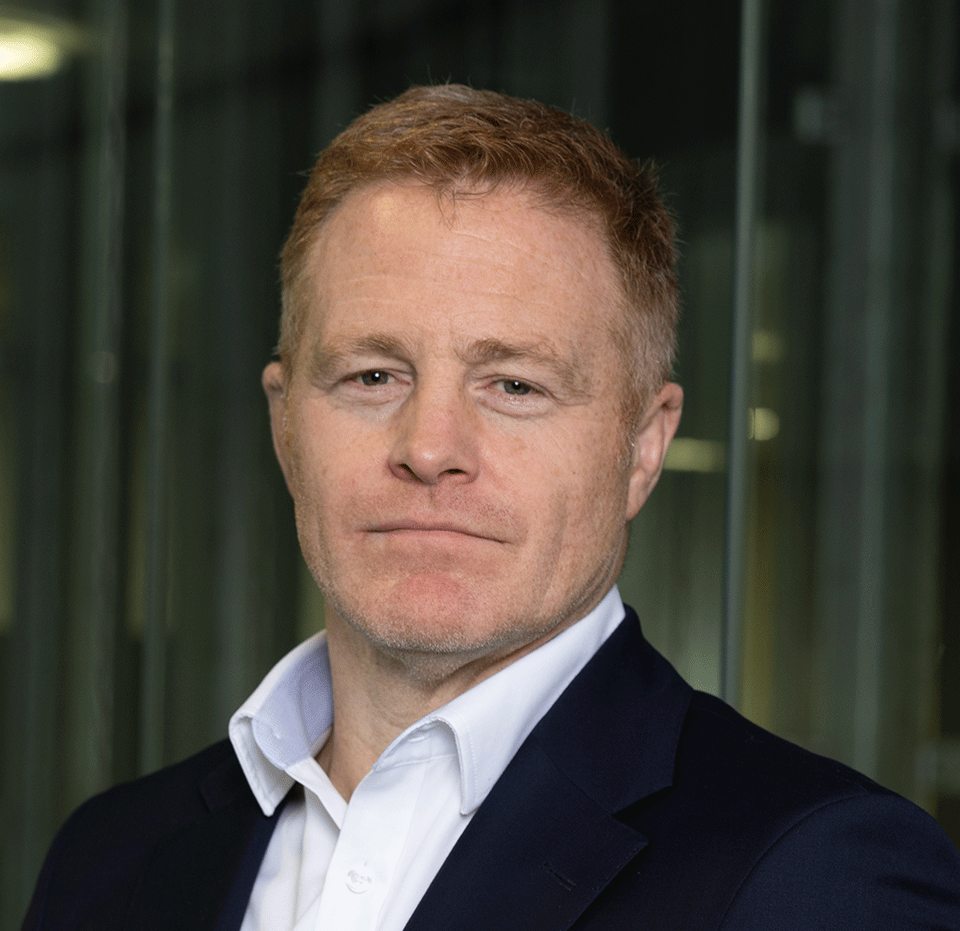
Anatoly Chubais left the Russian government on January 16 the same way he served it for over four years, with quiet class.
“I hope this has to do only with one individual, not a whole economic policy,” the reformer remarked, tendering a resignation already ordered by president Boris Yeltsin.
The future of sound economic policy is far from clear, however. As head of the State Property Committee and later first vice-premier, Chubais quietly endured the slanders of every major post-Soviet blowhard from Ruslan Khasbulatov to Vladimir Zhirinovsky. Now Boris Yeltsin has added his name to the list.
Yeltsin’s chief economic adviser Alexander Livshitz, a man of whom one generally expects better, kicked off the scapegoat campaign. First he patted history’s greatest (by volume) privatizer condescendingly on the head as a “young man who will undoubtedly still do more for his country”. Then he blamed him, among other things, for state workers being paid months late.
Yeltsin personally expanded the indictment to absurd proportions a few days later, announcing that but for the odious Chubais, the semi-official Our Home is Russia political bloc would have doubled its score in the December parliamentary elections, from 10% to 20%. Chubais was completely uninvolved in the Our Home campaign, which relied almost exclusively on the personality of prime minister Viktor Chernomyrdin.
Yet Chubais proved durable precisely because he lacked vanity. Unlike his more theatrical colleagues Yegor Gaidar and Boris Fyodorov he understood that politics is the art of working with people you do not always agree with. When the press cornered him for a reaction to Yeltsin’s charge, he murmured merely that the president “may have exaggerated”.
A professor of economics by the age of 23, Chubais started his political career by organizing half a dozen colleagues to grow vegetables and using the profits to contest St Petersburg’s first city council elections in 1990. The group included most of Russia’s soon-to-be privatization technocrats: Pyotr Fillipov who wrote the Privatization Law; Dmitri Vasiliev who now heads the Securities Commission; and Pyotr Mostovoi who runs the Bankruptcy Authority.
Chubais is the highest-ranking victim of Yeltsin’s apparent campaign to sack all the decent people in his government.
Yet Chubais’ work as a privatizer is done and cannot be undone. While his voucher scheme turned few Russian enterprises into anything remotely resembling investor-owned businesses, it did wreck beyond repair the centralized command system and put each factory’s fate in the hands of its managers and workers. Craig Mellow
SCHRODERS TOUTS AFTER RECORDS
The allure of winning lucrative and prestigious mandates for big Japanese privatization sales – NTT, Japan Tobacco, JR East – has investment banks once again boasting about their superior qualifications.
The most original tactic comes from Schroders, one of the last British-owned investment banks, whose secret weapon is 60 centimetres long, made of iron but worth its weight in platinum. It is a piece of track from the first Japanese railway line, financed by the Imperial Government of Japan’s first-ever foreign bond issue in 1870, placed successfully in London by Schroders. The holy relic is kept in the office of Hitoshi Tanaka, who stepped down last year as chairman of Schroder Securities in Japan and is now senior adviser.
The first railway line was a landmark in Japan’s modernization but ran only a short distance from Tokyo’s Shimbashi to the port city of Yokohama. It was opened by the Meiji emperor in December 1872, as recorded at the time in Japanese ukiyo-e wood-block prints. (The steam locomotive for the line was built in Lancashire, England and today occupies pride of place in the Transport Museum in Tokyo.)
“For your typically sleepy Japanese fund manager it grabs attention. It’s definitely a unique way to start a conversation – rather than talking about the latest coupons on warrant bonds,” says Steven Thomas of Schroder Securities (Japan).
There is a rumour that Kleinwort Benson was part of the 1870 consortium, although Shimpei Kasama of KB in Tokyo is understandably keener to talk about his firm’s role as global coordinator (with Dresdner Bank) for the privatization of Deutsche Telekom.
“I heard that Barings was asked for support in building the railway, but when executives in London opened an atlas they concluded that the land between Tokyo and Yokohama was a swamp, so they refused,” says Mitsuhide Fukumoto, head of capital markets for ING Baring Securities in Tokyo. His head office in London, however, claims this error of judgement was remedied by Barings’ placing of “the first Japanese government securities in the USA” during the 1903 to 1905 Russo-Japanese war, and financing “in the early 20th century” railways in the south and west of Japan. Fukumoto prefers not to dwell on such distant glories: “Please write that Barings’ big claim is now the support of ING, that in terms of assets we are the biggest finance house in the world.”
Peter McGill
LAST ORDERS, PLEASE…
Germany’s most famous wine bar may have served its last drink. It has taken a battering since the privatization agency sold management of it in 1990. Auerbach’s Keller in Leipzig, which figures in Goethe’s Faust, stayed in private hands right through the communist era although it was operated by a state catering company. In 1992 Frankfurt property king Jürgen Schneider bought the operating rights and a share in the property, but the pub became embroiled in Schneider’s bankruptcy in 1994.
Commerzbank has taken over Schneider’s interest in the site. But last September the Keller closed for a Dm3 million refit and may not reopen because of a dispute between the liquidators and unions. Its permanent loss would be almost as tragic as the fate of Goethe’s eponymous hero, who sold his soul to the devil. The real Dr Faustus is said to have drunk there with his students in the 1520s. In Goethe’s play, Mephistopheles amazes Faust and some students by causing excellent wines to gush from a wooden table in the bar.
The city of Leipzig has been involved in negotiations to keep the historic pub going. Economic chief Christian Albert Jacke predicts an agreement soon.
David Shirreff
PRIVATIZATION GIVES MONGOLIANS THE HUMP
Privatization in Mongolia may have its enthusiasts from president Punsalmaagiin Ochirbat downwards, but the post-communist government would not be wise to rely on the votes of camel-lovers in the next general election.
The privatization programme has had unwelcome consequences for camels from the nomadic country. The daily newspaper in Ulan Bator, Ardiin Erkh, has suggested that up to a third of them have been killed in the dash for ready money since the collapse of communism.
“As the collectives have been privatized in the 1990s, the animals were distributed indiscriminately to those who knew nothing about livestock, as well a
s skilled herders,” a food and agriculture ministry official, Mr Donzoi, was quoted as saying. Mongolians have slaughtered about 225,000 Bactrian (two-humped) camels since 1990, selling the meat and fat or using it for food, he said.
Even with natural growth of the herd, the number of Mongolia’s camels had fallen to 366,100 by the end of 1994 from 537,500 in 1990, a loss of about one-third, he added.
“Some of the people who received camels in the privatization process thought of them as meat,” he said. “Thus the camels, which have abundant meat and fat, came to be seen as the most profitable means of getting money.”
The official said the economically difficult years of 1991 and 1992 were particularly hard on the herd, with 177,000 camels being slaughtered. An average of only 24,000 a year were killed in 1993 and 1994, he added. Donzoi said the camel decline may now have been halted.
Camels also fared poorly during Mongolia’s three decades of Soviet-style collectivization, which began in 1954, falling in number from what had been a historical peak of 893,000. “Loss of camels in large numbers began a year after collectivization,” Donzoi said. “This proves how bad the consequences are when owners and their property are separated.”
Rural herders can be excused today for not grasping the Mongolian government’s wider privatization aims. President Ochirbat last year reviled the administration for failing to sustain the private sector and communicating the good news about privatization.
Although only 19.2% of the economy is in private hands, state inaction has led Mongolians to believe the private sector is far bigger. “Because of faulty propaganda about privatization, the public understands that the state no longer owns anything,” the president said.
Henry Gibbon
THEY LIVE TO ROADSHOW
Behind an unassuming red-brick facade lurks one of London’s most extraordinary offices, and quite possibly the most successful force in world privatization: Imagination.
Founded in 1978 by Gary Withers (still managing director), Imagination began by launching new products for Ford. But when IPO roadshows began with the large UK privatizations in the late 1980s, it quickly seized the initiative, organizing roadshows for British Gas, British Steel and the UK electricity companies.
To begin with, these were full of the razzmatazz of the confident, high-spending times. Paul Mackay – an exuberant pony-tailed Australian who was production manager of The Rocky Horror Show before joining Imagination in 1985 – wowed investors with his illuminated columns of bubbling water and tubes of crackling neon.
As recession bit in the 1990s, the extravagant displays were toned down and Mackay’s ponytail came off, but the company kept its grip on the roadshow market. Last year it handled nearly all the major privatization roadshows – including National Power, Repsol, Telefonica, PTT and ENI. These contributed nearly a third of its £44 million turnover.
Because Imagination got such a head start, competitors have found it hard to win mandates.
Drawing on a multi-skilled workforce of 200, Imagination sees to everything from the scripting and stage settings to the catering, travel and accommodation. “They’re like an executive Mothercare,” says one banker, referring to a well-known chain that sells baby-care products. “Roadshows can be a ghastly business, and Imagination is extremely good at creating a hassle-free environment.”
Mackay’s number two, Simon Bruxner-Randall, previously worked with him as a lighting designer. “With roadshows, as in theatre,” he says, “the show must go on.” For one major global offering, Imagination’s attention to logistical detail involved having two planes on standby at a private airfield in case Chicago airport became snowbound. “One thing we won’t do,” says Bruxner-Randall, “is reduce costs to the extent that we’re taking any risks.”
Nevertheless, the huge cost of roadshows (anywhere between £250,000 and £1 million) can be a sensitive political issue, and is the main reason why Imagination’s only serious competitor, HP:ICM, recently won the mandate to do the UK’s Railtrack roadshow. “We all know how to do roadshows now,” says HP:ICM’s managing director Lois Jacobs. “And clients have a better understanding of how much things cost.”
Philip Eade