
|
|
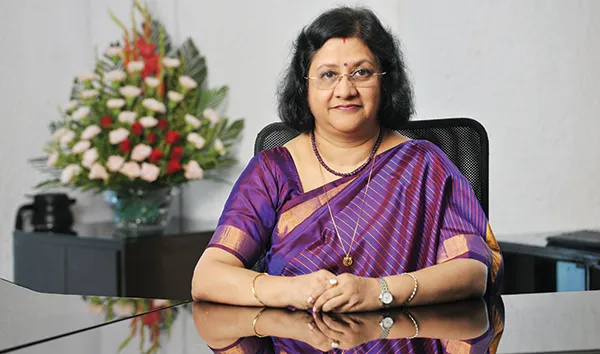
Arundhati Bhattacharya, chairman of State Bank of India |
“The institution was very large even then, but I don’t think we reckoned it would be like it is today,” she says.
Everything was 100% manual then; right up through the 1990s, one could walk into a branch of the bank and be confronted by phalanxes of staff several deep behind the windows, one to take the order, one to carry a piece of paper to someone else at the back, another to generate an extra bit of paper, a fourth to bring cash back to the front again.
But it has always, she says, had a sophisticated training system. “It’s been a great journey, mainly because this is one bank that makes sure you cover three or four areas of banking,” she says. “As a result, you get taken out from one vertical of banking and put into the next one. The challenges are great, because you have to learn on the job, but it is something that gives you a better perception of the bank in its entirety.
“And it never allows you to get bored. You are for ever on the learning curve. It’s as if you are changing jobs every four years or so. It makes us into people who have a lot of ability to mould ourselves.”
But with this baffling, peerless domestic scale, how does a chairman get a message across consistently to more than 200,000 people – closer to 300,000 post-merger?
She has faced this challenge for a while, having run the human resources department on her rise through the bank several years ago.
Aspirations
The bank has an internal system, SBI Aspirations, in which top management write their thoughts to be read by anyone with an employee number. She does webcasts alongside any big launch, or the quarterly results. The bank sends small mobile phone messages – daily nuggets, she calls them – regarding new launches or other news. And there is a self-training system, with 10,000 people on it at the moment, with modules staff can attempt, as well as 3,700 classroom specialists on staff.
Bhattacharya also talks about the group’s voluminous social media presence – it is, she believes, the number one bank in the world in terms of its Facebook presence – and its hundreds of YouTube videos about the bank, which brings us to a surprising finding: that the vast old dinosaur of SBI is remarkably technologically savvy.
In his benchmark report on technology in the Indian financials sector, Credit Suisse analyst Ashish Gupta said SBI was “clearly ahead of PSU [public sector] peers in terms of digital innovations and is among the top-three market players in most of the payment channels.” It is number one in terms of mobile banking transactions; Gupta puts its share of that market at about 38%, calling the mobile banking app “one of the most comprehensive apps with innovative features.”
Those integrated features include QR code verification – the first to do so for money transfers on Indian mobile banking apps – IMPS [a mobile phone direct payment system) and direct benefit transfers. Use of the app has grown at 54% CAGR to hit 13.5 million, Gupta says.
Tie-ups
SBI has also been quick to see the opportunities of partnership. A keen proponent of e-commerce, to make the best of its huge customer base, it has tied up with players including Amazon, Snapdeal and MakeMyTrip, and has built a business with Indian fintech leader Flipkart. It has rolled out e-kiosks and digitised branches, and using the Aadhaar-linked know-your-customer verification system to allow customers to open a new savings account in these branches in 10 minutes.
It is as advanced as any UK bank on contactless cards and is converting its entire point-of-sale network to be compatible. Bhattacharya says its wallet offering is the only one that’s operational in 13 languages. “We are addressing the rural masses, as well as the middle and upper classes: our wallet offering can be used by anybody.” There is plenty more in this vein: the bank’s budget for digital initiatives was hoisted to Rs50 billion for financial 2016.
“The bank’s biggest strength,” says Gupta, “is the unrealised potential of its large customer base.”
In this part of the business, Bhattacharya has a lot of admirers. “State Bank of India is a great institution. For their size, they are very progressive: working with e-commerce companies, lending to Uber drivers, the whole thing,” says Nandan Nilekani, co-founder of Infosys, one of the architects of the Aadhaar national ID card and all the financial apparatus that has been built on top of it, and probably the most influential voice in Indian technology. “They have very dynamic leadership. Bhattacharya is outstanding. I’ve known many CEOs and I would put her up there with anybody else.”
Bhattacharya invited Nilekani to speak to the bank’s board. When Euromoney asks what he told them, he smiles and just says: “They took it very well.”