 |
|
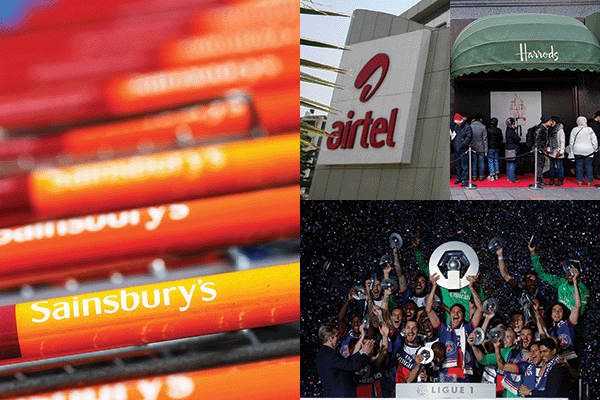
Clockwise from top left: Sainsbury’s, Airtel, Harrods and Paris Saint-Germain |
For a country that is relatively new to wealth, Qatar has a surprising diversity of state institutions entrusted with investing it all. The Qatar Investment Authority is not the only game in town, or not anymore: as Qatari investment has grown in quantum and sophistication, specialist businesses have evolved to focus on activities in particular sectors. But how do they fit together? And are they as streamlined and co-ordinated as the state would like to believe?
Very clearly, the most visible Qatari state entity is the QIA, its sovereign wealth fund, and two subsidiaries within it: Qatar Holdings, which does most of the overseas direct investment, and Qatari Diar, the property developer. This is the institution whose swashbuckling global deal-fighting style transcends the pages of the FT and the WSJ to reach the Daily Mail or USA Today; its targets are often so visible and iconic that people who have no interest at all in finance know that it owns Harrods in London, and J Sainsbury, and Paris Saint-Germain.
But here’s the thing: the QIA doesn’t own Paris Saint-Germain. It belongs to another institution, called Qatar Sports Investment. And it doesn’t own all those French fashion brands like Le Tanneur. That’s Qatar Luxury Group. And when Qatar bought a 5% stake in Indian telco Bharti Airtel last year, that wasn’t through the QIA either; it was through the endowment fund attached to Qatar Foundation. There is a multiplicity of these peripheral vehicles.
Most of them have been around for a while, but have perhaps only recently started doing deals big enough to be noticed internationally. The theory is that they bring specialist ability beyond the QIA’s deal-closing nouse. “In the old days,” says a senior banker in Doha, “everything used to be the QIA, but as we have learned along the way, we have begun to specialize, and today the models have changed.
|
I don’t think it’s simply a case of three people sitting in a room and saying: ‘Hmm, let’s do ABC today, which subsidiary will we do it through?’ One Qatari insider |
“For example, 10 or 15 years ago, there was no QPI,” he says, referring to the petrochemical-focused investment arm within Qatar Petroleum. “But a specialist like that is in a much better position to negotiate. QIA might be very good at making deals happen, but they don’t have the expertise in oil and gas.”
Akber Khan, director of asset management at Al Rayan Investment, makes a similar point. “Take Qatar Luxury Group, where several of the top management team are ex-Louis Vuitton,” he says. “It is unlikely anyone else in the country understands luxury as well as they do. This doesn’t mean they can’t be directed, but they are certainly more than capable of working out what to do themselves.”
Opinions vary on the degree of co-ordination between these institutions. Qataris describe a situation of sophisticated harmony and communication; bankers who serve them tend to describe something rather more disjointed.
A natural assumption would be that all these investments are co-ordinated, or at least approved, by a handful of people at the very top. Some say this is how it is. “No matter how many of these entities there are, it’s still the same people making the decisions for all of them,” says one impeccably connected executive in Qatar.
“It’s a little like an integrated corporation,” says Rod Ringrow, who heads State Street in the Middle East. “It’s a model you see in other Gulf states, such as IPIC and Mubadala in Abu Dhabi, with different vehicles looking at state investments in the country.”
Others give the subsidiaries more independent credit. “I don’t think it’s simply a case of three people sitting in a room and saying: ‘Hmm, let’s do ABC today, which subsidiary will we do it through?’” says one Qatari close to several investment institutions. “They all have professionals working within them with different mandates. I’m sure they sometimes have to bring investment ideas up to the decision-making hierarchy – at some point, if it’s big enough, an investment will require a sign-off from a handful of people at the top – and some investments will come top down rather than bottom-up. But certainly not all of them.”
Tangled mess
Others think the idea of a co-ordinated plan is generous, and that the subsidiaries instead represent a tangled mess that is a consequence of extremely rapid growth. “It’s disjointed,” says one banker who has advised many Qatari institutions. “There are so many examples. The QIA buys Fairmont Raffles, then Qatari Diar is building hotels. Qatar Rail is under Qatari Diar for no reason: Diar is a real estate developer. I once pitched a deal to Qatar Sports Investment showing them a perfect sport operating asset, and asked for their balance sheet. The only thing they had on it was real estate. They’d been given land by the government instead of cash.”
This point of view is arguably supported by some puzzling recent developments. As Euromoney wrote in November, a case awaiting trial in London pits Chelsfield Advisers against Qatari Diar over the development of the former US Embassy there. That wouldn’t be so odd, were it not for the fact that Qatar Holdings has a stake in a Chelsfield company (admittedly a different part of the same group than the entity that is suing, but still connected); Qatar Holdings and Qatari Diar are both subsidiaries of the QIA.
Then there’s the curious situation around Canary Wharf, where Qatar’s sovereign wealth fund, alongside Canadian investment firm Brookfield, is bidding to buy the iconic London block from Songbird Estates, which is itself 29% owned by Qatar. Nothing unusual in a transfer of assets within related companies – but Songbird refused the bid and wants more.
| Further reading |
 |
| Five Qatari investment institutions that aren’t the QIA |
There are two ways of looking at things like this: a belief that subsidiary companies must be left to do business independently and to the best of their abilities, even if that creates friction or competition (or even litigation) between companies with common ownership; or that an empire has grown so big that it is impossible to manage.
Either way, even if there is a handful of people truly in charge, we are witnessing a crucial changing of the guard among those people. “There are two Qatars, pre and post handover,” says one banker who has worked in both Qatari and international institutions.
“Pre, there were five players, representing two pockets of money. On one side you had the Emir and Sheikha Moza [his wife] with [then-energy minister] Al-Attiyah; on the other, HBJ [then-prime minister Hamad bin Jassim bin Jaber Al-Thani], with finance minister Yousef Kamal sort of in the middle,” he says. These are the people who saw the real wealth arrive in Qatar: Hamid bin Khalifa Al-Thani was Emir from 1995, HBJ was prime minister from 2007 but had been foreign minister since 1992, Al Attiyah held his office from the same year, and Yousef Kamal was in his post from 1998. “Any major decision had to be ratified by those five.”
But then, in June 2013, the Emir announced his intention to hand power to his son, Tamim bin Hamad Al-Thani; with him, the rest of the old guard went too, with a new finance minister, former fighter pilot Khalid bin Mohammad Al-Attiyah (not to be confused with the earlier Al-Attiyah, a different man), and a new prime minister, Sheikh Abdullah of the ruling Al-Thani family.
The impact of this on state investment is still to be understood, and people vary in their opinion. “The people pulling the strings haven’t really changed, except HBJ,” says one banker. “You are going to have new blood running around but not a massive impact. It’s like running a corporation, except it’s as much a political as an economic game.”
In this reading, the development of smaller subsidiaries is a way to keep important but potentially power-hungry people occupied.
Significant change
Others think the change will be more significant for investment. “The old prime minister and foreign minister was pretty instrumental in a number of the entities you’re looking at, so that has changed,” says one fund manager. Indeed, HBJ was vice-chairman and CEO of the QIA, chairman of Qatar Holding and on various other boards; Yousef Kamal, for that matter, was on the QIA and Qatar Holdings boards, was chairman of Qatari Diar and on the Qatar Foundation board, among others. “Also, I have the impression that with succession came a review and that they will now be looking at things more domestically and regionally than in the previous plan, which mainly involved buying a lot of global assets.”
Alongside these subsidiary entities, the QIA retains its reputation as a ball-breaking deal-maker and negotiator, which couldn’t care less if the world’s investment community thinks it a lesser beast than the Abu Dhabi Investment Authority (Adia) just because the Qataris barely give out any investment mandates and the Emiratis do so in abundance. Specialist investment arms might come and go, but the QIA will still be there, scouring the world for a bargain.
Stories of the Qataris’ zest for a good deal abound. One that does the rounds concerns the purchase of Harrods from Mohammed Al Fayed by the QIA. The story goes that Al Fayed originally wanted £5 billion for Harrods, and that a series of negotiations brought it down to a little over £2 billion, but when it came to signing, Al Fayed tried to add an additional amount at the last moment. Supposedly the Qataris walked out of the room, drove to Heathrow, got on their private jet and went back to Doha, to make a point. Six months later, when the deal took place, it was for £1.5 billion.
“They get what they want,” says one who works with them. “When they want absolute control of something and it’s between them and a seller, at that stage they are just ruthless. They love a bargain and they err on the side of destroying relationships in order to get it.”
One Qatari remarks, with considerable pride: “Anyone who has ever had to negotiate selling an asset to QIA will tell you it’s the world’s worst experience. They are such shrewd negotiators that once you’ve done it, you never want to do business with them again, because you feel like you’ve been robbed.”
Still, not everyone thinks they’re quite the hardline negotiators they are made out to be; one banker points out that the Harrods purchase was still for almost 30 times profits at the time, an unheard of multiple in retail after the financial crisis.
| Understanding the impact on an individual becoming the richest in the world overnight is one thing. Appreciating the effect on a country of 200,000 citizens is quite another Akber Khan |
In any assessment of the evolution of Qatar’s economy, state apparatus and investment machinery, it is always important to remember just how recent this wealth is. “Qatar’s first LNG shipment was in 1996, but it didn’t become rich, in the sense we know today, until the turn of the century,” says Al Rayan Investment’s Khan.
“For a country with among the least surface water in the world, avenues to really drive growth were relatively limited prior to the dramatic growth of LNG. And unlike some of our neighbours, Qatar has not been a busy trading thoroughfare over the last couple of centuries. ”
Indeed, pre-LNG, there was some pearl and fishing work, but not much else – a barely relevant piece of sand on the coast of Saudi Arabia. “Adia has been around for 30 years. Qatar didn’t have a hospital then, never mind a sovereign wealth fund, ” says one banker.
“In Qatar we are in generation one of the wealth; in the rest of the region it’s generation three, four or five,” says Khan. “That leads to material differences in culture, in approach, in society as a whole. Qatar’s GDP in 2014 is likely to be more than four times what it was just 15 years ago” – the highest in the world, in terms of GDP per capita. “The speed with which this change has occurred is extraordinary and probably unprecedented.”
He adds: “Understanding the impact on an individual becoming the richest in the world overnight is one thing. Appreciating the effect on a country of 200,000 citizens is quite another.”
That being the case, it’s perhaps naive to assume that a seamless institutional base will have developed for the international investment of that money; and if it’s not always clear to international eyes how it all fits together, that’s hardly Qatar’s problem. They’ve got other things to worry about.
“In Qatar,” says a senior Qatari, “the challenge is not whether we have money or not, it’s what we’re going to do with it. Smart investment is the ideal solution.”