
| Further reading |
 |
| Euromoney Country risk: Brazil Chile Colombia Peru Mexico Uruguay Paraguay |
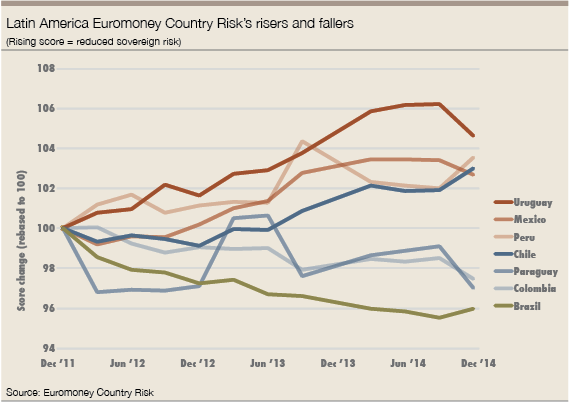
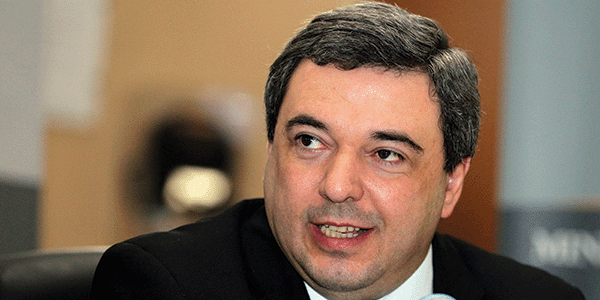
Up until three years ago Brazil was the vacuum cleaner of the region. It was the ‘B’ in Brics, it had very high interest rates and was growing at about 5%,” says Mario Bergara, Uruguay’s economy and finance minister. “From 2011 they have stopped growing at that rate, and interest rates went down from about 12% to 7% and some of the capital that had previously been going to Brazil started to look around at neighbouring countries. There was a significant change for us in terms of capital inflows from that point.”
Uruguay is not the only country benefitting from a new era of international investment in Latin America.
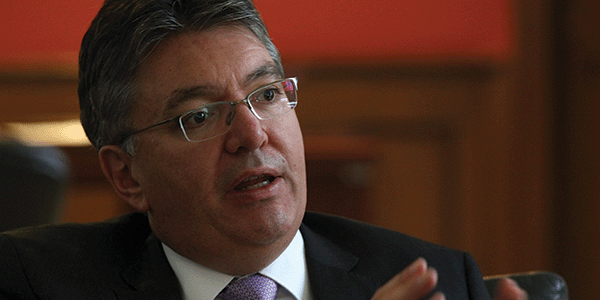
“I couldn’t agree more,” says Mauricio Cardénas, Colombia’s minister of finance, to the hypothesis put to him that international investors are increasingly differentiating between Latin American countries.
The trend has been evolving slowly but steadily over recent years and the near-end to the US’s policy of quantitative easing has begun to see liquidity in the region pooling into the safer buckets of risk.
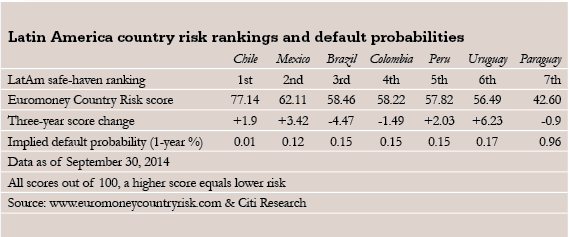
Greater awareness of which countries have adopted monetary, fiscal and exchange rate orthodoxy – as well as the financial health of growth and the orientation of the economies – have led to greater clarity about the region’s strongest credits, with Colombia being one of them.
“The markets are becoming more discriminating and that’s good for countries that are the outperformers – they are differentiating themselves from the rest,” says Cardénas. “Within Latin America there are many differences: in economic policies, in national resource endowments and in the role that the private sector plays relative to the government. So I think it’s for Colombia’s gain to have markets that are beginning to see more shades of colour.”
 |
| Within Latin America there are many differences: in economic policies, in national resource endowments and in the role that the private sector plays relative to the government. So I think it’s for Colombia’s gain to have markets that are beginning to see more shades of colour Mauricio Cardénas, minister of finance, Colombia |
In the past, says Cardénas, every Latin American market seemed to be viewed through the same lens. “The differentiation process enables Colombia to show that it is a country with very sound economic policies – with strong opportunities – and that it is a country that the market is favouring. Think of portfolio flows. They have been leaving many countries in the emerging markets but Colombia has been getting unprecedented inflows – more than ever in our history – and that is because the markets are saying something is different here.” Colombia’s record inflows also owe much to the additional capital attracted to the country after JPMorgan increased the proportion of bonds from the country in its leading EM bond index. But in a sense it becomes a circular argument because Colombia’s greater inclusion in the index was driven by its improving risk profile, which in turn added this technical liquidity.
In truth, Latin America has always had a mix of very different credits and investors have always differentiated between sovereign and corporate risks. However, the sheer amount of liquidity that was searching for yield following 2008 when the US embarked on its QE experiment did seem to blur many of the distinctions as crossover high yield and investment grade investors came to the region looking for returns.
Even emerging market investors that focused on other regions began to look at Latin America, and spreads tightened across the board. Some point to the liquidity available in frontier credits [for example, in June this year Ecuador returned to the market less than six years after it defaulted on $3.2 billion and the strength of demand allowed the borrower to squeeze the price to below 8% for a $2 billion bond] as proof that investor discrimination – if not differentiation – had stopped driving deals.
Chile was the first investment grade country in the region, long before its neighbours of Colombia, Peru and Mexico achieved that status. It is still the highest-rated sovereign. Alejandro Micco, Chile’s deputy finance minister, says Chile is in many ways showing the path for these countries. “When you go to Lima today it is like Santiago was at the end of the 1990s,” Micco says.
He warns that progression won’t be linear and will have to be adapted by individual countries. “Latin America is very different,” he says, when asked how he believes investors view the region. “But I think there are three things that cut through all the countries: politics, economics and the whether the country is dependent on the emerging world or the developed world for growth.” Micco says that, from a political perspective, Chile’s left-wing government shares much in common with Dilma Rousseff’s Brazil but the strength of the Pacific Alliance is its pragmatic approach to any political difference and its coalescence around a set of economic principles – free trade, monetary and fiscal orthodoxy and (relatively) free-floating currencies.
“The Pacific Alliance is a new group that has common policies regarding having open market economies,” says Micco. This macro-economic approach is consistent and allows flexibility and space to allow for differences in politics, stages of development and orientation of exports.
Micco says Chile didn’t just pave the way for the rest of the Pacific Alliance countries, in terms of being a model to follow of an investor-friendly regime, but also points to the region’s future challenges. As these countries’ fast-growing economies become middle-income countries, economic prosperity creates growing social, political and institutional challenges. These obstacles to growth – as Chile is finding out today – are more complicated and subtle than adopting the economic framework that will take them to this point. Micco expects that the difficulties Chile faces today will be exported across the region by the end of this decade.
Colombia hopes to share Chile’s middle-income problems – and soon. Cardénas has set out an ambitious growth target: annual growth of 7% for the next 12 years will bring the country to GDP per capita of $20,000, which is around the level of Portugal today. Cardénas concedes that it is an ambitious objective, but realistic nonetheless.
Colombia’s current long-term growth rate is close to 5%. “That’s what most of our models suggest is our potential GDP growth,” Cardénas says. “That is very healthy but not enough for us to really accelerate the speed at which we want to eradicate poverty and increase the living standard of Colombians. So we have to think what else needs to be done so we can grow faster in a sustainable way.”
Colombia’s answer is twofold. The first is infrastructure, and the government is already well underway with an ambitious series of road projects, together known as ‘4G’, that envisages $27 billion of new roads built in the country in the coming five years. “When the programme is complete our long term economic growth will increase by about 0.7 percentage points per year – during the construction phase it will add even more,” says Cardénas. The remaining added growth needed to achieve the 7% target will come from a dividend from the peace process that is nearing resolution. Cardénas expects that an agreement with the leading rebel faction, Farc, will boost agriculture, energy, mining and tourism.
While other countries in Latin America share the potential for peace dividends (Mexico’s drugs troubles lower growth potential as do – to a lesser extent – gangs in Paraguay) the whole region is looking to infrastructure to boost growth.
Brazil has belatedly privatized concessions for ports, railways, roads and airports. Mexico is planning to build roads and a new Mexico City airport. Even Uruguay, which already has better-than-average infrastructure, is planning a new deep water port, as well as improvements to its road network. This creates competition regionally, not just for finance but for resources.
Colombia’s 4G programme is a good example of this, with Cardénas saying the local banks had capacity issues to fund the full amount. “For the big infrastructure projects the local banks may be a bit constrained – it’s a significant size even for them,” says Cardénas. “That’s why we have opened the possibility of making sure more foreign banks come and lend to the road concessionaire – we were willing to provide some exchange rate support for that. Of course, foreign banks don’t want to deal with the FX risk that comes with investing in toll roads in Colombia so we are hedging part of that.”
These projects also provide the opportunity to build stronger national development banks, as well as engaging with local institutional investors to repackage risk to them and deepen local capital markets. In Colombia’s case, the main buyers are the pension funds which are conservative in buying bonds that contain any element of construction risk. So the government changed the governance of these institutions to enable them to participate through debt instruments in the near term.
“We have made a special regulatory change for pension funds to be able to invest in this new [toll road programme] asset class,” says Cardénas. “It’s a debt fund, from which they can lend to the concessions so that they are not restricted to investing through equity or bonds. This will enable pension funds to provide loans to the concessions.”
Energy is also a staple ingredient to future Latin American growth. Mexico’s dramatic opening of its oil, gas and electricity industries is making the headlines but there are opportunities throughout the region. To the extent that countries need to compete for investment, they are prepared to do so.
“Mexico is going to be a new player and a strong player and it has tremendous potential. Oil companies are going to be interested in investing in Mexico – we, for example, through Ecopetrol will be interested because it will help us diversify our assets. So we will be looking at opportunities in Mexico,” says Cardénas.
“But Colombia will remain competitive. We will remain a country where oil companies find it interesting to participate and we will do that by making sure that our terms – especially in the offshore and the unconventional oil sectors – are attractive enough so that we keep getting significant investments. So Mexico is a new player – we are watching – but we will not be less competitive than Mexico.”
Cardénas confirmed this means that Colombia is prepared to improve investment returns for foreign participants in the country’s oil sector and says: “We are already discussing potential changes.”
Chile, too, has energy needs, but Micco says the issue isn’t financing. It’s the problem that is affecting the country on many different levels and is a consequence of its economic success. As Chile’s economy has improved, as poverty has decreased and educational standards and its middle classes have grown so too the policy challenges have changed. The country needs, like the rest of the region, to increase energy investment but the problem isn’t attracting capital. The problem is increasingly getting projects off the drawing board.
“In the short-to-medium term our biggest issue is energy,” says Micco. “We have lacked investment for the past four years and so prices have started to rise. The marginal cost fixed in the spot market has started to be very high, because marginal production is with oil. We are starting to have problems, but it is not a problem of money to invest, the problem is of communities. Nobody wants a power plant at the back of their house. This is a problem that is a middle income problem. It is now difficult to be able to construct a big investment project because the communities complain and they have a lot of power. They block investment. And we still don’t have the institutions to respond to this new challenge. Development is not only about money, it is about the development of institutions.”
Chile has built on very stable macro-economic foundations. That economic discipline created investment and growth that has now led to demands from the new middle classes that the country’s social and political systems are struggling to answer. Chile is looking at electoral reform, to move to a multilateral political system of proportional representation. The tax system is being made more progressive – with a larger fiscal take – to try to satisfy ever-greater demands on the education and health systems.
Importantly, these changes are being made with consensus across the political spectrum. The recently passed tax reform increases the tax burden, from 12% of GDP to 18%. Of those additional percentage points of tax, one will be used to close the current fiscal deficit with the rest spent on education.
Across the region, progressive tax reforms are being introduced. In Mexico, whose government could be labelled to the right of centre, ministers talk openly about using the tax system to redistribute wealth. Ministers openly discuss GINI coefficients and seem to accept that lower is better.
Latin America is home to many of the most unequal societies in the world but, unlike in the US for example, redistribution is not a banned word and politicians from all backgrounds appear to accept a need to share the economic growth more broadly than in the past. There are still differences in approach, however.
 |
|
From 2011 [Brazil’s] interest rates went down from about 12% to 7% and some of the capital that had previously been going to Brazil started to look around at neighbouring countries. There was a significant change for us in terms of capital inflows from that point
Mario Bergara, economy and finance minister, Uruguay |
For Uruguay’s Bergara, it is more about how tax revenues are spent rather than how they are raised: “In 2006 we passed a progressive tax reform but the main tool is on the spending side. You might tax the wealthier people but you also have to be prepared to make things right on the spending side. Our social policies focus on the poor – because sometimes social policies are designed in a very broad sense and you are not sure if the subsidies go to help the right people.” Bergara claims Uruguay has the highest per capita ($17,000) income and the lowest GINI coefficient (0.38) in the region. A similar challenge faces Chile. “It was easy to grow when the country’s GDP per capita was $5,000 – you could do the big reforms. But now Chile is a middle income country so we have to start to think about another type of development,” says Micco. “We clearly have a comparative advantage in mining and seafood – and we have to continually compete in these industries. But now we have to start to provide high quality services and high quality inputs to these industries.”
Bergara says Uruguay and Mexico are alone in the region in not improving their terms of trade during the past decade, when the rest of Latin America benefited from China’s growing demand for its mineral wealth. Uruguay’s solution is a template for others – and enabled the country to equal, and in many cases exceed, the commodity-driven growth of its neighbours.
“Uruguay grew during this decade at a pace unseen in the last century, averaging 5.5%,” says Bergara. “During this time the population growth was almost zero, so this is per capita growth. We achieved this by boosting investment. Historically Uruguay had a 12% to 14% [to GDP] investment ratio. Right now it is between 23% and 24%. That has been a significant change.”
This investment has led to productivity driven growth. The country has opened for inward investment and has created tax incentives for investment that comes with technology and other economic innovation. FDI has increased from 1% of GDP to averaging between 6% and 7% in recent years. The country now has full employment and its lack of spare human capital capacity is a potential bottleneck. The solution is more investment in education to continue productivity increases. “We are investing much more in education. The public budget for education has climbed from less than 3% to more than 5% and we are still allocating more.”
It is striking that in Uruguay, which is about to vote for a new president, greater investment in education is an area of consensus. In Chile, too, politicians of all parties recognize the need and demand for better education. This, for Micco, is easier said than done. “Our issue for the long-term is human capital – we are running a lack of human capital and studies show there is a complementary relationship between the quality of human capital and adoption of technologies and the development of new technologies so we clearly have to spend more money on education and increase the quality,” he says.
“But it is not easy. The education market is very complex. It is very hard to see the quality at the school level because results are so inter-related with the background of the students so it is hard to differentiate between the performance of the school or if they are selecting students with parents with good backgrounds. This is a huge task.”
If Chile and Uruguay show the future for the rest of Latin America – the challenges of sustaining growth beyond the growth of primary commodities and improving productivity and economic performance beyond the adoption of macro-economic orthodoxy – who do they look to for templates to sustain growth?
For Micco, it is Australia. “Australia was a commodity-exporting country but they then stated to develop a lot of services around the mining industry and now they export services and machinery for that sector,” he says. “We have to think like this. We cannot continue to grow just with a mining industry – not because I don’t like mining, I don’t believe in the commodity curse theory, but we cannot grow only from mining exports. It is impossible to double this growth to infinity. So now we have scale we can provide services, and we are starting to do a little of that. We have been exporting services to Peru, for example, and a lot of multinationals are arriving in Chile and bought these services companies and are improving the management of them and we have no problem with that. But it is obvious that you cannot continue only with mining.”


