 |
As far as battles for control of a company are concerned, the fight between the main shareholders of Turkey’s largest mobile phone operator has had a bit of everything in it. There is an international cast of powerful protagonists; a complex ownership structure that makes the Bosporus’s intricate web of shipping lanes look simple; a ruling by the UK Privy Council; and a last-gasp intervention by the Turkish authorities to resolve the dispute and prevent a strategic asset falling into foreign hands.
At the heart of the battle is one of Turkey’s richest men, Mehmet Emin Karamehmet, who is fighting to keep control of the firm he co-founded. His Cukurova Holding, a family-owned conglomerate, is pitted against Turkcell’s two other big shareholders, TeliaSonera, a Nordic telecoms operator, and Altimo, a subsidiary of Alfa Group, a large Russian investment firm controlled by Russian oligarch Mikhail Fridman.
The good news is that the intervention in March by the Capital Markets Board of Turkey, the securities regulator, seems to have finally forced the dispute towards a resolution.
The bad news is that it has already gone on for far too long, has partly paralyzed the telecoms company, suppressed its share price and trampled minority shareholders, all of which have still not been paid a dividend for 2010 or any year since.
“It’s obviously impacted Turkcell’s share price because the company has been unable to distribute dividends,” says Mehmet Agyuz, an Istanbul-based equity analyst at broker Yapi Kredi Invest, who has a buy recommendation on Turkcell stock. “What’s more, the company’s management may have executed its strategy in Turkey pretty well, but perhaps they have missed opportunities to expand in the region because of this battle at the top.”
As a result, important decisions, such as dividend distribution, have been blocked and extraordinary shareholder meetings have ended in fiasco.
The problem has been a deadlock on Turkcell’s seven-member board: each of the big-three shareholders has two board seats, but five votes are needed for a quorum.
And even though Altimo and TeliaSonera have joined forces, they need the vote of the independent chairman, Colin Williams. Yet TeliaSonera argues that Williams is not truly independent and is denying shareholders the right of a vote to replace him.
A series of new changes to corporate governance rules by the CMB have effectively prevented Alfa and TeliaSonera from ousting Williams as chairman. Nevertheless, with the main shareholders having failed to appoint three new independent directors in line with these new rules, the CMB felt compelled to step in.
On March 11 the regulator imposed three new representatives on Turkcell’s board, two of whom are former ministers in Recep Tayyip Erdogan’s government, and the third is the chairman of a university board of trustees. The three existing members were stripped of their seats. Although brutal, sometimes the end can justify the means.
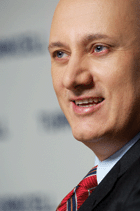 |
| Turkcell’s chief executive, Süreyya Ciliv |
“The problem between the main shareholders is likely to be over soon,” says Erdem Hafizoglu, an equity analyst at interdealer-broker BGC Partners in Istanbul, who has a buy recommendation on Turkcell stock. “Following the UK court ruling and the CMB action, the company is now closer to resolving the shareholder dispute.” The back-story is that in 2005 Karamehmet’s Cukurova, which was then under pressure to raise cash, agreed to sell part of its stake in Turkcell to Sonera, which is now part of TeliaSonera. However, Cukurova then decided against selling and instead raised over $1 billion in cash via a loan from Alfa, pledging shares in Cukurova Telekom Holding, which controls Turkcell, as collateral. As a result, TeliaSonera claimed Cukurova had reneged on a sale of shares. Alfa then said Cukurova was in default on the loan and moved to seize the shares pledged as collateral.
Although TeliaSonera holds the biggest stake in Turkcell, with 37%, the complex ownership structure means that a smaller 13.8% of shares gives control of the company. In January the UK Privy Council ruled that Cukurova could regain control of the 13.8% stake from Alfa, which it said had “legally” seized the shares pledged as collateral, but only if Cukurova repays the loan plus accrued interest to Alfa. The Privy Council has yet to announce the precise amount that Cukurova has to repay.
On the back of this ruling and the CMB’s intervention, however, there is a new optimism around Turkcell’s future. But on being asked if the long-running battle could be nearing a conclusion, Turkcell’s chief executive, Süreyya Ciliv, understandably cannot offer much assurance either way.
“We cannot make any comments regarding shareholder issues at this time,” he tells Euromoney. “But we can say that we are continuing to focus on our operations to deliver maximum value for our shareholders.”
Turkcell’s management team is doing a pretty good job of delivering that. By many measures, the company is thriving. It is Turkey’s largest mobile operator, serving over 35 million subscribers there and another 30 million-plus through subsidiaries and minority stakes in other countries in the region.
Furthermore, based on its 2012 full-year numbers, it can boast annual revenues of TL10 billion-plus ($5.5 billion), ebitda of TL3 billion-plus – with a healthy ebitda margin of about 31% – and net income of over TL2 billion, up 76.5% on 2011. Its market capitalization – the company is listed in New York and Istanbul – stands at $13.26 billion, and all these numbers are expected to continue to grow further, says Ciliv.
“In 2012, we grew our voice revenues by 6%, broadband revenues by 44% and subsidiaries’ revenues by 33%. Particularly in the last quarter of the year, we have generated our highest historical quarterly revenue on 15% growth in revenues and 22% growth in ebitda year on year. These figures also rank us as the highest-growth company among those operators to have announced their year-end results thus far in Europe,” he says.
“We expect to continue growing our business, with the sustained contribution of our voice and mobile broadband businesses and our subsidiaries,” says Ciliv. “In 2013, we will continue investment in our mobile and fibre networks. We expect group revenues in the range of TL11.2 billion to TL11.4 billion, and ebitda in the range of TL3.3 billion to TL3.5 billion. The group’s operational capex-to-sales ratio is expected at around 15%, similar to that of 2012.”
Reading these numbers does raise the question of what the company could achieve with a united and harmonious board.
In the meantime, growth could be achieved through joint ventures and acquisitions in neighbouring countries and farther afield, which is a strategy Turkcell has been actively looking at.
For example, Turkcell in April revived its interest in Bulgarian mobile operator Cosmote Bulgaria Mobile EAD, known as Globul, which is owned by Hellenic Telecommunications Organization.
“Turkcell has provided a nonbinding indicative offer for a 100% stake in Globul,” confirms Ciliv. The perennial stumbling block, however, is trying to obtain approval from the board. “There have been no board decisions regarding the matter,” he says.
Ciliv says that Turkcell will continue to look at investment opportunities in the Balkans, Middle East and North Africa region and across industry sectors that include mobile and fixed-line telecommunications and services, convergence technologies and wireless service providers or mobile virtual network operators.
“We may continue to participate in additional public tenders for new licences or the privatization of public telecom companies as in private-sale transactions,” he adds.
There are also investment opportunities in Turkey, such as the potential purchase of the national lottery should its privatization be revived, and in western Europe where the company can serve the local Turkish population. In Germany, for example, Turkcell has signed a five-year wholesale traffic purchase agreement with Deutsche Telekom to provide 3G mobile technology to Germany’s 3.5 million Turks.
“We may replicate this business model in the future for other European countries with Turkish populations,” says Ciliv.
Largely driving this need for regional expansion is intense competition in its home market from its two main competitors, Vodafone Group and Türk Telekom’s Avea. It is one challenge Ciliv is both keenly aware of and fiercely critical about.
“Competition in the Turkish mobile market remains quite aggressive,” he says.”Our competitors’ focus on subscriber market share, rather than profitability, has resulted in an overall profitability decline in the market. Therefore, we clearly need to see more rational play in our sector.”
While trying to ensure healthy and fair competition, the Turkish authorities are responding to such calls, but it is partly their response in recent regulatory changes that could have an adverse impact on revenue and profit generation in the sector.
The shifting regulatory framework and its potential impact on Turkcell is one of the reasons why investors aren’t piling into the company’s stock, even if it is still generating solid earnings.
In the first quarter of the year, Turkcell Group net income rose 10% year on year to TL566 million, driven by a 13% rise in group revenues to TL2.7 billion. The bulk of this came from Turkcell Turkey revenues of TL2.2 billion – up 11% on the same period the year before.
“The regulator recently imposed minimum retail SMS prices on Turkcell, while cutting the SMS MTR [mobile termination rates],” says Dalibor Vavruska, an analyst at Citigroup. “While the regulator agreed to Turkcell’s suggestion and altered the minimum SMS price, no such decision has yet been made on minimum voice pricing or possible changes on voice MTR. We understand that negotiations are ongoing between Turkcell and the regulator, which may have material impact on Turkcell’s business.”
The other reason investors remain hesitant about buying Turkcell is simply corporate governance risk, according to Vavruska.
“The delays of the London Privy Council’s decision, which would ultimately determine control in Turkcell, together with the Turkish government’s significantly increased influence in the company, in our view expose corporate governance risks ahead of the scheduled May 22 annual general assembly,” says Vavruska. “The market is likely to focus on dividends, but we think that it is equally if not more important to focus on the future controlling entities and their incentives.”
Turkcell shareholders could be forgiven for being preoccupied with the prospect of receiving more than TL3 billion in dividends owed. But they should not lose sight of the strong operational and financial performance the company has delivered despite the battle at the top.


