 |
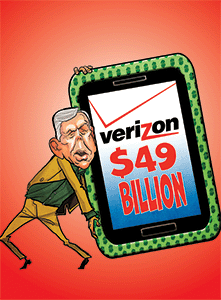
Six months is now a very long time in the bond markets. “If you had said to someone in the midst of the May and June sell-off that within a couple of months there would be a deal that would attract $100 billion of orders and tighten 60bp in the first two to three days of trading, they would have raised their eyebrows,” says Jamie Stuttard, head of international bond portfolio management at Fidelity Investments. But there was such a deal: the $49 billion, eight-tranche bond take-out that backs Verizon’s purchase of Vodafone’s 45% stake in Verizon Wireless. It’s the deal that not only created records, but seemingly left everybody happy. Verizon’s executives deserve plaudits for one of the great risk management exercises of all time. Banks involved in the deal have their share of both a landmark deal and an enormous pool of fees – profits that were likely swelled with the sharp rise in the price of the Verizon bonds after the deal broke.
Even bankers not on the deal talk of it in glowing terms, not least because it opens the eyes of other corporate issuers to what is now achievable in the bond markets. And investors who received their allocations are probably the happiest of all. They are sitting on highly liquid bonds and an immediate profit – with one telling Euromoney it was the type of payday they were unlikely to see again in a long time.
But perhaps Verizon’s shareholders are the ones that, in time, might look back and think they lost out. For this was not only a deal that broke records, it also went against a lot of the norms of the bond market. In some ways, the book was built more like an equity deal, with a handful of investors taking huge chunks of the bonds on offer. And size and tenor proved much more important to the issuer than price.
The extraordinary way in which the deal tightened after launch suggests that the bonds might have been priced as much as $2 billion too cheap. The question for Verizon’s management, and its shareholders, is simple: was this a price worth paying to de-risk one of the largest M&A deals of all time?
Although this landmark M&A deal has been 10 years in the making, its huge cash component gave the bond take-out a sense of urgency. Verizon is paying $130 billion for the stake: $58.9 billion in cash, $60 billion in stock and $5 billion in notes payable to Vodafone. It is also selling its 23% stake in Vodafone Omnitel to Vodafone.
Given the enormous sums involved, it is easy to forget that the debt component of the deal was structured to limit its impact on the company to just a one-notch rating downgrade from A3 to Baa1. Indeed, despite funding the second-largest M&A deal on record, Verizon believes it can get back to an A3 rating within four to five years.
 |
| Verizon chairman and CEO Lowell McAdam |
“The financial structure of the deal was very important to us,” said Verizon chairman and CEO Lowell McAdam shortly after the bond deal had closed. “Fran [Shammo, Verizon’s CFO] and I spent a lot of time with the rating agencies to understand what sort of impact the financing would have on us, and we only wanted to take a one-notch downgrade. So when you looked at that it really dictated the structure of the deal between the debt and equity.” The cash component of the deal was initially funded via a $61 billion 364-day bridge loan, the cost of which stepped up 25 basis points a quarter if drawn. This explains the urgency of getting the bond take-out done. Part of the bridge – $12 billion – was to be taken out in the loan market and the $49 billion balance bridged to the bond markets. The size of this endeavour was unprecedented – as was the scale of the fallout for the deal’s four lead managers (who had underwritten the bridge loan between them) were things to go wrong. They had put up an enormous amount of their own money, but felt that conditions in the market were such that the deal could get done. “Confidence in the bond market enabled us to arrange the largest bridge in history and make the largest commitment by a single firm ever in a completed bridge,” says Dan Simkowitz, co-head of global capital markets at Morgan Stanley. The bridge loan was underwritten by JPMorgan, Morgan Stanley, Barclays and Bank of America Merrill Lynch equally.
With speed being of the essence, the question was how much of the bridge the bond markets could take in one go. “During the spring and summer we had a view that this could be very large,” Simkowitz continues. “This led to our unprecedented bridge facility that gave Verizon comfort as they negotiated the transaction and confidence that there was low risk to the permanent financing and of getting hung on the bridge.” That confidence did not initially get anywhere close to taking the whole lot down in one go though. “I would be very surprised if you spoke to anyone who had felt that this would be the reaction prior to the deal,” admits a banker close to the deal.
This was despite extensive market sounding throughout the summer. “We did an enormous amount of work looking at what the capacity of the markets was for this trade and how much banks would be able to take onto their balance sheets,” Claire O’Connor, head of Americas loan capital markets at Barclays in New York, who led the Barclays team that worked on the bridge loan, tells Euromoney.
The consensus seems to have been for an initial takeout in the range of high $20 billion to $30 billion. “BAML and the other banks worked on this for a very long time,” says Keith Harman, head of media and telecom debt capital markets at Bank of America Merrill Lynch. “We looked at the US dollar, euro and sterling markets and did a detailed bottom-up assessment of every major investor. We were confident that the bridge was going to be able to be taken out and we were confident of something in the $30 billion range for US dollar alone – that had been the ball park for months before the deal.”
The initial plan was to go to the dollar market for this first, then tap euros and sterling and return to the dollar market early next year for whatever balance was left. Verizon has no need for non-dollar currencies, but did not want to swamp the dollar market straight off the bat.
The elephant in the room during deal negotiations was the Federal Open Market Committee meeting on September 18 at which seemingly everyone involved in the financial markets (and many members of the FOMC itself) expected a reduction in the level of quantitative easing to be announced. Given how the markets had reacted to the mere suggestion of such a thing in May, there was an added and very understandable desire to complete the bond take-out ahead of any interest rate rise.
Although negotiations had been under way since the beginning of the year, the deal therefore found itself in the eye of the debt market storm that followed Fed chair Ben Bernanke’s tapering comments in May. Having put the bridge loan in place, Verizon had no choice but to come to the bond markets at the very point at which everyone was treating a rise in short-term interest rates as all but inevitable. “When we went out in the markets we were a little concerned because obviously there were a lot of uncertainties out there,” said McAdam. “Every time chairman Bernanke says something, the markets move and Syria obviously makes the market move, and whether we are going to be funding the government or not makes the market move.”
The sheer scale of the fundraising required, together with the nervous volatility among bond investors over tapering, meant that there was enormous pressure on the underwriters to make sure that the bond issue was rock solid. “From the company’s perspective, if you are undergoing a transformational acquisition the bond issue simply has to get done,” says Stuttard at Fidelity.
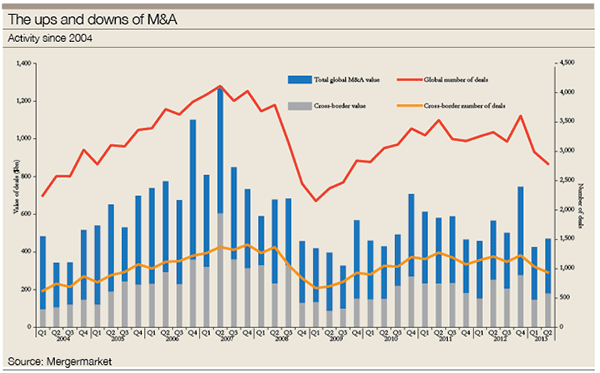
Doubly so for this deal. “Verizon was a very special case,” says Ben Edwards, portfolio manager at BlackRock. “The market had become very concerned beforehand: there were so many bonds on offer that there was huge apprehension as to whether a deal of that size could be taken down. The TMT sector is where M&A risk has priced – LBOs, mergers and releveraging are all anticipated. The entire media sector had repriced roughly one month before the deal in anticipation of it.”
 |
Any company that has taken out an expensive bridge to the bond markets wants to get the refinancing done in one go. But it is quite clear that no one involved in this deal really thought that a one-shot bond deal would be on the cards. “There wasn’t an expectation that it would be as big as it was,” admits one banker involved in the deal. “But there were enough people that had thought that $35 billion to $40 billion was possible that it wasn’t like we did not have any sort of game plan when it became obvious that demand was huge.” This throws up several key questions: why did the exhaustive market sounding prior to this very well-flagged transaction underestimate demand to such an extent? And did the unique combination of extraordinary size, pressure to de-risk and bond market uncertainty push a corporate in the midst of a long-coveted purchase simply to pay too much?
The bonds came in eight tranches. There were two floating-rate tranches: $2.25 billion three-year notes paid 153bp over Libor and $1.75 billion five-year notes paid 175bp over Libor. The company then offered 2.5% for $4.25 billion of fixed-rate paper; 3.65% for $4.75 billion of five-year notes; 4.5% on $4 billion of seven-year bonds; 5.15% for $11 billion of 10-year paper and 6.4% for $6 billion of 20-year bonds. A $15 billion 30-year tranche paid 6.55%.
There is no doubt that this was generous: the average yield on 10-year investment-grade debt is 3.5%. The 5.15% on offer on the 10-year tranche compares with 4.62% on Verizon’s existing outstanding 10-year bonds – a big new-issue concession of 55bp. The 10-year and 30-year spreads equate to 225bp and 265bp over treasuries respectively whereas the firm’s outstanding 10-year and 30-year paper was priced at 157bp and 175bp over treasuries at launch. “When you bring a deal like this you need a very healthy NIP [new-issue premium],” says Stuttard. “We had seen GM back in 2003 and Petrobras and Apple this year, but this was on a completely different scale. The NIP was around 30% over the overall secondary market spread, which is very unusual and it shouldn’t be any surprise that people piled into it.”
Why was the new-issue premium so high? “The company was very focused on de-risking. It already had substantial debt outstanding and was one of the largest issuers in the corporate bond index,” says O’Connor at Barclays. “Verizon had been very explicit that it wanted to get as much size and tenor as possible.” Indeed, before the bond sale Verizon already had $47 billion of debt outstanding – a figure that it was now looking to double (as at September 30 total debt outstanding at the firm stood at $98.5 billion). That in itself is a huge ask. It also wanted as many dollars as possible. Faced with this situation it knew that it needed every investor it could get – at whatever that would cost – and pricing became a tertiary concern. “Verizon’s intent was to reduce the bridge and eliminate market risk,” says Jim Probert, head of Americas investment grade capital markets at BAML. “That was a very important objective.”
 |
| Claire O’Connor, head of Americas loan capital markets at Barclays |
In addition to needing to attract every dollar it could, the potential for market volatility had the Fed announced a tapering of stimulus after September 18 was a very real concern. “The risk to the company was that it didn’t know what the Fed was going to do. If the FOMC meeting had had a different outcome and rates had spiked, then things might look very different,” says O’Connor. The bonds therefore had to offer a sufficient yield to give investors comfort that a near-term interest rate rise would not be a problem. “The large offering enabled the company to eliminate all the interest rate and currency risk that would have occurred in a staged offering,” says Simkowitz. “The single offering enabled them to avoid speculating on the interest rate market.”
The lead managers were well aware that they were presenting a bargain, but perhaps not quite expecting the investor reaction to it. When the transaction was launched and the price talk was wide of what was expected, investors were still being told not to pad their orders as they could get fully allocated. “There was huge demand for cheap paper,” says Edwards. “This was immediately 7% cheap to the market at the 30-year point and 12% to 13% cheap to the market in the long run, which is a huge discount.”
As the transaction got under way, however, it became clear that getting fully allocated was something that most investors could only dream of. “Over the course of the second day [Tuesday, September 10] momentum was clearly building and the company sensed that it might be able to do it all,” says Joe Valenti, managing director, global technology, media and telecommunications group, at Barclays. “It was very clear they were going to place a premium on size versus price and the market began to understand that the deal was not going to move from price guidance.”
Investors must have been unable to believe their luck: Verizon was going to shoot for the moon in dollars and buyers were not going to get squeezed on the price. “I happened to be in London meeting with investors as we were pricing this,” McAdam recalled. “We were hoping to get to the $30 billion kind of range for debt. As the demand built we were pleasantly surprised and made the decision there. I know it concerned some of the investors in Europe, but we were able to take it all out in one swoop and do it all in US dollars, which made things very attractive for us.”
This is where the scrambling really started. Once investors realized that this was it, the eyewateringly cheap pricing together with the credit quality of the company and its index weighting meant that this became a must-have deal. “On Tuesday afternoon we hit an inflection point where everyone realized this was going to be a one-off opportunity,” says Valenti. Verizon obviously wasn’t coming back to the market again, and bidding behaviour among investors became increasingly aggressive. Key accounts that had started out at one number simply kept increasing their orders. “Almost every investor got approval to go above their allocation on this,” reckons one buyer.
“The deal took on a life of its own,” says Harman at BAML. “Investors realized that if they weren’t increasing their orders as the deal grew they were effectively short the bonds. This was unusual. You would have thought that the index players would have been tapped out at some point, but they weren’t – they kept going.”
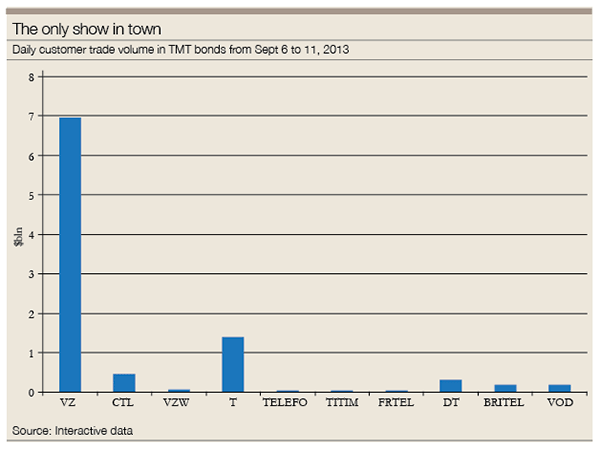
Analysis prepared for Euromoney by Interactive Data shows a net trading exodus from existing Verizon bonds between September 6 and September 11 of $600 million. “Our analysis over the days leading up to the Verizon bond issue revealed people were selling old Verizon issues to make way for this beforehand, but they were also adding AT&T,” says David Varano, EVS portfolio analyst at Interactive Data. There were net trading inflows into AT&T of nearly $150 million. “The new-issue premium on offer here was possibly denting the price for a peer.”
 |
The protracted offering process lasted from the late afternoon of Monday September 9 to Wednesday September 11. “As we watched we were surprised by how orderly and systematic it was,” recalls Harman. “The process felt like we were pricing a smaller deal, not a $49 billion one. The four active bookrunners put enormous staffing into this. It was extraordinarily orderly – almost uneventful.” There were an awful lot of bonds to sell, but the lead managers had a pretty clear run. “There wasn’t a lot else in the market – no one was going to get in the way of this trade – so we had everyone on the desk focusing on it,” Valenti agrees. The four lead underwriters underwrote equal shares of 62.8% of the deal, earning estimated fees of $41.65 million apiece. Seven second-tier underwriters (Citi, Credit Suisse, Mizuho Financial, Mitsubishi UFJ, RBC, RBS and Wells Fargo) underwrote 33.6% of the bonds and would be expected to take $12.7 million in fees each for this, with Deutsche Bank and Banco Santander bringing up the rear, underwriting 1.8% of the deal, which would probably earn them $4.8 million each. By the time the deal closed on the afternoon of Wednesday it had attracted over $100 billion of orders – a staggering sum. “We called in every favour we possibly could in order to get the biggest possible allocation on this – it was a payday that you won’t see again for a very long time,” one investor tells Euromoney. That is for sure: the Verizon bonds traded between 40bp and 70bp tighter on the break – which translates into a $2 billion gain for those investors fortunate enough to get their hands on them. The 30-year tranche traded up from 99.88c to 106c within 24 hours, with the 10-year bonds reaching 102.74c. Indeed, according to MarketAxess, the 10- and 30-year tranches accounted for roughly 17% of all investment-grade corporate bond trading the day after the deal was done.
“We locked in between seven and nine points on the long-dated tranche, which was very nice, but we didn’t get our full allocation,” says a US buyer. “This deal left a lot of room for investors to make money.”
Although the final book ended up with 1,000 discrete accounts, the skew towards large asset managers is quite striking. Some 27% of the order book went to just two buyers – Pimco and BlackRock. That is $13 billion, of which $8 billion is understood to have gone to Pimco and $5 billion to BlackRock. Indeed, roughly half of the $49 billion deal is believed to have gone to just 10 firms.
 |
| Dan Simkowitz, co-head of global capital markets at Morgan Stanley |
Once the dust had cleared it became apparent that something quite extraordinary had happened. “The reality of what Verizon and the underwriters accomplished didn’t really set in until a couple of days later,” says Harman. Simkowitz at Morgan Stanley tells Euromoney that it took a lot of people by surprise. “There were a few of us early on that thought that a very large number was possible, but to see it in action was quite remarkable. It took a lot of market participants by surprise in terms of the quantum that was possible.” Barring something truly unexpected, the Verizon bond deal will be the story of the corporate bond market this year. Year-end league table rankings will be determined by the extent to which institutions were involved in just this one deal. But the price to the client was high – even before the Fed decided to leave QE unchanged on September 18 and the bond markets subsequently rallied. Hindsight is a wonderful thing and the markets quickly forget the extent to which rising rates were deemed a fait accompli in early September. But has this monster of a deal revealed the extent to which, with so much at stake, it was simply too big to price?
There are many, many reasons why it made sense for Verizon. Despite the enormous new-issue concession it has reduced its weighted average cost of capital (WACC) from 210bp to 197bp while at the same time extending its weighted average tenor from 12 years to 18 years. It took substantial execution risk off the table and avoided commitment fees on the bridge loan. By securing all-dollar execution it also avoided swap costs from euro and sterling tranches. “Verizon understood that interest rates were at a historical low and that this was a moment that they could take advantage of,” says Harman.
US borrowers have been pretty tolerant of pricing in this environment, as their borrowing is fixed rate. This gave the company the luxury of offering no movement on the very generous price guidance in order to guarantee take-up, while at the same time cutting its WACC. “Management transparency meant that the deal was very well telegraphed,” says Valenti. “Had there been the usual dynamic around tightening price it would have been a very different outcome.”
But the fact that over $100 billion had been allocated raises the question of why no movement in price was considered. The purpose of a bookbuild is to squeeze people down, but in this case it seems that the overwhelming desire not to jeopardize the full $49 billion take-out trumped all other considerations – even if it meant paying much more than investors were expecting. Unsurprisingly, the underwriters defend this stance. “Did they leave money on the table? The answer is no,” says Valenti. “At the end of the day we all use insurance to mitigate risk, and that is exactly what Verizon did.”
The issue was highly skewed towards the long end, with $32 billion of bonds carrying a maturity of 10 years or more. With $15 billion of 30-year bonds to sell, the company must have been very sensitive to the recent experience of investors that bought the 30-year tranche of Apple’s April issue. Thanks to the market’s ‘taper tantrum’ over the summer these bonds had lost 17% since launch by September. The need to offer comfort to buyers of the long-dated bonds over the prospect of rate rises must have played a large part in determining the level at which the bonds came.
“It is easy to say in retrospect that they could have paid less,” one banker argues. “There were a lot of investors in the deal and you don’t always know whether they will stay in at a lower price. You need to be careful – if investors had thought that price was the primary objective, would the order book have been as large?”
 |
| Ben Edwards, portfolio manager at BlackRock |
Maybe not – but it would probably have been large enough. “Every investor that bought this deal would have bought it at a more expensive level,” says Edwards at BlackRock. “The reason that every investment-grade investor wanted it was not just because it was cheap but because it ticked a lot of boxes. It had virtually no execution risk and the sheer size of it means that Verizon is now no longer an acquirer or a target, which removes M&A risk from the name.” Verizon also wants to get back to an A-/A3 rating, so the bonds have an upwards credit trajectory, which is very attractive to investors. “They could have done it at a much better level for the company, but until they actually went out with the bonds there was huge apprehension about whether it could get done,” Edwards says. The allocations to large investors are staggering not only in terms of the actual number of bonds involved but also as a percentage of the deal. Would they really have dropped out if the price were 20bp tighter? “The initial price guidance will have been established at the point at which the two or three large, key investors care,” says one buyer who was allocated bonds. “When you have $49 billion of bonds to sell, you need the very large buyers to be there, and if that is what they want to pay, that is where the price is. On a deal like this you don’t want to get caught speeding with an investor that you care about.”
You also need to be sure that the bonds are in the right hands. There was no way of knowing how a $15 billion, 30-year tranche will trade in the aftermarket because a tranche this size had simply never been done before. “With a transaction of this size and with the situation where it was, there was huge focus on volume,” says a banker at one lead manager. “When there are large investors that are capable of putting in large orders that are good, sticky money, we will allocate to that. It is a very easy conversation to have if you are talking to a hedge fund about $250 million to $500 million that you know they are going to flip immediately.”
It is very difficult to talk about the Verizon bond deal in terms of expected market behaviour simply because it is so mind-bogglingly big. Pimco and BlackRock alone had taken down the equivalent of 76% of the largest bond deal ever done before this one (Apple). It is hardly surprising that the issuer was prepared to be so generous when it had a $61 billion bridge loan time bomb ticking away in the background. “The size of this offer means that it would have been difficult to price even in normal markets,” says Varano at Interactive Data. “This was a huge rush by a borrower to lock in rates.”
But the deal is a stark lesson in how the impact of central bank-driven distortions in the market is amplified when deals reach such an enormous size. Apple was able to issue $17 billion at historically low spreads for a double-A plus name in May, helped by 10-year treasuries at sub-2%. Verizon has now issued more than double that at unexpectedly wide spreads for a Baa1 credit with treasuries approaching 3%. This see-sawing has taken place over the course of less than six months.
Bond investors will pay up for liquidity, and in this brave new world of bond market illiquidity tranches on this scale from a solid investment-grade credit should have been cheaper for the issuer to sell, not more expensive. The level was so hard to read because of both the necessity for the issuer to get as much out of the door as quickly as possible and the taper-driven disquiet in the bond market at the time.
Verizon seems very happy with the outcome – as are its bondholders – so does it matter if money was left on the table? “Maybe Verizon came 20bp too wide, but in the long-term scheme of things it doesn’t matter,” says the head of DCM at an underwriting bank not involved in the deal. “They got it done and it is in the right hands.”
But while this was a once in a lifetime deal for every investor involved it was probably a once in a lifetime deal for Verizon too. And 20bp multiplied by $49 billion is a lot of money. “We were very surprised at the pricing,” admits a large US buyer. “They did not need to offer that level of new-issue concession. It was just such a big deal and they just wanted to get it done. It gave credit investors a much-needed win, but the issuer overpaid. But I reckon they looked at it and said that if investors get a couple of extra points, so be it.”