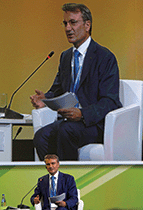
On its own, the Russian market, already the region’s biggest, has become even more important to regional banks’ profitability. And Sberbank is more profitable than ever before in its domestic market, where its market share of deposits is still more than 40% and its annual profits more than $10 billion. Russia was crucial for Raiffeisen, last year’s winner of the regional best bank award, in posting slightly higher regional profit. Despite large market shares elsewhere, Russia made up almost two-thirds of Raiffeisen’s regional profit. Yet there are worries about the sustainability of the profit increases Raiffeisen has posted in Russia. The shock resignation this year of Raiffeisen’s CEO for the region, Herbert Stepic, was unfortunate, as was the arrest of the head of Société Générale’s Russian unit, just as it was turning profitable. But uncertainty, for example over Raiffeisen’s strategy to raise new capital, was becoming increasingly urgent. By contrast, Sberbank’s $5.2 billion part-privatization and secondary offering in London and Moscow in September – its first international listing – was a vote of confidence. Overall, German Gref, since he became CEO in 2007, has brought Sberbank’s staff, technology and service to clients into the modern world. Expansion into investment banking has in part marked the shift. But most important to this award is that Sberbank has acted to mitigate the obvious limits to its growth within Russia, by growing cautiously on a regional level: most notably in the region’s second-biggest market, Turkey. Investors have looked particularly favourably on this year’s acquisition of DenizBank, which gives Sberbank a top-five bank in Turkey. Sberbank has a platform to develop in a further eight central and southeastern European countries, thanks to its Volksbank acquisition, also completed this year. Mark Arnold, formerly head of GE Money in Hungary, was hired in February to ensure Sberbank makes good use of the former Volksbank network. After buying a small Kazakh bank in 2007, Sberbank is also one of Kazakhstan’s biggest banks, as other local lenders have deleveraged. Sberbank’s position in Kazakhstan is repeated in smaller markets in the former Soviet Union. Such growth contrasts with the position of UniCredit, for example, which sold its Kazakh bank this year, at a large loss. UniCredit also sold down to just over a majority holding in Bank Pekao, Poland’s second-biggest bank, this year. UniCredit has said it will reinvest the capital within the region, but the sales are hardly a statement of commitment. UniCredit also has large market shares in Russia and Turkey (among other regional markets). Yet its CEE presence might be to a large degree dependent on the financial health of the Italian government. There are still signs of hope for western European banks in central and eastern Europe. Take the success of Raiffeisen’s Romanian unit, which wins the award in that country this year. It shows the game is not over. But the tide has turned – and for better or worse, this award turns with it. That is the story in commercial banking at least. In investment banking, even if VTB Capital and Sberbank both now gain a big share in Russia alone, western banks can still claim regional pre-eminence. It is a US bank, Citi, which wins the award for best investment bank in the region. The contest in investment banking – which house can boast leading positions, across products and geographies – is still largely between Citi and last year’s winner, Deutsche Bank. Goldman Sachs is also a competitor, particularly in M&A, but much less so in debt. In M&A, with $79.8 billion of league table credit, Deutsche Bank has a persuasive argument over Citi, both in volumes and the number of deals on which it advised (such as the Sberbank-DenizBank deal). However, this is not the case in the other two key investment banking categories, debt and equity. In debt, Citi and Deutsche had roughly equal market shares by pure volume (Deutsche Bank had very slightly more). But Citi was bookrunner on roughly 50% more by number of deals and was also involved in a higher proportion of the most interesting and important ones. For example in Turkey, Citi was instrumental on the first-ever Eurolira issue, launched by Akbank in January, as well as on the Eurorouble deal for sub-investment-grade Vimpelcom (which showed just how far the local-currency Eurobond market could go in central and eastern Europe). Citi was also bookrunner on the Nomos Bank subordinated bond, paving the way for the flurry of Russian sub-debt deals, and the even more trailblazing VTB perpetual bond, as well as the first-ever RegS transaction for Hungarian energy firm MOL (for which Citi helped source crucial Polish buyers). Citi’s lead over Deutsche and Goldman is strongest in equity, where the business in Poland stood out (perhaps largely thanks to the depth of its wider local banking presence there). Citi is top of the league table in equity regionally, with deals extending also to Russia, Turkey and Hungary. Citi acted on the $1.9 billion IPO of Russian telecoms firm Megafon (which despite initial doubts was, by the spring, trading some 40% above its issue price). It was bookrunner on three Polish bank rights issues, the IPO of Polish property firm PHN, and on Halkbank’s $2.5 billion follow-on, Turkey’s largest-ever public equity sale. Finally, in M&A, Citi was also prominent, advising Russian state-owned oil and gas firm Rosneft on its takeover of rival TNK BP – by far the biggest deal of the year. Citi advised Santander on its takeover of the Polish unit of KBC (perhaps the key Polish deal) as well as some of the most important deals in Turkey. In debt capital markets, a rising tide of bond market activity in CEE lifted all the main DCM players last year, as in other regions. But none of the global banks came close to matching the record of JPMorgan, which takes the best debt house award. Ranked at number four in the Dealogic league table for the previous awards period, excluding the Russian state-owned banks, JPMorgan moved up to take the top spot this time, acting on a total of 73 deals and notching up nearly a third more business by volume ($16.4 billion) than Deutsche Bank. Key to this was a strong performance in Russia, where it had $7.3 billion in deal volume from 36 transactions. It also had impressive geographical diversification, acting on all three of the year’s deals from Georgia plus issues from jurisdictions as diverse as Croatia, Czech Republic, Kazakhstan, Slovenia and Ukraine. A slightly weaker showing in the Turkish markets, where JPMorgan was ranked number six, was compensated for by a presence on two out of three corporate debut deals from Turkey: Anadolu Efes’ $500 million 10-year in October (winner of Euromoney’s deal of the year award) and a matching issue from Arcelik. Other notable deals included inaugural transactions for Russian corporates NLMK and Sibur, the Akbank Eurolira deal and Sberbank’s $2 billion tier 2 blow-out in October. Chunky dollar deals for corporate issuers including Rosneft and Gazprom, as well as the Ukrainian and Slovenian sovereigns, also helped.
One of only four international banks to act on Sberbank’s market-reopening $5.2 billion secondary offering in September (also a Euromoney deal of the year), the Swiss house was also instrumental in introducing Russian names Megafon and Moscow Exchange to the equity markets in November and February respectively. Credit Suisse also put in a strong showing in Poland’s equity markets, acting on the $216 million IPO of power firm ZE PAK as well as record-setting secondary offerings for state-owned bank PKO BP ($1.68 billion) and private-sector rival BZ WBK ($1.5 billion). A mandate for the $526 million listing of Kazakh telecom Kcell also spoke to the strength of Credit Suisse’s regional franchise, which includes an unrivalled equities distribution platform. In M&A, not only did Rothschild, as an advisory-only house, act on a total of 21 completed transactions in the region during the awards period, it also grew its market share to an impressive 19.8%. That is an increase of 10.8 percentage points on the score for the previous 12 months. Particularly impressive was Rothschild’s role as adviser to Sberbank in its DenizBank takeover, the largest deal out of Turkey in the awards period and the fourth largest in the wider CEE region. In the energy sector, Rothschild was involved on the sell side in Rosneft’s takeover of TNK BP. In Poland, Rothschild acted as adviser to chemical firm Zaklady Azotowe Pulawy on an unsolicited offer from Synthos and a subsequent €1.3 billion merger with Azoty Tarnow. It was also adviser on one of the year’s big Polish financial-sector M&A deals: Raiffeisen’s takeover of Polbank. Rothschild is able to make use of advisers on the ground in Athens, Istanbul, Moscow and Warsaw, as well as representatives and local partnerships in another five CEE capitals – with further deals this year covering such countries as Albania, Czech Republic, Serbia and Ukraine. Risk advisory remained a key part of the CEE offering at Deutsche Bank. It proved to be a big revenue generator as the increasing sophistication of regional corporates and financials played to the German house’s traditional strengths. In the awards period, Deutsche helped CEE coal producers reduce inventory and fix forward prices in response to a slump in demand for coal, and used strips of knock-out call options and put-spread options to give an eastern European airline an affordable hedge against potential fuel price rises. Notable achievements in the FIG sector included reducing the cost of a dollar-to-forint swap for a Hungarian financial institution via an extinguishing currency swap that was credit linked to the Hungarian sovereign and the introduction of similar structures in Turkey to help the country’s banks cut their financing costs and returns on their short-term instruments by embedding credit default swaps in financing and investment products. A year of impressive innovation and growth also earned Deutsche Bank the award for best flow house. The bank retains large sales and trading teams on the ground across the main CEE markets, enabling it to execute more trades in more jurisdictions than competitors. In foreign exchange, Deutsche Bank retained the top spot by overall market share for CEE in Euromoney’s foreign exchange survey for 2013 and regained its number-one ranking in the qualitative rankings for regional currencies. Notable trades included a $1.5 billion-equivalent Hungarian forint cross-currency swap, while even in the less liquid markets of last summer the bank regularly executed large tickets at spreads substantially tighter than those available from competitors. Product innovation has always been key to Deutsche Bank’s flow strength. This year, the bank pioneered new structured investment products such as Turkish warrants and zloty-linked notes, and it was also a first mover in instruments including Russian OIS Fix based interest rate swaps, credit-contingent repos in Turkey, and vanilla repos in Romania.
Best Project Finance House UniCredit continued to show the highest degree of geographical diversification of any CEE-focused project finance house, providing project finance loans in a total of seven countries including Poland, Turkey, and Russia, as well as such markets as Bulgaria and Romania. The Italian group acted on a total of 18 transactions, giving an allocated volume of $1.7 billion and a market share of 11.3%, compared with just $797 million from six transactions for its closest private-sector rival, according to Dealogic’s league table. Key deals included the largest-ever project finance transaction in Slovakia and the Czech Republic (a €2.7 billion gas project) – and a $2.8 billion road public-private partnership project in Turkey, as well as a $1 billion pre-export facility for Kazakh copper producer Kazakhmys. The momentum in CEE cash management remained with UniCredit. It increased revenues from the segment by 13% in 2012 and knocked market leader Citi off the top spot in Euromoney’s cash management survey of non-financial corporates for the first time. With banking subsidiaries in 19 jurisdictions across central Europe, the Balkans, Russia and the CIS, UniCredit is able to deliver an unrivalled range of local services, while close cooperation between its regional network and central FX and markets divisions makes for better cross-border activity. Key strengths include cash pooling, where UniCredit has established itself as a first mover in markets from the Baltic states to the Czech Republic, and cards acquiring. A strategic decision to focus on the latter has paid dividends in the form of nearly 20% growth in the segment in 2012, thanks to the growth of internet shopping, and given it market-leader status in corporate cards acquiring. Overall, UniCredit introduced more than 50 payment and collection products throughout the network last year, and the pace of innovation at the bank in cash management in central and eastern Europe looks likely to be maintained through 2013. |