Just over a year ago, Aviva Investors and a small Switzerland-based investment advisory firm called Hadrian’s Wall Capital announced the first close on an innovative new fund that, it was hoped, could help unlock the potential of Europe’s nascent project finance bond market.
The fund, called the Aviva Investors Hadrian Capital Fund 1 because it was a strategic partnership with the global asset manager, was to invest in long-dated senior infrastructure debt and ultimately provide an alternative to the monoline insurance that was once so important for project bonds.
Before the 2008 financial crisis, monoline guarantees (wraps) were a critical part of the project bond market because the credit enhancement they offered elevated the ratings of the bonds to triple A, enabling institutional investors to get comfortable taking on greenfield construction risk.
Today the monoline industry is a shadow of its former self, having all but collapsed during the financial crisis. But this in turn gave rise to the alternative Aviva Investors and Hadrian’s Wall Capital devised to create an investment fund that could perform a similar private-sector credit enhancement role.
At its simplest, their innovative solution involved splitting the investment-grade rated senior debt issued by a borrowing company into two tranches. The first tranche would be bought by the fund as a subordinated bond while the second tranche, which receives credit enhancement as a result of the fund’s investment, would be placed as senior bonds on the capital markets.
However, as good as the idea was, some 13 months after the fund’s first close was announced it has hit the wall, and the committed capital is now being returned to anchor investors Aviva Life & Pensions, the European Investment Bank and Development Bank of Japan.
So what went wrong? “The decision… is a result of a combination of factors, including the challenges of executing the innovative funding approach of this fund against the background of a weak pipeline of suitable investment opportunities,” explains a spokesperson for the fund.
Its failure is more of a disappointment than a massive setback for Europe’s project finance bond market, but what this does highlight is that there are supply-side constraints on infrastructure projects and the financing of them in the bond markets.
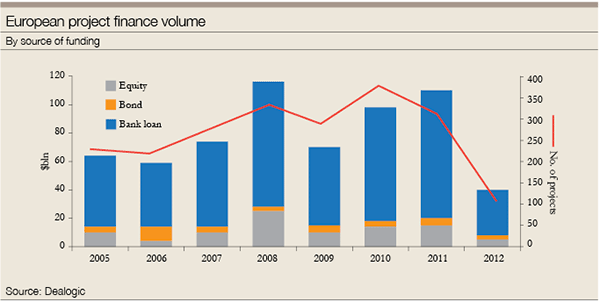
Last year, for instance, European project finance volume plummeted to its lowest in seven years at under $40 billion and down from over $100 billion in 2011, according to Dealogic. Of that, bank-loan financing still dominates, with bond financing less than $5 billion.
Olivier Musset, global head of energy in the natural resources and energy financing group at Société Générale CIB, says that although the project finance bond market is small, “it is clearly a trend as banks increasingly move to manage their balance sheet more dynamically in a Basle III environment.”
He adds, however: “It takes two to tango, and you need to educate investors who are willing to buy bonds with construction risk.”
That may be so, but Rob Hardy, executive director, OECD infrastructure, global real assets, at JPMorgan Asset Management, says the market is now at an interesting point where institutional investors are saying they love the asset class’s “fantastic stable long-term returns”, whether in debt or equity.
Furthermore, Hardy says that it is governments that are frustrating supply, particularly in the UK, because they are trying to work out what they “need to do to deliver this huge pipeline of greenfield investment opportunity in a way that brings together the capital that wants to invest with the needs of the developers and governments themselves”.
The infrastructure investment needs of the UK and continental Europe are huge. UK chancellor of the exchequer George Osborne said in June that up to £300 billion ($457 billion) of infrastructure investments would be made over the next decade, while the European Commission reckons investment need in Europe is between €1.5 trillion and €2 trillion by 2020.
“To the extent that governments can get their delivery method right and reopen a market where there is a visible pipeline again, I think the private capital will follow,” says Hardy. “Clearly the front end of the sausage factory has to be fixed before the output is at proficient levels to interest institutional investors once again.”
 |
Given the amount of investment needed in the next decade, deal flow can surely be expected to pick up considerably – especially as the need to reopen the capital markets and facilitate the delivery of private capital for greenfield infrastructure has become a political imperative. Although bankers say there is unlikely to be a wave of project finance bonds hitting the European markets in the short term, public-sector and private-sector initiatives already under way might accelerate the growth and development of the market.
The most high-profile initiative is the EC and European Investment Bank’s Europe 2020 Project Bond Initiative, which was launched last year in response to the shortage of financial resources as well as the need for big investments by European governments, many of which simply cannot afford to directly fund infrastructure projects.
The initiative, which is in pilot phase, essentially uses credit enhancement techniques to elevate the credit quality of the issued project bonds and could deliver over €4.5 billion of funding to up to 10 projects in the EU.
The first bond – called Watercraft Capital although the entire project is known as Project Castor – to be issued under the initiative was announced to the market in July. It is expected to raise over €1.4 billion to fund an underwater gas storage facility in Spain.
BNP Paribas, Crédit Agricole CIB, Bankia, CaixaBank, Natixis, Santander and Société Générale CIB have been mandated as lead managers of the bonds, which receive support from the EIB in the form of a €200 million liquidity line, which will boost the rating of the bonds to investment grade.
In addition to this, the UK and Italian governments have announced equally important public-sector initiatives.
Last summer the UK Treasury launched its Guarantees Scheme, which provides up to £40 billion-worth of guarantees to lenders and investors providing bank or bond funding to eligible ‘shovel-ready’ infrastructure projects in the UK.
At the same time, the Italian government ratified a law that paves the way for the creation of infrastructure project bonds by expanding the categories of issuers; permitting investment in bonds by qualified investors; enabling publicly backed insurers and financial institutions to issue guarantees supporting project bonds; and creating a new tax regime favourable to bond issuers, guarantors and investors.
However, while public-sector efforts to kick-start growth and development in the project finance bond market have grabbed the headlines, the private sector has also been busy creating market-based bond-financing solutions that are backed by banks and institutional investors.
The fund of Aviva Investors and Hadrian’s Wall Capital has failed, but it is hoped that the other main players, including one bank-led consortium operating under the acronym Pebble (Pan European Bank to Bond Loan Equitization), and a pension-fund-led consortium called Clip (Capital Lease Infrastructure Program), are more successful.
Similar to the EC and EIB’s initiative, Pebble – understood to be backed by NIBC, ING and Santander – provides subordinated debt positions for capital market investors to enhance the underlying credit ratings of senior project bonds. Clip is a further variant of this, and comprises a consortium of 80 global pension funds that provide 100% of capital for to-be-built projects.
Some of the world’s largest asset managers are engaging directly too.
Allianz Global Investors announced in July that it would invest €127 million in the long-term debt financing of a City of Music complex to be built on Seguin island in Boulogne-Billancourt, Paris.
Total construction costs of the project are €170 million; of that €127 million is coming from bank loans provided by HSBC, Bank of Tokyo-Mitsubishi UFJ and Bayerische Landesbank.
Where AllianzGI comes in is in the refinancing of the whole €127 million construction loan, which will be done through a 30-year securitization funded in full by the German asset manager. It marks the first bond-financed public-private partnership in France.
“With bids made on a number of other infrastructure projects, we look forward to securing and managing further investments for clients across Europe,” says Deborah Zurkow, CIO infrastructure debt at AllianzGI.
This type of direct investment no doubt presages a further rise in bank-to-institutional investor bond transactions, but another transaction, completed in the UK, could point to the return of an intermediary that was once the linchpin of the project finance bond market, and perhaps could be again.
At the end of June, Leeds City Council, in northern England, successfully raised £100 million though a project bond sale to finance the redevelopment of the Little London, Beeston Hill and Holbeck social housing areas of the city.
What was rare about it was that it was wrapped by monoline Assured Guaranty Europe, making it the first public primary private finance initiative bond to be guaranteed in Europe since the onset of the 2008 financial crisis.
There are more to come. The University of Edinburgh started selling an AGE-wrapped bond to finance investment in student accommodation in July, and later this year AGE will wrap two other social housing and regeneration projects in the north of England, both of which are similar in size to the Leeds bond.
It might be too early to say that this marks the return of the monolines to the infrastructure finance market, but few would disagree that there is a big business opportunity there for the taking.
“We certainly see it that way,” says Nick Proud, chief executive of Assured Guaranty Europe. “There is barely a government in the world that hasn’t announced a substantial infrastructure investment plan as part of their economic stimulus, and at a time when the banks have retrenched from this market, the capital markets can provide a much-needed funding source.” He adds: “The disappearance of most of our competition during the crisis did leave a significant vacuum. To have our model revalidated and rolling again is therefore significant for the market.”
Time will tell as to what extent monoline insurance will and can play an important role in the growth of the project finance bond market, but for Proud it is healthy that monolines are no longer the dominant force.
“As much as I would like to say we can do everything that is out there, that is just not going to happen,” he says. “For the capital markets to fulfil their role again in infrastructure there are going to have to be alternative solutions to us as well.”