 |
Traditional balance-sheet lenders have accelerated their withdrawal from commercial real estate senior debt, leading to a greater concentration of available capital on core markets such as the UK, France and Germany.
“We have seen continued retrenchment from traditional lending banks, and real estate debt is now relatively scarce. Indeed, a few of the traditional banks have become more overt about their lack of appetite; we’ve seen more names announce that they are not focused on real estate,” says Eric Adler, senior managing director and head of Europe with Pramerica Real Estate Investors in London.
Add in the continued uncertainty around where economic growth will come from in 2013, and it’s not surprising that real estate markets are flat.
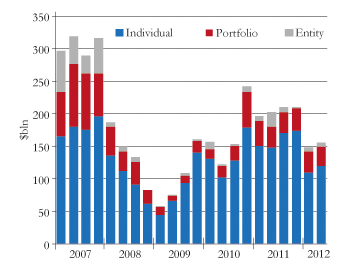
According to Real Capital Analytics, which tracks global real estate transactions larger than $10 million including multi-family apartment buildings and development sites, commercial real estate volume totalled $306.3 billion for the first half of 2012, down some $100 billion on the same period last year. “Every property type except for apartments posted a drop in volume compared with a year ago.”
 |
|
New players keep old lenders on the sidelines Debt dries up in China property |
|
Global results Regional results Results by country List of companies mentioned |
| Methodology |
The sharp reduction in risk appetite and balance-sheet availability among senior lenders in Europe has created an opportunity for nontraditional lenders to enter the market, especially where borrowers require leverage above 60% loan-to-value. While the number of lenders in senior debt continues to fall, insurance companies and other funds that entered the market full of optimism following the crisis are increasing their lending.
Fitch Ratings noted in an August report on European structured finance that it had received an increased number of requests from insurance companies, brokers and debt funds to have whole CRE loans rated. “Non-banks can take up some of the slack in CRE. As banks have retreated, terms available to new lenders have improved, which has naturally caught the attention of insurance companies and fund managers eager to diversify from traditional but now low-yielding alternatives,” the agency said.
According to Adler, who oversees the US insurers’ real estate lending activities in the region, the non-bank sector has gained critical mass in the junior and mezzanine market segments and is beginning to grow its share of the senior market too. “The opportunity in the junior lending markets is now playing itself out and is attracting an ever greater number of competitors,” he says. “We are seeing increased numbers of traditional private equity players seeking entry to the mezzanine debt markets, although operational challenges create inertia in translating that strategy into available capital. We are also slowly starting to see insurance companies participate in specific senior loans, but we are still some years away from a situation where insurers command 30% of the senior market and can offer a product very similar to the banks, as is the case in the US.”
Are these new investors gaining a foothold in a market that the traditional lenders will later bemoan missing out on? With an annualized total return of 9.8% in 2011, according to CBRE, CRE last year outperformed both bonds and equities by a comfortable margin. With the Barclays Capital Global Aggregate Index showing a current yield of 1.91%, the sector seems well positioned to outperform fixed income again. Relative to sovereign bonds, CRE spreads are close to historical highs in many of the largest markets, with countries that offer the most generous spreads to government bonds, such as Australia, the US, Germany, Japan and Canada, enjoying relatively stronger transaction flows.
| Global quarterly transaction volume |
| Real estate transactions over $10 million |
 |
| Source: Real Capital Analytics |
“We are doing as well as last year, with a little bit more uncertainty about what the future is going to hold,” Raymond Torto, global chief economist with CBRE in New York, says. “We were confident this time last year that we were turning the corner, but we’ve recently seen a stumbling of political action in the US and in Europe. Global rents and capital values are basically flat in Q2 2012; the overall macro malaise has caught up with the asset class after a year of increases in 2011.”
The market has largely abandoned standard pricing by matrix across the capital structure and has moved to a bespoke model where each transaction is priced subject to the specific details of the asset in question and the risk/reward requirements of the lenders and investors. This dynamic, combined with the reduction of overall risk appetite, has led the pace of transactions to slow in even in the most desirable markets, such as London, Paris and core Germany.
Financing is available for core European assets, and appetite for leverage remains in line with 2011 trends, with senior lenders typically willing to lend up to 50% to 60% LTV. To the extent that guidance on general pricing is available, senior debt is scarce and relatively expensive. At the most liquid end of the scale, top-quality German assets and tenants are able to attract up to €150 million five-year of senior debt (67% maximum LTV) at a level of around swaps plus 170 basis points; in the UK five-year senior debt is available in clips of no more than £60 million (65% maximum LTV) at around swaps plus 250bp, about 50bp higher than this time last year, according to CBRE research.
At the other end of the risk scale, Spanish real estate is currently attracting five-year senior funding in clips of €30 million (60% LTV) at a level of swaps plus 350bp.
Increased competition in mezzanine lending, at a time of reduced capacity in the senior market, is driving a paradoxical breakdown in the linear relationship between leverage and risk appetite, Adler says. “In deals with significant real estate risk where the senior piece is lacking, mezzanine lenders are looking at lower LTV attachment points, say 40%, but higher interest rates to reflect value-added risks,” he says. “In the traditional mezz space, however, the arrival of more and more players means it’s likely that you will be competed down to high single digits against a higher LTV attachment point.” At the highly levered end of the scale, there is virtually zero appetite to lend above 75% LTV, even among mezzanine providers.
As the transaction volume data show, the results of reduced availability of senior debt lenders and operational inertia in parts of the non-bank market are increased fragmentation and erratic deal flow. “We are seeing a lot of single-asset deals focused in Germany and UK where we are being asked to provide mezz funding at an interest rate of around 9% to 10%. We are seeing a relatively strong pipeline of those, where there is still a shortage of players able to write £30 million to £50 million cheques,” Adler says.
There are a few bright spots in the traditional lender markets, however. BNP Paribas recently closed the largest CRE refinancing in France since 2007 with the help of a privately placed securitization. The €472 million bond is secured by a first-ranking mortgage on the Lumiere building, the largest private office building in Paris, and was placed with French institutional investors, according to market reports. Given its classic core characteristics (tenants include Natixis, SNCF, Crédit Foncier, ING Direct and Société Générale), and the purely domestic profile of both underwriter and investors, its unlikely that this trade will herald the reopening of the European commercial mortgage-backed security markets however.
“Some of the lenders are starting to figure out ways to participate in certain deals, with more focus on domestic markets, less cross-border activity, and a focus on creative ways to participate in major markets and better assets,” a European CRE investor says. “The CRE space is very tough, and banks have to get creative to find ways to keep going.”
With $47billion of new transactions reported in the second half of 2012, excluding development sites and multi-family residential properties, the Americas commercial real estate investment market grew by 33% between the first and second quarters, although it remains down by nearly 10% on a year-on-year basis, according to CBRE data.
According to Matthew Anderson, managing director at Trepp, a New York-based provider of commercial mortgage data and analysis, steadily improving credit quality in CRE loan portfolios has given US lenders improved capacity to make new loans both at home and abroad. “Since the financial crisis hit the US mortgage markets, we have seen a gradual improvement in credit quality, with commercial real estate lenders benefiting from a stop-and-go recovery on a quarter-by-quarter basis,” he says. “We have seen a gradual disposal of problem loans, which has been most apparent on the construction and land development side, where delinquency rates have come down from the high of 19.6% posted in Q1 2010, although they remain elevated at 12%.”
Against a backdrop of gradually improving credit quality and troubled asset disposals, US real estate lenders have shown an increased risk appetite and are taking advantage of reduced competition to write loans on better credit terms at more attractive rates. Anderson says: “The money for the premium properties is domestically driven. Although there is certainly some foreign money, European banks have pulled back and the influx of Asian money hasn’t kept pace with the reduction in investment from Europe. Overall foreign lending appears to have declined in the US.”
Indeed, with US life insurance companies’ commercial mortgage holdings performing ahead of market expectations – realized capital losses fell to $0.4 billion in 2011 compared with $1.3 billion in 2010, according to Fitch Ratings – the asset class remains popular with banks and insurance companies alike. The market is set to post a second year of double-digit growth. New US commercial mortgage originations have increased every year since 2009, with $184 billion raised in 2011, according to the Mortgage Bankers Association. So far in the second half of 2012 originations are up 25% year on year, and up 39% on the first quarter, driven by increased activity among life insurance companies and government-sponsored entities Fannie Mae, Freddie Mac and the Federal Housing Administration.
Anderson notes that although demand for commercial loans has picked up, it is still much lower than it was five years ago when originations topped $500 billion. “The problem for the US banks has not been having capital to lend so much as the weakness of demand for new loans from borrowers,” he says. “With roughly $350 billion to $370 billion of commercial mortgages coming due each year, most of the demand is to refinance maturing obligations rather than fresh investment opportunities.”
While US banks have resisted offloading troubled real estate loans into the secondary market, specialist distressed investors have focused on the Federal Deposit Insurance Corporation’s structured sales programme, which since its launch in May 2008 has delivered 32 portfolios of residential and commercial real estate loans to private investors, totalling 42,300 assets with an unpaid principal balance of $25.5 billion. The programme relies on a risk mutualization mechanism whereby the agency finances 50% of the initial capital outlay for the bidder with a seven-year interest-free loan, which allows the agency to retain an interest in the assets while transferring day-to-day management responsibility to expert private-sector professionals who also have a financial interest in the assets and share in the costs and risks associated with ownership.
According to Paul Fuhrman, principal at Colony Capital, which has acquired seven portfolios under the structured sales programme with an unpaid principal balance of just shy of $4 billion, the flow of opportunities coming out of the FDIC program is slowing down. “The deals we have done with the FDIC are performing ahead of schedule, and the remaining debt should all be paid off within 12 months,” he says.
Given the investment in real estate risk management required to manage portfolios of this scale, the number of potential bidders in the few deals currently in the market is limited, which translates into relatively attractive pricing for active organizations. Colony has acquired portfolios in a price range of 20 to 75 cents on the dollar depending on the underlying asset quality, with land loans offering the deepest discounts.
With the pace of FDIC sales slowing, the agency has closed just one sale this year. Colony is now turning its attention to the private sector, where banks tend to be in better shape than when the distress cycle began and few could afford to take the hit. “The banks that are going to fail, for the most part have failed, and many are now in a stronger position with respect to balance-sheet health,” Fuhrman says. “More banks can now afford to realize losses from asset sales and are under increased pressure from regulators to do so.” Although many banks are looking to offload non-performing single-family loans, Colony is more interested in the deeply discounted opportunities available in the construction and land space, Fuhrman says.
“There are around 7,000 banks left alive in the US and most of them will have some exposure to underperforming commercial real estate loans,” says Fuhrman. “It’s a huge opportunity, and the competition is relatively limited.”
According to Trepp data, it is a $1.4 trillion opportunity, with US banks sitting on more than $228 billion of construction and land development loans alone. Official institutions and ultra-high-net-worth individuals will be hearing about the compelling value proposition in US commercial real estate for some years yet.