The world has become a riskier place. Of all the main economic or geographical areas, all except Australasia and the Caribbean have experienced increased risk so far this year, according to Euromoney’s country risk survey. Noteworthy deterioration in economists’ sentiment has been recorded not only in Europe, but also in Africa, central and eastern Europe and the Middle East, as concerns over the eurozone’s sovereign debt crisis have further dampened global economic growth and cast a shadow over private-sector and public-sector balance sheets. Country risk scores for north America, Latin America and Asia have also been affected by this gloomy outlook, although to a lesser extent.
Even the Bric countries (Brazil, Russia, India and China) – the world’s emerging economic powerhouses – have suffered declining ECR scores in 2012, as concerns over their export markets and increased domestic security risks have tempered analysts’ optimism.
In total, 108 of the 186 countries in the survey have become riskier, with just 56 becoming safer. The trend indicates that analysts are increasingly nervous about the health of the global economy, even after a summer in which trading in global debt and equity markets has been less frenetic than in recent years.
More than 400 economists and country risk experts from a range of financial and other institutions take part in Euromoney’s country risk survey. They evaluate the risks faced by international investors in 186 markets worldwide, scoring countries across a range of political, economic and structural risk criteria. The ECR survey combines these contributor assessments on 15 of the most important risk factors with other data on access to capital, credit ratings and debt, to formulate an overall score out of 100 (where 100 is the least risky and 0 the riskiest). The survey has been running since 1993 and is now updated in real time, providing an early-warning indicator of emerging risks, distinct from the sovereign credit ratings supplied by the agencies.
|
||||||||||||||||||||||||||||||||||||||||||||||||||||||||||||||||
Since 2010, the debt-ridden eurozone has been one of three regions to have witnessed the largest increase in perceived risk among ECR contributors. The others are the Middle East, thanks largely to conflict and security concerns, and the Brics. The average scores for all three have declined in virtual synchronicity, by 10 points each.
In central and eastern Europe, another region where there has been substantially heightened risk, the safety margin to Latin America and Asia – hitherto considered riskier parts of the world by economists – has been further questioned in the light of bank instability contagion fears, diminishing growth prospects and other domestic factors.
War-torn Syria is the country whose risk has risen the most this year. Its overall score has fallen by 6.8 points, and it has fallen 15 places in the global rankings to 156th. For most other sovereigns, questions remain about a range of other political, economic and structural factors, including government finances and bank stability, many of which are weighing down on risk profiles. Within the G10, seven countries (Italy, France, the Netherlands, Japan, the UK, the US and Canada) have seen increased risk this year.
Italy remains the riskiest sovereign in the G10, with a score of 58.7 points. Its ECR score is in free fall, having lost 4.5 points since January. The borrower has slipped from 32 to 41 in the global rankings over the past couple of years. Three other G10 countries (Sweden, Switzerland and Belgium) have attracted improved risk sentiment, underpinned by amelioration in their survey assessments for economic risk. Switzerland remains the safest G10 constituent, on a score of 88.8, second only to rock-solid Norway, which remains the safest sovereign in the ECR survey.
North America retains its position as the safest investor location in the global rankings. Neither the US (15th), nor Canada (seventh), are exceptionally risky by global standards. Their scores have fallen in line with the global trend, but more gradually than the European countries, supported by strong political risk assessments. A feeble economic recovery in the US, with high unemployment (8.3% of the labour force in July) and parlous government finances, are the main issues exercising economists and country risk experts as the presidential election approaches.
Increased risk perceptions have been more visible across the eurozone, where the region’s debt crisis has lurched unevenly from market panic to fleeting resolution and back again, despite the determination of policymakers to solve the crisis. As a result, the ECR score differential between north America and the eurozone has widened from seven points to almost 12 over the past couple of years as north America has held firm and Europe’s crisis resolution programme has floundered.
Far from resolving the crisis, a series of sovereign bailouts in Ireland, Greece and Portugal (all of which have faced 20-plus points falls in their ECR scores since 2010) has raised questions about fiscal sustainability in Italy, Spain and other smaller sovereigns, including Cyprus, Malta and Slovenia.
The eurozone’s problems have been laid bare by the high cost of borrowing. As of mid-August, 10-year benchmark government bond yields had fallen from their recent highs, but were still elevated, with Italy’s 10-year borrowing cost at 5.8%, and both Ireland and Spain trading at over 6% – hardly engendering confidence in long-term fiscal viability. Credit default swap spreads – measuring the cost of insuring sovereign default – are also elevated, despite tightening slightly in reaction to the latest European Central Bank scheme tying bond purchases to political reform, announced officially on September 6.
| Eurozone CDS spreads |
| Five-year tenor |
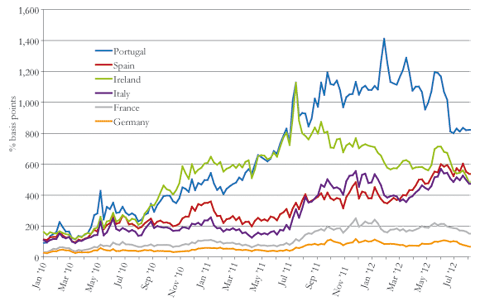 |
| Source: Markit |
The ECR survey also reveals considerable deterioration in risk across central and eastern Europe. The eurozone disease is spreading, inflicting pain on countries such as Slovenia, Hungary, Turkey and some of the Balkan states with close links to Greece. Sovereign CDS spreads for Slovenia widened to more than 500 basis points in August, a five-fold increase this year, seemingly identifying the country as yet another bailout candidate.
Domestic problems also account for some of the region’s problems. Hungary, whose score trend remains one of the more potent risk stories in the survey results, is easily the region’s worst performer, with a 4.8 point score deterioration so far this year. The sovereign has plunged 11 places in the global rankings to 68, a long-term trend decline – the sovereign has fallen 25 places over the past five years. Economists have responded to the government’s stalling programme of fiscal consolidation, complicated by a weak economy, currency depreciation and a delayed agreement with multilateral lenders, by downgrading the country across 10 of the survey’s 15 indicators since January. As a result, the borrower has slipped below not only Bulgaria and Portugal, but also India, Russia and Indonesia.
Confidence in the world’s emerging powerhouses of Brazil, Russia, India, China and South Africa has also waned in 2012. The five economies of the Brics have suffered an aggregate ECR score loss of 6.5 points this year, lowering the average score by 1.3 points to 56.8. South Africa (down 2 points), Brazil (down 1.9) and India (down 1.7) have endured the worst declines in sentiment, resulting from concerns about export market conditions, amid waning demand for commodities and increased domestic security risks. All five have seen large declines in their economic assessment scores as contributors have reassessed their expectations for global growth and acknowledged the slowdown in the breakneck pace of China’s expansion. Four of the five Brics (Russia being the exception) have also endured lower political risk scores – led by India (down one point) and China (down 0.8).
Economists’ opinions of sovereigns in Asia remained largely unchanged in the wake of the global financial crisis, as European ratings plunged in response to the troubles of the eurozone. Singapore and Hong Kong remain among the world’s safest sovereigns, ranking third and 11th, respectively. However, confidence in Asia Pacific sovereigns is now being undermined by reduced growth prospects and deteriorating perceptions of political risk in China and by the effects of continued turmoil in Europe on global trading links and supply chains.
Nevertheless, country risk scores in Asia have remained relatively robust, with an average score decline of just 0.4 so far this year – much less than other parts of the world. But the pattern of increased risk has resulted in several of the region’s main emerging markets succumbing to lower scores, including Indonesia, Malaysia, Singapore and South Korea. Several east Asian countries, including China, Hong Kong, Singapore, Indonesia, Malaysia and Vietnam, have experienced substantial downward shifts in economic assessment scores, signalling their exposure to the darkening global macro outlook in the eyes of economists. Among this group, the Philippines – down 0.4 points since January and 10.5 over the past two years – ranks lowest globally, at 67 on the global scale.
In south Asia, declining scores for India, Pakistan and Sri Lanka in 2012 indicate that domestic political and internal structural risks, as well as weakened cross-border trade flows across the Indian subcontinent, are factors contributing to the heightened Asia risk outlook.
Declining sentiment toward 13 of the 20 LatAm sovereigns has negatively affected Latin America’s risk profile in spite of domestic improvements in a handful of countries. Argentina, Brazil, Chile, Mexico and Venezuela are all seen as increasingly risky in 2012, while Peru and Uruguay are among the few sovereigns to receive improved scores over the period.
Overall, Latin America has shed 0.3 points since January, with an average score of 45.2. In global terms, the continent remains sandwiched between central and eastern Europe (52.4) and Asia (43.6) in terms of its risk perception (both excluding the CIS countries). All three categories of risk for the region – economic, political and structural – have been downgraded by ECR’s Latin America contributors.
Argentina is proving to be one of the region’s worst performers this year and has descended to 105th in the global rankings. Against a backdrop of the nationalization of state oil company YPF and other unorthodox economic policies, including raising tariffs and rationing foreign currency to protect against capital flight, Argentina has dropped into the riskiest of ECR’s five tiers as economists have lowered their scores for all 15 of its sub-factors. Argentina’s points deficit to Venezuela, the riskiest of LatAm’s main economies, was 2.8 at the beginning of 2012, but has since narrowed to just 0.1.
By contrast, Chile retains its position as the safest LatAm sovereign, with a score of 74.9, placing it 16th in the world, having climbed three places since January. With a cumulative rise of 28 places over the past five years, Chile remains in a class of its own among the emerging markets. Brazil, having shed 1.9 points since January to 60.9, remains the region’s second-safest sovereign, but it has fallen behind Chile in 2012. The two countries are 23 places apart in ECR’s global rankings, with the points gap widening to 14 points from 12.3 at the start of this year.
Economists’ continuing concerns about the political and economic health of the Middle East and north Africa region have resulted in an average drop of 0.9 points this year, with Syria’s implosion the largest score driver. For now, the MENA region retains comparative stability in the eyes of economists, given the tumultuous events that overtook the area in 2011. Yet while the region’s oil producers remain insulated from the worsening global outlook, declining economists’ scores point to concern that the area as a whole is not immune to external factors, with individual states vulnerable to domestic issues.
Conflict-riven Syria suffered the largest score deterioration in the ECR survey since January, with 6.8 points coming off its overall score, and a 15-place fall in the rankings to 156. The country has exchanged places with Libya, where sentiment has improved since the overthrow of the Gaddafi regime and the resumption of oil production. Iran, Syria and Yemen have the weakest economies in the region, weighed down by domestic concerns and reduced exports. By contrast, economic scores for five of the six Gulf Cooperation Council members – Bahrain, Kuwait, Qatar, Saudi Arabia and the United Arab Emirates – have improved as the recycling of oil and gas revenues and comparatively strong banking systems insulate the region from eurozone contagion. Oman, the exception, is unchanged.
African sovereign risk perceptions have increased, partly reversing the region’s gains in 2011. In a year in which investor confidence in Africa has been undermined by Europe’s travails, the region’s country risk scores have fallen by an average of 0.5 points since January. Africa remains one of the world’s weakest regions, 16 points adrift of Latin America and 15 behind Asia. While Egypt (down 12 places in the rankings) and Zimbabwe (down 13) continue to be weighed down by their own domestic problems, the continent has mainly suffered from increased global risk perceptions, with weaker global growth crimping commodity prices and exports, despite continuing strong domestic demand as the region’s populations expand. The falls in ECR scores during the past six months have been most pronounced for several sub-Saharan borrowers. They include Malawi (down 4.3 points to 28.2), Ghana (down 4.2 to 41.8) and Nigeria (down 4.1 to 37.7), where economic and debt concerns have taken prominence over domestic political risks. The falls mean that Kenya, Zambia, Tanzania and Uganda have all slipped in the global rankings.
ECR uses expert opinion to create a live indicator of country risk, rating 186 markets worldwide.