It has barely passed 4pm, and except for an immigrant security guard there is no sign of life in the labyrinthine corridors of the Saudi Ministry of Economy and Planning. It is an unpropitious environment for Euromoney’s first interview since the Arab Spring with a senior government minister in the Arab world’s biggest economy.
When Mohammed Al Jasser’s office is eventually reached – in a top-floor corner of the ministry – it is a mini-cluster of activity in an otherwise deserted building. Al Jasser set up his office at the ministry in December, after leaving his former position as governor of the central bank (holder of Saudi Arabia’s $570 billion-odd in foreign reserves). It is one of his first one-on-one interviews in his new economic coordinating role.
| Saudi fiscal balances are robust again |
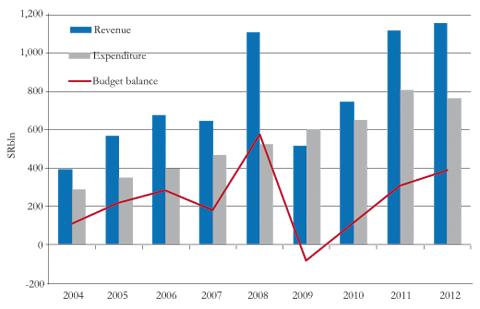 |
| Source: Development Prospects Group |
So has the Arab Spring prodded Saudi economic policy-making into action? Can a $384 billion infrastructure programme create more jobs for Saudi Arabia’s legions of frustrated youth – and not just in government departments and petro-industries? Or is last year’s announcement of $130 billion in additional spending – including cash bonuses for government workers – just entrenching an economic model built around cushy government jobs? Al Jasser is quick to rebut the suggestion that Saudi Arabia lacks the political stability to enact real change, or that proposed reforms are getting derailed by opposition from within the shaky coalition of interests that prop up the Saudi state. “If you look at the highways, the universities, the hospitals, the schools, the industrial zones, the number of factories, even the composition of domestic production and exports, it is all changing,” says the minister.
Investors hope that Al Jasser, as a former Saudi Arabian Monetary Authority governor, might have more authority at the ministry than his predecessor and be better able to coordinate the use of government petrodollar spending, which is now at record levels. The idea that he might inject some life into the economy ministry (which previously had a reputation for being rather sleepy) has contributed to wider hopes that the regional political cataclysm is injecting more dynamism into the Kingdom’s governance and, by extension, into its banks, markets and economy.
The appointment in October of a new crown prince, Prince Nayef, following the death of the King’s former heir apparent (an only slightly younger Prince Sultan) might have triggered Al Jasser’s arrival at the economy ministry. At 78, Prince Nayef himself might bring more stability than youthful energy.
But the choice of new governor for the central bank has been taken as a further sign that long-awaited reforms might now be treated with more urgency. The appointee, Fahad Al Mubarak, is seen as a break from the past. Rather than having a background in development economics, he is a former investment banker and a former chairman of the local stock exchange. Al Jasser, on the other hand, came to the governorship after a long stint as deputy governor and at the finance ministry.
In the capital markets, rumours have been rife since last autumn that the stock exchange might be about to open up for the first time – after many years of expectation – to direct investment from outside the Gulf. Test trades have been carried out, according to insiders, for a Chinese-style qualified foreign institutional investor scheme. Al Mubarak’s arrival, at least initially, did little to dampen the rumours. His experience at Morgan Stanley means that he is seen as savvy about international flows in the equity markets.
Until April there was no official announcement on the opening up of the stock exchange. But rumours alone contributed to a big uptick in valuations and trading volumes in the first part of the year. Average daily trading rose to double or even triple the values of last year and the year before. Despite a sell-off early in the month, by late April the main index was still up almost 18% year-to-date.
Analysts reckon the recovery in the stock exchange after more than three years of relative lethargy is partly attributable to retail domestic investors, who dominate the exchange, having got fed up with playing in the local property market. There were steep rises in property prices last year but the market is now expected to cool. Partly because of positive domestic sentiment in Saudi Arabia on the back of high oil prices, investors are returning to the stock market instead. A resurgence in margin lending at the banks has been another support for the stock market.
Higher oil prices – and government spending – have led to a growth in deposits at the banks, where post-Lehman cash-hoarding has further bolstered liquidity. “Saudi banks are much better provisioned compared with two years ago,” says Murad Ansari, an analyst at EFG Hermes. “Credit quality is healthier and they are focusing on growth again. Percentage loan-book expansion is already in the mid-teens.”
Again partly thanks to higher government spending, demand for bank lending is also increasing, and not just from stock trading. During 2009 and 2010 the government thought it more expedient to give contractors advance funding for infrastructure projects. But as banks’ risk appetite has returned, the government has been letting more contractors go to the commercial banks for upfront funding.
Greater liquidity at the banks, as well as at government agencies and funds, has furthermore facilitated an unprecedented upswing in issuance in the Islamic capital markets. By mid-April, the value of bond and sukuk issuance from Saudi Arabia in 2012 had surpassed issuance even from the UAE, which is traditionally by far the Middle East’s biggest fixed-income market. Saudi sukuk issuance in 2012 has already been greater than in any full year since 2007, according to Dealogic.
This is partly because the government is keener than ever to nurture a bigger Islamic capital market. The Arab Spring has reaffirmed the government’s resolve to press ahead with transport, housing, and education improvements scheduled to cost hundreds of billions of dollars. These infrastructure projects, according to Al Jasser, have “consequences for development and investment in the economy, including a new set of jobs for Saudis”.
A bigger domestic and international sukuk market for Saudi projects gives the government an alternative route, aside from the budget and currency reserves, through which to fund these projects. Hence the decision in January to go ahead with the first-ever government-guaranteed sukuk: a SR15 billion ($4 billion) deal from the General Authority of Civil Aviation. The sukuk finances a long-awaited upgrade to the airport at Jeddah (the main gateway for the Hajj).
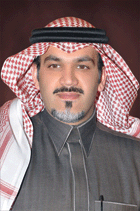 |
| Fahad Al Saif, head of debt capital markets at HSBC Saudi Arabia |
Private companies have followed: dairy firm Al Marai issued a SR1 billion sukuk in March; HSBC affiliate Saudi British Bank (SABB) sold a SR1.5 billion privately placed sukuk in early April. There has also been talk of billionaire Prince Al Waleed Bin Talal’s Kingdom Holding issuing publicly traded fixed-income instruments for the first time. “When you speak to CFOs, debt capital markets are on their agenda because of the liquidity in the market and the success of other issuers,” says Fahad Al Saif, head of debt capital markets at HSBC Saudi Arabia. Public-sector salary increases and other patrimonial benefits to the population have led to a booming demand for consumer credit (as in other oil-rich states where governments have been trying to shore up support over the past year, such as Russia). In Saudi Arabia, the introduction of unemployment benefit last year has contributed to consumer confidence. “Many banks, not just SABB, are focusing on the retail side of the business,” says Majed Nagm, SABB’s head of retail. He mentions, in particular, personal loans and housing finance.
On a macroeconomic level, Al Jasser acknowledges that higher government spending has contributed “first and foremost” to levels of non-oil economic growth that in 2011 and early 2012 have been higher, by some accounts, than at any other time in the past 30 years. He denies that the economy is becoming more dependent on high oil prices as a result of spending increases since the Arab spring, however.
Over the past 10 years, according to Al Jasser, non-oil GDP has risen from 67% to 75% of the total. Non-oil exports of goods, he says, have been rising as a proportion of total imports. “The government collects all its revenues from oil, and that is in lieu of taxes on citizens,” he says. He casts doubt on any large-scale imminent change to this. The minister admits, given that the budget relies almost entirely on oil revenue, that it could be said that the bigger absolute size of the government’s budget is an indicator of greater dependency on oil prices.
“But it is the relative terms that matter, and [spending as a proportion of oil revenue] hasn’t changed much over the years,” he says. “Our reserves have risen significantly, and our debt-to-GDP has declined precipitously. This indicates that we are taking into account the possibility of a decline in oil revenues in the future, God forbid that something should happen to the global economy. From a stability point of view, which is most important for us, we are building up cushions and fortifications, if you will, to safeguard the economy in case of a decline in oil prices.”
Saudi Arabia has some $570 billion of reserves at the central bank. Nevertheless, the preoccupation with that much-vaunted stability in the Kingdom can be seen to be more detrimental in other areas of policy. Some observers would say that it continues to hamper many much-needed reforms, even after the Arab Spring. Some might even argue that the desire for stability in the short term undercuts the possibility of true stability in the long term of the kind enjoyed by more-developed countries.
The immediate pressure for change might have eased, as populations across the Arab world have witnessed the tragedy of civil war in such countries as Syria and Libya. After the initial panic around the fall of Ben Ali, Mubarak and Gadhafi, there is a growing impression now that any reformist energy that might have existed last year is slackening, even while the big rises in recurrent spending did almost nothing to solve such problems as youth unemployment and lack of fulfilment, at the heart of the original revolts.
It was perhaps a sign of the times when the head of the Saudi capital markets regulator, Abdulrahman Al Tuwaijri, broke his silence about opening the market to foreigners in early April. Senior investment bankers in Riyadh took Tuwaijri’s pronouncements as a signal that officials were having second thoughts about opening the market in the near future, or at least not as previously envisaged.
“It is still within our strategy but it should be done in an orderly and gradual manner to make sure it does not impact the market’s stability,” said Tuwaijri, in comments reported by Reuters (note the use of the word stability again). “This gradual manner will happen, but we need time to make it happen in a safe and orderly manner.”
Nevertheless, advocates of opening the market would say that the market at the moment does not enjoy the slightest degree of stability, as demonstrated this year. Some say market manipulation has revived along with trading volumes in 2012, to the extent that even the king asked Tuwaijri in a letter to enforce a clampdown, according to some (unconfirmed) local newspaper reports.
Those in favour of opening up would say that only institutional investors might lead to a market more oriented around research and company results, and less dominated by retail investors, who go wild at the slightest rumour (the reaction to rumours about opening the market being an example). And only foreign access will bring in much more in the way of institutional investors.
Opening the market to foreign institutional investors might therefore benefit most the smaller, angrier investors – the kind likely to take to the streets. Smaller investors are more likely to lose money at the hands of rich and powerful market manipulators, who have been known to whip up stocks only to dump them on the unsuspecting.
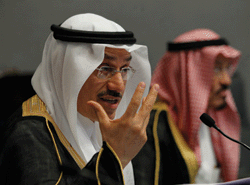 |
| Saudi Arabia’s new economy minister, the former central bank governor Mohammed Al Jasser |
“I don’t think the process of reform has stalled – far from it,” says Al Jasser. But others would point as well to the housing market, which despite the Kingdom’s oil wealth still suffers from acute shortages. Almost $70 billion of the additional spending announced last year was for a new state programme to build 500,000 houses. The King also announced an increase in the maximum interest-free housing loans issued by the Real Estate Development Fund, an arm of the finance ministry: from SR300,000 to SR500,000 per applicant. Commercial banks Al Inma and Bilad have signed agreements with the fund this year to try to speed up the distribution of loans, including by facilitating repayment via the banks. Other banks have been in talks about tie-ups with the fund too.
However, the fund has had a chequered history since its establishment in 1974, sometimes even involving corruption. Even today, while some observers say the speed of dealing with loans has much improved, others say it still has a reputation for taking up to 10 years or even longer to process applications.
In April, shortly after the fall of Egypt’s president Hosni Mubarak, there were reports that the King’s advisory council had finally approved a crucial mortgage law, which has been going through the official organs for at least five years. One year on, however, the law has still not been enacted. “I am impatient, for example, and the mortgage law, still, I would like to see it sooner rather than later because it is an important component of the financial structure of the economy,” says Al Jasser when talking about the wider pace of reform.
The point of the mortgage law is to give banks easier access to collateral, so they can extend more housing loans, independently of the state, and on the basis of an evaluation of the creditworthiness of the customer and the asset – and in turn to help solve the housing crisis through a market mechanism, and the private sector. But the government’s worry remains, bankers say, that if the mortgage law allowed bankers to start turning defaulting borrowers’ families out of their houses, it might call the government’s Islamic ethics into question.
So the housing shortage continues, much to the destabilizing discontent of a youthful population already frustrated at the lack of fulfilling jobs. Asked whether he thinks the mortgage law is still a possibility, Al Jasser says: “Yes, of course, but I have stopped giving predictions on when.” And it is that kind of exasperation at the pace of reform that seeps across the Saudi economy.
When asked whether the Arab Spring has added impetus to reform in the Kingdom, Al Jasser points first to the focus on creating more jobs in the private sector for young Saudis. “The awareness of the need to make the labour market more flexible for Saudis is at the forefront of policy-making and discourse in this country,” he says.
There has already been a crackdown on the use of foreign labour. Al Jasser says making working visas less readily available and charging employers higher fees for using foreign labour will increase compensation levels for Saudis and therefore encourage them to take jobs that might otherwise have been left to foreigners. He also wants to give incentives for locals to work harder by making it easier to hire and fire Saudis (although he does not elaborate on the details).
“Productivity could increase if it was easier for employers to choose from the supply of Saudi labour that is available,” he says. “The message we want to give is that if you want to have a better-paying job, then you had better raise your productivity. This is when people will be chasing you instead of you going and chasing them to hire you.”
He adds: “Making our economy more capital intensive than labour intensive will create more jobs for Saudis who are highly educated. We are embarking on a strategy to become a knowledge-based economy. So as a government we are trying to create a conducive environment for the creation of new industries and new businesses that will be driven and fuelled by this demographic window [of young Saudis].”
Al Jasser points to jobs that might be created, not just in banks, petrochemicals or oil (sectors where he says the Kingdom has done well) – but also in pharmaceuticals or industrial components, for example. However, the Kingdom’s fear of destabilizing change appears to have made impossible even the creation of a small sovereign wealth fund, for example, which could buy up stakes in foreign companies that might transfer knowhow or agree to set up high-end manufacturing facilities in Saudi Arabia partly in return for a stable equity investor.
In an interview with Euromoney in 2009, the secretary general of the Saudi Public Investment Fund, Mansour Al Maiman, said his organization and its parent, the finance ministry, was close to forming a new sovereign wealth fund, to invest in equity in companies inside and outside the Kingdom. Perhaps it could have been a Saudi version of Abu Dhabi’s Mubadala, which likes to refer to itself as an investment and development company. But five years on, in another example of the glacial Saudi pace of reform, there has been no more news on Maiman’s proposed $5.3 billion investment vehicle. Instead, almost all the Kingdom’s foreign currency continues to end up, it is thought, funding the US fiscal deficit via treasury bills.
Al Jasser says one of his focuses is that bringing more women into the workforce would drastically reduce unemployment. He says that every government department is now expected to have a women’s section. One of the flagships of the Kingdom’s recent drive to create highly skilled jobs for nationals is the new Princess Noura University.
| Indicators of consumer spending |
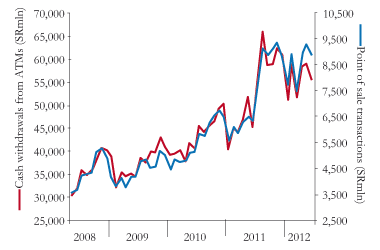 |
| Source: Jadwa |
The $11.5 billion construction project is complete, with a 13-kilometre light-rail system. It was finished just in time to coincide with the Arab Spring, last May. By car, it takes several minutes to drive by the site on the motorway from Riyadh airport. From the outside, the monumental entrance is adorned with a large billboard portraying the benefactor, King Abdullah. But critics say it is just like other high-profile real estate schemes, such as the King Abdullah Financial District in Riyadh. Is this not just the same old focus on splashing money on grandiose real estate projects, build by such companies as the Saudi Binladen Group, and promoted by foreign branding agencies? Could more attention be given instead to actual educational attainment, or on practical improvements in Saudi citizens’ job prospects?
Sceptics might say that building a massive university for female medics, engineers or technicians – when women are banned by the religious authorities from driving to work – is akin to building a huge state-of the-art opera house in the centre of Riyadh (this happened in the 1970s) when even cinemas are banned. Perhaps it is even akin to building a financial district in Riyadh, with more than 3 million square metres in floor space, as the existing project will have, when foreigners cannot even buy shares on the local stock market.
Al Jasser naturally disagrees. “You need such campuses like this, with all the necessary facilities, if you want to create a labour force with high knowledge content,” he says. He also points to large development projects for mines in remote parts of the country, linked by new rail systems to coastal industrial complexes. “I have no doubt that these are significant projects that are needed for an economy of our size and of our aspirations,” he says.
A year after the beginning of the Arab Spring, for the average young Saudi this country is once again a place of very gradual, perhaps stiflingly slow, change. But for bankers and investors who are careful and in the know, it might also be a place of gradual growth: gradual improvements in the ability of banks to extend credit for housing; gradual improvements in corporate governance and financial sophistication; and a gradual opening of the stock market – to Gulf Cooperation Council nationals, then to non-Gulf foreigners, then through swaps, exchange-traded funds, and beyond.
For bankers and investors, now might not be the time to get carried away with the opportunity in Saudi Arabia – but neither should they forget about it.



