Deutsche Bank has upped the ante in the technology race raging among the world’s largest FX banks as it seeks to extend the lead it has held in the industry for the past eight years.
Superior trading technology has been one of the pillars that have given Deutsche its competitive advantage in FX and enabled it to be the undisputed leader over the past decade in a sector that has the most attractive return on equity of any global markets business.
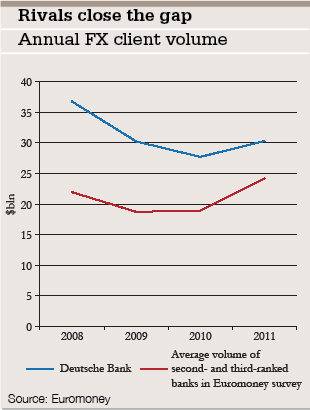
But that lead is being eroded. In 2008 Deutsche commanded almost 22% of market share in FX. That has now fallen to 14.55%, and the gap between Deutsche and Citi, the second-biggest FX bank, is now just 2.2 percentage points, compared with six points in 2008.
Size matters in FX, which according to consultancy firm Coalition is making an increasing contribution as a proportion of banks’ total fixed-income, currencies and commodities revenues. In 2009, FX accounted for 16% of total FICC revenues; that had risen to 27% by the end of 2011.
So Deutsche’s lead is a prize worth defending. In an effort to extend it, the bank has unveiled the second phase of its FX trading platform, Autobahn, by introducing a new application programming interface (API) that it says will revolutionize how it prices and risk-manages its currency-trading business.
After three years in development, Rapid (Revolutionary API Design) is now in the early stages of rolling out to Deutsche’s clients. The bank has 10 customers taking the feed, initially in New York, and is aiming for between 50 and 100 more clients by the year-end, when the feed is rolled out in Europe.
Rapid marries advanced low-latency trading technology with the bank’s large-scale market-making capabilities for the first time. This will lead to faster, more consistent pricing across Deutsche’s client base and enable it to more effectively manage the risk generated by these transactions.
That should lead to a substantial increase in client volumes, the bank says. In 2011, Deutsche executed $30.3 trillion in trades, according to Euromoney’s annual survey published in May, and it forecasts that by the end of 2013 it will be trading $1 trillion a week.
“This [API] is next generation, and something rivals will be trying to catch up and leapfrog to at some point in time,” says Robert McKeon, head of markets and liquidity at FXDD, a New York-based retail FX aggregator. “It gives Deutsche much better risk management, which makes them much more consistent in the spreads they can offer us, enabling them to be top of book in all market conditions.”
Rivals aren’t convinced. The head of eFX at one rival says: “There is scepticism that Deutsche has done anything really new, as things like building out co-location centres are already being done at other banks. There is great buzz about it, but I’m undecided whether this is an evolution or just impressive spin.”
The API feed is generated by two key inputs. First, by the requirements of each client in relation to the type of liquidity they want, including any constraints they might wish to choose on how their flow is risk-managed – clients can control their liquidity and have unique risk management.
Secondly, Rapid will use cross-asset alpha signals derived from Deutsche’s own models, which calculate where the likely market price will be when the market maker clears the risk on the client trade.
Risk management is also being enhanced by the build-out of multiple co-location centres, starting in New York, and with London and Tokyo to follow. Deutsche hopes to extend that to Canada and Australia within 18 months.
While in the first instance that will enable those clients that want to trade in microseconds to trade more effectively, crucially, from a risk-management perspective, it gives Deutsche added flexibility to risk-manage positions and undertake price formation in multiple centres, or globally for its clients.
“We can benefit from local risk management or global risk management, depending on the flows in each location,” says Zar Amrolia, Deutsche’s global head of FX and markets electronic trading. “It’s bespoke risk management based on latency and flows in other centres.”
Getting to that point has proved to be a complex problem to solve. In the maths world, it is as the travelling salesman problem: mathematicians have for years grappled with finding a solution that calculates the guaranteed shortest route between a large number of cities.
In its application to the FX markets, Deutsche has tried to find a workable answer to the question: is it more effective to risk-manage flows in the trading centre of origin, or offset that against flow in another trading centre?
“Effectively, you have to model the decay function versus the netting benefits of matching flows in a larger centre,” says Amrolia.
Rapid’s price formation also goes further than any other liquidity provider in the market, by moving away from market-making based on the concept of a core pricing stream. Banks then add in a so-called ladder and a spread, depending on the client type and the size of the trade.
 |
“Each one of our clients on our platform is unique,” explains Amrolia. “So, we will be working together with each name to offer tailored liquidity to meet their individual requirements.”
For example, certain clients might not want the flow they’re executing through Deutsche to touch the market immediately, preferring to lay that off against the rest of Deutsche’s clients. Another client might wish to clear the flow into the market immediately. In other instances, a customer will look for an element of consistency, or a smoothing out of liquidity, so that execution costs are similar, irrespective of the quality of the liquidity existing in the market at that time.
“It’s like bespoke relationship management,” says Philip Wood, Deutsche’s global head of electronic spot trading. “What type of liquidity do you want from us, and how do you want this to interact with the market?
“In the e-trading world even a year ago, this wasn’t on the table as something you could manage. It was a case of when clients dealt, traders would have to lay off that risk. This is a different stage of evolution.”
Running alongside the development of Rapid and the first phase of a new generation Autobahn – based on a more modular-style app-based platform launched in July – Deutsche has ramped up its capacity to process trades as well. It says it can now process 5 million trades a day, and can scale that up even more because trades can now be compressed.
Wood says its peak trading capacity has stood up well with the 10 clients using the platform. Peak execution on Rapid after the release of non-farm payrolls on September 7 saw the platform execute 400 trades a second, which he says is an improvement of more than 30% from its existing API during peak trading sessions. The upgrade of Autobahn and launch of Rapid led to record client monthly volumes for Deutsche in August.
While this will raise the stakes for the entire market, Amrolia argues that Rapid was designed to challenge some of the less visible rivals, such as high-frequency trading firms.
While in some circles low-latency trading techniques have been seen as contentious, some firms have become leading market-makers in recent years with similar types of technology as Deutsche is introducing, but catering for a smaller group of specific clients.
In particular, London-based Lucid Markets appears to have gained a firm foothold, according to some trading firms that spoke to EuromoneyFXNews. In July, Lucid sold a 50% stake of its business to retail broker FXCM for $176 million. In an accompanying press release, the firm disclosed that it traded $13.4 trillion in FX in 2011. Another London-based firm, GSA, is rumoured to have traded volume in excess of Lucid’s, but it has not publicly disclosed a figure.
Based on those notional volumes, Lucid would have ranked seventh in Euromoney’s annual FX survey. However, Lucid and GSA are not considered eligible for the annual survey because they do not provide a credit counterparty function in the FX markets, and do not have a sufficiently broad client base to be considered as qualified market-makers. Therefore, it isn’t possible to determine what percentage of that volume is customer flow.
By adopting similar technology, combining it with a traditional bank’s market-making rules framework and then applying these to a bank FX franchise, Deutsche believes it has raised the technology bar.
“We have over 5,000 clients who provide their flow,” says Amrolia. “Combining that scale with nimbleness has been a hard challenge, but with Rapid we can provide superior liquidity in a way that we believe will revolutionize the industry.”
FXDD’s McKeon, who has spent the past four months testing the new API with Deutsche, concurs.
He says for the FX industry it boils down to this question: why be in the FX business if you are not going to commit yourself to having the best technology and a place that gives you very strong risk management? After all, FX is the most high-volume/low-margin business in the financial markets.
“If you’re a follower in this business, you’re yesterday’s news,” says McKeon. “It’s over for you, because you’re just not going to have enough transactions to make it worth your while.”

|




