 |
|
|
Best Global debt house: Deutsche Bank |
|
|
Also nominated: Barclays Capital and HSBC |
The past 12 months in the debt capital markets have demanded not only nerves of steel but also an ability to anticipate where opportunity will arise in such volatile and unpredictable conditions. Deutsche Bank has reaped the rewards of just such foresight across the debt markets. “The number of banks that operate on a truly global basis is a very narrow field,” says Miles Millard, global head of capital markets and treasury solutions (CMTS) at Deutsche Bank in London. “We were the first of the true global players to pick where the likely opportunities would come from.” This entailed improving FIG coverage in developed and emerging markets to deal with a heavily indebted FIG sector; beefing up in SSA 18 months ago to meet the needs of heavily indebted governments and a recognition that the global economic recovery would come from emerging markets and that this would have big implications for its debt business. “We knew that we would see an increase in applications from emerging market borrowers to move from domestic to international bond markets so we regeared and refocused our efforts in emerging markets,” says Millard.
Most banks will argue that they adapt to meet the changing needs of the marketplace but in Deutsche’s case this has been demonstrably the case. The DCM business is now part of the CMTS group formed last November as part of Project Integra. “CMTS is an expanded origination platform which enables us to be much more integrated with CIB,” explains Zia Huque, managing director and global head of syndicate at Deutsche. “This is essential to where the business is headed. The reality is a migration of the corporate client base away from loans and towards the bond markets. By doing this we have created a bigger and more effective platform. You need reach to be able to do this – very few banks have the footprint to be truly relevant across all markets.” The bank’s range is truly impressive. Any bank claiming to be a global debt house needs a strong local-currency business and Deutsche’s is second to none. Last year it arranged the first-ever Asian local-currency bond in the Philippines; a synthetic renminbi bond for Shui On Land; a rouble sovereign bond for Russia, a Brazilian real inflation-linked bond for Banco Votorantim and a Ukrainian hryvnia international bond for Ukreximbank.
Deutsche now claims to be the only top-five arranger of international bonds in every region of the world, a sign that its focus in DCM has paid off. It was involved in nearly every landmark sovereign deal of the year, including the vital €6 billion 10-year trade for Spain in July. “This revived market confidence in the sovereign at a time of great concern and gave a positive tone to every market,” says Adrien de Naurois, who relocated to London from New York this year to focus on the SSA business in debt syndicate. The bank has also been on deals for Italy, the EU and Spain’s Fondo de Amortización del Deficit Electrico among others.
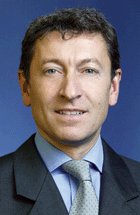 |
“We knew that we would see an increase in applications from emerging market borrowers to move from domestic to international bond markets so we regeared and refocused” |
In European FIG the year has been characterized by volatile access and regulatory uncertainty. This requires unparalleled market knowledge and people on the ground. Deutsche has been integral to the rotation of borrowers out of senior secured and into covered bonds and has driven the hybrid market for insurance companies – being on eight of the 11 perpetual deals last year. It was also on key subordinated trades such as the €1.25 billion lower tier 2 issue for Intesa Sanpaolo, the $2 billion trade for Lloyds Bank and Bank of Ireland’s €2.7 billion liability management exercise. Deutsche rose to the challenge on the corporate side as well, raising more capital for peripheral European corporates than any other bank and bringing the first bond by a Greek corporate since November 2009 for Coca Cola HBC and successful jumbos for Telefónica and Telecom Italia. Deutsche is not one of the largest players in the US debt markets but has held its own in a year when more than half of issuance was in US dollars and more than 30% by US issuers. It has been involved in some of the largest liability management exercises ever done (for AT&T and IBM) and has been a key adviser to the US Treasury and FDIC. The revival in leveraged finance has also played to the bank’s strengths in this market – it kick-started the European leveraged finance market in October last year with the $2.4 billion Sunrise Communications acquisition by CVC Capital Partners, the biggest-ever dividend recap out of Asia for Stats ChipPac and the second-largest amend and extend ever executed: $6.3 billion for Univision. “Who else is everywhere and who else has this momentum?” asks Millard. “I don’t remember a time when we could look across the global market and see this quality of clients and feel that we have momentum in every bucket.”



