 |
 |
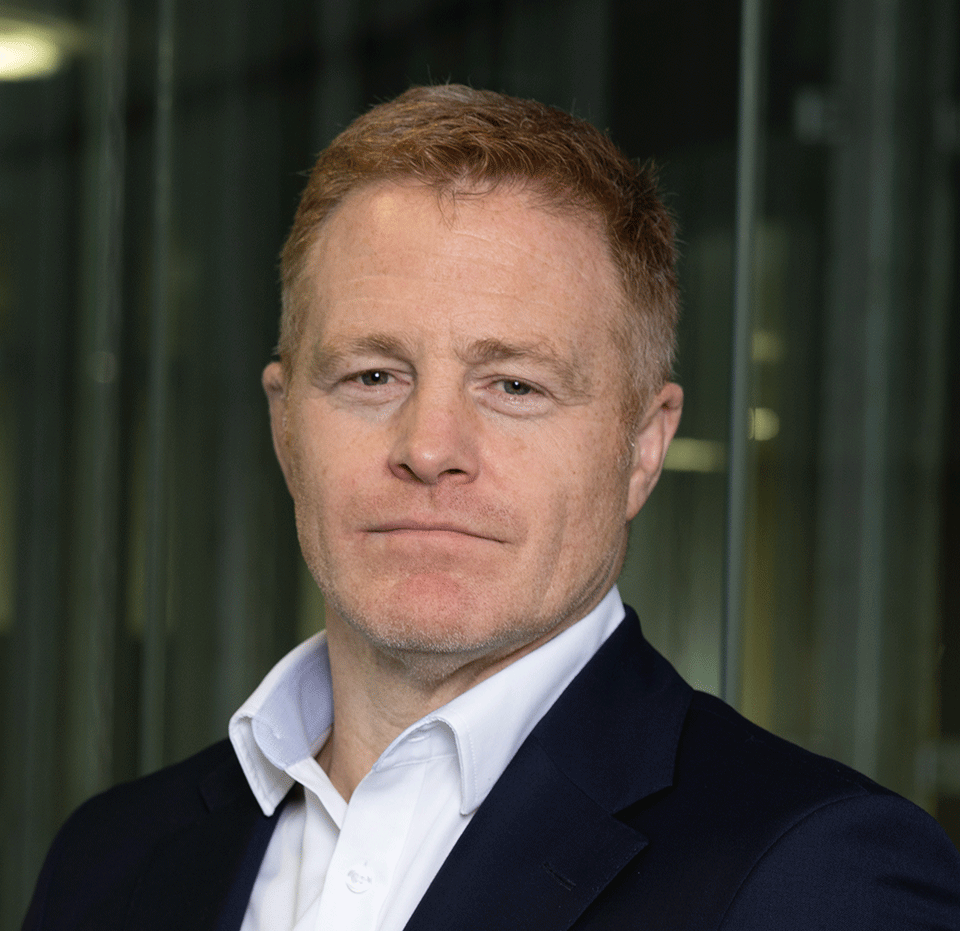
ROBERTO EGYDIO SETÚBAL is an engineer by training. Like his father, Olavo Egydio Setúbal, he attended the Escola Politécnica, the most prestigious engineering university in Brazil, before following his footsteps into the family bank. In the 1970s, when engineers were qualifying into the bleak job market of Brazil’s contracting industrial base, Setúbal senior hired engineers to his small but growing bank in droves. Engineers spread throughout all the bank’s departments: the treasury, its control functions and the back offices. Banco Itaú quickly became known as the bank of engineers. This was a compliment. The bank was quickly developing a reputation for having the same qualities associated with engineers: discipline, control, logic, method and, above all, consistency.
This culture is a large part of the answer to the question: just how has Roberto Setúbal grown his bank, which is today the world’s 10th largest? Itaú Unibanco’s market capitalization was R$109 billion ($67.9 billion) at the end of the first quarter of 2011. In 1994, when Setúbal took control of the bank, it was $2 billion. At that time Itaú was one of a pack of banks in a forgotten part of the financial world; now it is the standard bearer for a vibrant, growing and increasingly confident continent.
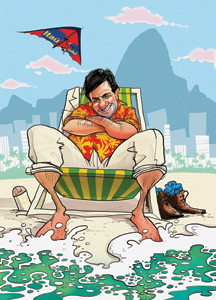
“Consistency,” Setúbal says calmly and modestly, is the explanation for this incredible growth. “You have to be consistent over time and along your life, and I think this has been my case.” He arrives at the bank every day between 8:00am and 8:15am (by car – no ostentatious helicopters for this bank’s president). His first meeting is 8:30am. He leaves at 7:30pm, never later than 8:00pm and doesn’t take work home. The day is mostly filled with regular weekly, monthly or quarterly meetings. “I have a very organized agenda,” he says. “At the start of my year between 60% and 70% of the space is already blocked for regular meetings. We have committees established for every important issue that the bank faces. This governance that I have created is important. It means that all important issues have a space to be discussed. This is important, this routine.”
Mergers and acquisitions have clearly been a driver of Itaú’s growth, pre-dating Setúbal’s tenure but continuing with him, and today investment bankers have, at times, literally been lining up to see him, to present bank targets of all kinds, sizes and with operations in countries all over the world. His bank is now usually rumoured to be among the list of potential acquirers for distressed banks in Latin America and the US, and sometimes even for European or Asian entities. He was recently pitched to buy a bank in Malaysia. “The problem is that people come to offer you what they have to sell, not necessarily what makes sense to you,” he says, adding that the bank is definitely not interested in acquiring banks in Europe or Asia. The US is a cautious maybe. “And secondly, they don’t care about the price. [Investment bankers] just want to show you the deal and say it’s a great opportunity because they are not going to pay for it. They want to make fees out of the deal [and will do] if it’s successful or not. I have to have the discipline for not overpaying for it just because they offer things that are very attractive.”
So is he often tempted? To paraphrase Shakespeare’s Angelo in Measure for Measure, Setúbal evidently believes it is one thing to be tempted, another to succumb: “Of course! It’s very tempting to say let’s make a big acquisition and then I will be a CEO of a huge bank or so on.”
But? “We have done many M&As – some very successful and others not as much – and you learn what to look for. And consistency is the important thing. I don’t think we are able to manage a global bank; we don’t have the skills so we have to be patient and do it step by step, like we always have. I don’t believe it’s possible to do this overnight. We will do it over time.”
Itaú has instead largely focused on regional expansion. A large part of the bank’s spectacular growth has been Setúbal’s ability to capitalize on the undoubtedly favourable macroeconomic environment in which his bank has grown. The emergence of the Brazil quarter of the Bric group of countries has, in recent years, provided the bedrock for Itaú to grow, both inside and outside of Brazil, in parallel with the expansionist strategy of the country’s leading corporates.
Dimon’s influence
Jamie Dimon, president of JPMorgan, gets cited in many articles on many subjects – and today not all are in the financial pages of newspapers or in financial magazines. But perhaps before now he hasn’t been credited with a footnote in the Itaú story. However, it was over a lunch with Dimon in São Paulo (in about 2004) that Setúbal says his approach to M&A strategy crystallized. “I remember having lunch with James a long time ago. He was not as he now is – he was just starting out at JPMorgan,” he says, smiling. “He said something that I will never forget. He said: ‘When I look into a deal I look for three things. Does it make sense to my strategy?’ Well, a bank in Malaysia doesn’t make any sense so I can rule that out. Unibanco makes a lot of sense. ‘Second is the price; is the price correct? And third, are you able to implement the deal that you are planning?’ I am not able to be a global bank tomorrow. I am not able to implement it.
|
Setúbal says he learnt important lessons on acquisitions from a conversation with JPMorgan chief Jamie Dimon |
|
|
“I found this very interesting and so I did a back test on all our acquisitions, and he was absolutely right. On some of them I overpaid, not by much but we expected a better result than the one that we came out with. On some of them the implementation was very complex – for example on BBA the price was very attractive because the risk of implementation was very high, but we were able to implement and looking backwards the price was very cheap – it was very successful, we have made huge returns.”
And, using these criteria, which deal does he view as his most successful? Since Setúbal had previously referenced the recent, hugely transformational Unibanco deal while recounting Dimon’s advice, a “U” is already written on Euromoney’s notepad. But he replies: “Banerj.”
The privatizations of the Brazilian state banking system offered a fantastic opportunity for rapid, acquisitive growth. However, in 1997 most bankers mistook the gilt edge of this opportunity for rust. All of Brazil’s banks were invited to join the auction for Banco do Estado do Rio de Janeiro (Banerj), but since it was a troubled business and had a workforce that was out on strike, no one was interested. Only Setúbal saw the potential. “It was the best transaction I have ever done,” he says. “It was the first state bank to be privatized and the state banks in Brazil had all kinds of problems. It was a very bad bank but they had one million clients – and especially the payroll of the state of Rio de Janeiro – and 250 branches in the second most important state in the country. So they had the clients and the distribution and we also had the platform so we thought it could be very successful. The price was very attractive.”
With no competitors, and a government motivated to complete the first privatization in a proposed programme of bank sales, the price was low: R$311 million (the auction’s reserve price had been R$310 million). “The big risk was implementation,” says Setúbal. “The bank’s employees had been on strike before the auction, so everyone was really afraid of the bank. And we were afraid too.” However, Setúbal’s calculated risk on the industrial relations issue paid off quickly: “We learned that the employees were more afraid of us than we were of them. Because they were now part of a private company they could be dismissed – it made all the difference.”
The other banks’ scepticism had disappeared by the time the next state bank came to be auctioned: Bemge of Minais Gerais. “[The competition] could see that we could manage Banerj, we could implement and change the brand, change everything,” says Setúbal. This time five banks submitted bids, before there was a furious final round of telephone bidding between Itaú and Bradesco, with the former winning the process on the 15th and final bid. “Because of Banerj we were the only ones who really knew how to value the bank and so we knew better how aggressive we could be on pricing,” he says. Itaú paid R$583 million for Bemge.
Itaú had, within one year, added an important retail base in Brazil’s second and third most wealthy and important states. It was already, through its São Paulo base, strong in the wealthiest. “This was a big step for the bank. Those two acquisitions were strategically very important to us in seeking a brand across Brazil and becoming a strong national bank,” he says.
So it is clear that, for Setúbal, the engineer’s calculated and consistent approach to banking is not inconsistent with taking calculated risks. “It’s interesting – you take risks when you do these deals. As a first mover we were very successful in these acquisitions. The price of Bemge was OK, but strategically – and in terms of implementation that was much easier for us following our experience [with Banerj] – this was very important for Itaú.”
Acquisitions of Banestado (the state bank of Paraná) and BEG (the state bank of Goiás) followed in 2000 and 2001 as the bank’s strength in the domestic retail market grew. Also, in 2006, the bank acquired the Latin American business of Bank Boston in a process of domestic consolidation that would strengthen the bank in Brazil, while adding its businesses in Chile and Uruguay.
Beyond retail: BBA
All these acquisitions strengthened Itaú primarily in retail banking. But Setúbal also understood the potential in wholesale and investment banking – far earlier than any other Brazilian bank.
Purely in price terms, the acquisition of BBA must rival that of Banerj. Itaú paid R$3.3 billion for the controlling group of Banco BBA-Creditanstalt, a wholesale and investment banking firm that became Banco Itaú-BBA on March 10 2003. In the first quarter of 2011, Anbima, Brazil’s banking organization, ranked Itaú as the country’s leading issuer of domestic fixed-income securities (with a volume of R$1.5 billion) and fifth in international issuance, acting as joint bookrunner on deals with a combined volume of R$6.6 billion. In equities, Itaú coordinated eight public offerings totalling R$4 billion and closed the first quarter of 2011 with six M&A advisory mandates.
Itaú BBA is the leading Brazilian investment bank and the only one that has, to date, succeeded in adding structuring, execution and international distribution that seems genuinely to impress peers at international investment banks. Itaú regularly gets on international deals for Brazilian companies, and not just because of balance-sheet relationships, as some uncharitable souls suggest.
The market is evolving beyond the “plus one Brazilian bank” style of mandate. In April 2011 Itaú led, with Bradesco and BTG Pactual, Gerdau’s R$5.45 billion equity follow-on transaction. This was the first time a deal of this size, reliant on international investors, had been conducted by Brazilian banks alone. “The Gerdau operation was a landmark – a remarkable thing,” says Setúbal. “It was the first time in a meaningful operation that we had only Brazilian companies heading the bookrunning, and it was very successful.”
Setúbal brushes aside views expressed by some in New York that the post-deal fall in the company’s share price (by about 3%) proves that the all-Brazil strategy backfired on Gerdau. “I think they claim that companies in Brazil need an international bank to try to sell themselves and they were able to make that happen for many years. But I think we have proved the contrary,” he says. “Today it is clearly possible for a Brazilian bank like Itaú to lead an operation like this – Gerdau was a big one – and they will probably be saying things like that for some time before it becomes a full reality. I believe that shortly Brazilian companies will be very comfortable with only Brazilian banks leading on deals like this. It’s evolution for us. It is a trend, [Gerdau] will not be something unique; we will see more and more of this happening in the future.”
He also dismisses suggestions that international banks have better access to the investor community and more credibility with it. “At the end of the day we all know that there are maybe a hundred investors that could figure and we are in the position to be in contact with all of them. We don’t miss any of these big investors. At the end of the day, is there really much difference? Especially when we are talking about a Brazilian bank putting a Brazilian company in the market? I would have access to all the investors – it’s not an issue and I believe this deal proved that.”
The success of the BBA integration is, according to Setúbal, autonomy. Its headquarters on Faria Lima are across town from Itaú Unibanco’s, and Setúbal clearly lets chief executive Candido Botelho Bracher run the business his own way. Setúbal oversees the risks inherent in the group’s business but is not involved day-to-day. The laissez-faire approach has worked, contrary, Setúbal notes, to the predictions at the time of the majority of analysts, who said the acquisition would create conflict at the bank. “It’s very, very difficult to combine a commercial bank, even a commercial bank with a wholesale business, with an investment bank. Usually these people don’t get along well and it’s very difficult to combine the two,” he says. “But by separating the company and giving them a lot of autonomy to be a competitive bank and develop their own business we have made it work.”
While largely separate operationally, the BBA brand is, for Setúbal, central to the banking group as a whole. “Itaú is leading the league tables this year and I am very happy about that. I think we have that one thing that makes us quite different. Compared with foreign banks we can offer our clients not only a first-class investment bank franchise with excellent people but together we offer a commercial and wholesale bank of first quality,” he says, adding that other local banks’ investment banking capabilities trail behind those of Itaú BBA. “So this is a big difference for us in terms of our relationship with other companies because it’s what makes us different. And this is really the secret that makes us different – this combination is very rare.”
Unibanco merger
Whereas BBA gives Itaú a strategic advantage, the merger with Unibanco gives it scale. In 2008 the combination of the second-largest and third-largest banks in Brazil created the country’s biggest: Itaú Unibanco. Setúbal says analysts had speculated about the merger for years; the banks had similarities – both had strength in the urbanized and richer southeast of the country, both were developing important businesses (and profits) through consumer finance strategies, both through operations with big supermarkets (Itaú with market-leading Brazilian chain Pão de Açucar and Unibanco with Wal-Mart Brasil) and credit cards. Luis Santacreu, banking analyst at Brazilian rating agency Austin Ratings, says the banks were always seen “as cousins. They were very similar so at the end of 2008 Setúbal was very clever and thought ‘why don’t I continue with this tradition of mergers?’ He saw the similarities; he saw how much the banks could gain.”
 |
|
|
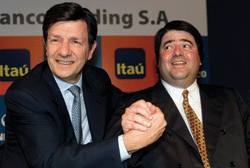
Former Unibanco chief executive Pedro Moreira Salles (r) with Itaú chief executive Roberto Setúbal : the merger of their banks has created a national champion |
Setúbal says he first discussed the possibility of a merger with Unibanco in 1998, one year after Pedro Moreira Salles became chairman of Unibanco’s board of directors. The acquisition of Banco Real in mid-1998 by ABN Amro had taken away another avenue for merger for both banks and was conspiring to push them together. The banks revisited the possibility in the early 2000s but in 2007 Setúbal and Moreira Salles began seriously to discuss a merger. No investment banks were involved; there were no teams of lawyers privy to these talks. So when the news broke on November 3 2008 it took the market by surprise – at least in terms of the announcement, if not the logic.
The result is a national banking champion. “We have a very strong platform,” says Setúbal. “Itaú Unibanco is number one in private banking, credit cards, asset management, investment banking – essentially if you think of any part of the banking system that has evolved in the past 20 years we are very strong in those markets – we are number one by far. In more traditional areas of commercial banking we have a more head-to-head fight with the other commercial banks in Brazil.”
Merging family businesses can be a tricky process, especially as dominant personalities and egos are often involved. Setúbal says: “Things can get very personal but we were mature enough to understand what was good for the company and what was good for the families. This was a big demonstration of doing something that was good for the companies, good for the shareholders but not necessarily for the individuals. It was not easy but it was possible.” Setúbal emerged as the combined bank’s president and chief executive, and Pedro Moreira Salles became chairman of the board.
Itaú Unibanco will continue its concentration on southeastern Brazil, and the A and B economic classes. “Our competitors have a much more spread-out penetration in the small cites of Brazil and have more points of sale than we have,” Setúbal says. “It’s a different type of banking. Brazil has been reducing poverty a lot and the C class has been increasing a lot but the classes that are growing fastest are the A and B class and that is something that is very important for us in terms of strategy.” Another key target for growth is the small to medium-sized company segment “as we believe this market, which has been underserved for many years, will outgrow other consumer and corporate segments”.
The merger was complicated. Unibanco had a more disparate internal banking structure, with some divisions operating as almost separate entities. More than seven IT platforms had to be consolidated into one group-wide system. And there were other costs: rebranding more than 1,000 Unibanco branches into the Itaú brand, integration of staff pay and benefits as well as other migration costs. Itaú’s efficiency ratio, which had been reduced to 47.2% just before the merger from 53% in 2005 rose to 49% last year. It is now 48.6%. Compared with the costs incurred by some US and European banks when they attempt to integrate merged entities into a single system, the speed of transformation and the low level of associated costs have been remarkable. Now Setúbal is targeting an efficiency rating of 41% in 2013, which would be a big achievement given that the bank has committed itself not to close any branches.
Setúbal says of the target: “I think we can do it. We have plans that will improve things a lot and we can really reduce costs now that we have only one platform. We have made the bank bigger and now we need to make it stronger.”
Of course, the alternative to improving the ratio through cutting costs is improving profits. The bank’s position in the domestic market should help because, despite slowing credit growth across all sectors, this reduction is from a 21% rate. The bank still sees credit growth of between 16% and 20% in 2011, “and probably closer to 16% – basically we have reduced the expansion of loan growth given the slowing conditions of the Brazilian economy,” Setúbal says.
Itaú intensified a more conservative risk approach to credit growth at the end of 2008 in anticipation of the current cycle of monetary tightening. Today Brazil’s Selic rate has risen to 12.25% and the bank expects probably another two increases of 25 basis points before the top of the cycle. Non-performing loans have risen because of the rising interest rates. The bank’s NPL rate is 4.2% and it expects this 90-plus-day rate to increase, since its 30- to 90-day delinquency rate is climbing. “The higher interest rates are already having an effect and also we are seeing at the margins strong signs of a reduction in growth – it has not led to increase in unemployment yet but the level of sales is declining in terms of what they were at the end of last year and the beginning of the year,” says Setúbal.
Setúbal thinks the NPL ratio will start falling by the end of 2011 and certainly doesn’t agree with recent diagnoses of an unsustainable credit-driven economy, despite estimates that 20% of Brazilians’ income is spent on debt interest payments. “Brazilian consumer debt and the service of consumer debt are high compared with many countries, especially those countries in the same level of development as Brazil,” he says. “It’s high but it’s not increasing. So we believe this is much more of a characteristic of our economy and financial system than anything else. In Brazil the banks have, for many reasons, developed this skill of lending to consumers. We are not running into a crisis but I would be worried if we were increasing the level of service to salaries in the economy.”
|
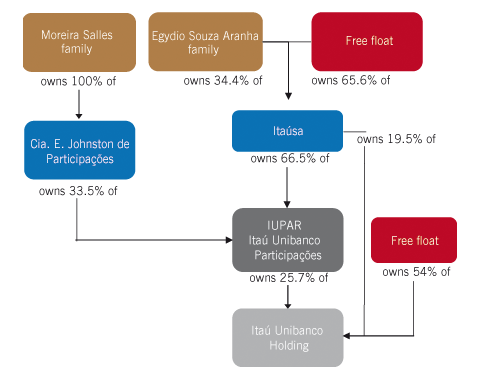
Itaú’s Ownership Structure |
 |
|
Source: Itaú |
As the head of the dominant Brazilian bank, Setúbal has no more transformational domestic M&A targets. Tactical acquisitions might present themselves sporadically, such as the bank’s recent purchase of Carrefour’s consumer financing operation (which it managed to steal away from an expectant Bradesco at the last minute). But the big growth opportunities will be outside Brazil. Setúbal thinks Itaú’s investment and wholesale banking international growth can be organic. “We can do it basically through our own capital and our own means, especially as we have a great reputation in the region and because we have Brazilian companies that are in different countries where we can support them; so there is opportunity for growth without needing to acquire a local bank and we are in the process of doing that.”
However, if the bank wants to add to its retail operations in Argentina, Chile, Uruguay and Paraguay it will have to be through acquisition. “To go retail you have to acquire something; it’s really impossible to start from scratch,” he says. “There are possibilities in the region, we are interested and looking but the thing with acquisitions or partnerships is that you need someone else to dance with.” Potential dance partners are being sought in the other important Latin American markets. “Colombia, Mexico and Peru are big countries that would be attractive for us.” Setúbal says a US acquisition is not a priority but could happen should an opportunity arise for an interesting franchise. Further afield – Europe and Asia – is outside the bank’s strategy, certainly for the moment.
And are valuations prohibitively high at the moment for on-strategy, regional targets? “Yes, at this point of time for many reasons the valuations of Latin American banks are higher than ours so we need to be careful.” Setúbal is at pains to emphasize that this cautious style will be maintained, if not perhaps enhanced because the bank is stepping outside its comfort zone: “We have to be very careful with the international expansion, we cannot think just about being a big bank, a global bank. We have to be very careful about what we acquire, what we shouldn’t acquire and what the risk involved is. Given our size, all the investment banks come here to offer us things but we have to be very disciplined that we are doing the right things, that we are creating value for the shareholders, being careful in developing while being under control.”
Investment bankers who turn up to pitch acquisitions to Setúbal at Itaú Unibanco’s custom-made headquarters in São Paulo’s Conceicão district might look out of the window of the reception area onto the constantly moving water-and-wind sculpture by contemporary Japanese artist Susumo Shingi and think that this Itaú Unibanco is a new bank; a revolution in southern hemisphere banking, and one that is signalling a freshness and a new vibrancy and is disassociating itself from its cautious, methodological and evolutionary past. But that would be to miss the consistency that is present everywhere within this bank of engineers, even within this ultra-modern reception room. The building in which it sits is called the Tower Olavo Egydio, after Roberto’s father. On the wall opposite the view of the water sculpture hangs an oil painting (A pequena aldeia) by Lasar Segall – an eastern European Jewish artist who claimed Brazilian citizenship in 1923 and whose work was bought by Olavo as part of his nascent collection of modern art.
The Japanese water sculpture is a recent addition to what is now one of the most important collections of modern art in the country. Continuation and consistency are everywhere within Itaú and are values that have underpinned the bank’s recent growth. Such a culture tends to be particularly strong in family-based organizations, as Itaú-Unibanco still is today. “Working here every day, arriving here early, making careful decisions and building the franchise – it’s the kind of management that is possible for a family controlled business where you don’t have to show quarterly results,” says Setúbal. “You can think longer term because you are committed to the longer term and I think this is part of the explanation about how we have been so successful.”
Setúbal has four years before the company’s mandatory retirement age of 60 applies to him. Beyond that, Ricardo Villela Marino is rumoured to be being groomed for power, the third generation within this now three-family dynasty. His graduate education was, unsurprisingly perhaps, in engineering at the Escola Politécnica. But the question of succession is for later. Roberto Setúbal is still very much in control. “I have always thought about the next two or three years and how much we can do in terms of building the bank, improving the business and looking at the opportunities,” he says. “When I was first appointed CEO of the bank in 1994 I would never have imagined that I could bring the bank to the point where we are today. I would have said it would be impossible.”