 |
|
|
Best Global emerging markets investment bank: Goldman Sachs |
|
|
Also nominated: Credit Suisse and Morgan Stanley |
The secret to any investment bank’s success in emerging markets is global connectivity. It’s a horrible phrase but one every bank is grappling with: how can they connect and then intermediate the investment flows between, say, a Brazilian mining company and a Korean steel firm or a Middle East wealth fund and a Spanish oil producer?
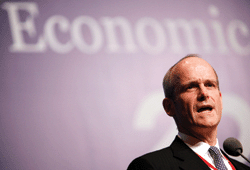
At Goldman Sachs the bank has appointed one of its most senior executives, Michael Evans, in a newly created position of global head of growth markets to oversee the challenge. Evans, a vice-chairman at the firm, has an unprecedented remit across all of the bank’s businesses, including wealth and asset management, to identify emerging markets clients’ needs and then service them, whether it be advisory, financing or upfront investment. “Growth markets is not a separate division,” he says. “The key is to harness all of our businesses to serve our clients’ needs. This model involves everybody at Goldman Sachs.”
Evans, who took on the new role in January, is no newcomer to these markets. Since 1994 he has been one of the architects in developing the bank’s China business. He has also been chairman of Goldman Sachs Asia since 2004 – a post he will keep. “The change in my responsibilities is more of a reflection of our recognition of the importance of addressing growth markets holistically,” he says.
He adds: “One of the things we’ve noticed over the last few years is that, to serve our clients most effectively, we really need to help connect them across markets and products and break down the artificial barriers between geographic regions.
“The second dimension is to connect the growth markets with the developed markets. So my other responsibility is to tie those two together.”
|
|
|
“The key is to harness all of our businesses to serve our clients’ needs. This model involves everybody at Goldman Sachs” |
As statements of intent they make perfect sense. The true test is, however, whether the vision leads to business. It’s too soon to judge the impact of Evans’s role but he is already working from a strong base. Goldman Sachs is as good as any investment bank in emerging markets, especially in M&A and equities, leading deals in all regions. And although its debt business is not quite top tier it is making headway, especially in emerging Europe and Latin America.
Goldman’s ability to connect globally is best illustrated by its role as adviser to a partnership of Japanese and Korean companies, including Nippon Steel, Posco and Korea’s National Pension Service, in their acquisition of a 15% stake in Brazilian rare metal miner CBBM for $1.95 billion in April.
It required collaboration between Goldman’s sector and industry bankers across different geographies. “Our people in investment banking don’t think locally or regionally but globally,” says Evans.
“In looking at where in the world those assets would be accessible, Brazil was identified as one of the places. Canada was another,” he adds, illustrating Goldman’s ability to identify opportunities for its clients.
In the equity markets, one of the bank’s most significant deals was the IPO in November for Mail.ru, Russia’s equivalent of Facebook. At $1 billion it became the largest London-listed IPO by a Russian business since 2007. Mail.ru generated strong demand, which resulted in multiple times oversubscription at offer price.
Goldman was one of the internet company’s leading shareholders before the IPO. Evans denies, however, that the bank makes principal investments with the specific intention of winning follow-on business. He cites a 12% investment in Taikang, a Chinese life insurer. “We didn’t invest to win an IPO mandate but because we think it’s a great company that will generate good returns,” he says.
Still, in Russia it’s hard to escape the notion that there’s a direct correlation between Goldman’s private equity investments – more than $1 billion since 2007 – and its successes in the capital markets and M&A. It is a top-three player in Russian M&A and debt this year and is in the top four in equities. Perhaps Goldman feels it has to demonstrate its commitment more in Russia than elsewhere after scaling back twice before. Goldman bankers say that what happened in Russia is history. What matters is the bank’s commitment now.
One market Goldman entered early and remains prominent in is China. In 2004 it became the first foreign firm to enter into an onshore securities joint venture, with Gao Hua. The combined resources of Goldman Sachs, GSGH and Gao Hua constitute the largest team among international investment banks in China. So far the experience has produced mixed results. In 2007, the venture was ranked sixth in underwriting domestic Chinese listings. Last year, the firm had no A-share IPO mandates though in February it led a $3.5 billion A-share follow-on for Sinopec through a convertible bond. Evans, however, is adamant about Goldman’s China business. “We believe it’s been a tremendous success and we’re very pleased with the way it has developed,” he says, adding that the bank has a number of transactions in the pipeline.


