 |
|
 Real estate survey results Global Regional breakdown Country breakdown
Methodology
|
THREE YEARS ON from the Lehman Brothers bankruptcy, it is safe to say that the deluge of commercial real estate (CRE) bargains that investors had expected from stricken banks in the US and Europe will not materialize. Although the stand-off between balance-sheet lenders and potential distressed investors has eased over the past year (with several important portfolio divestments already executed and more coming to market) industry-wide recapitalization and deleveraging on both sides of the Atlantic have prevented forced selling and restricted the flow of dirt-cheap opportunities. Against the backdrop of continued monetary and fiscal easing, renewed risk appetite among banks and institutional investors has emerged to tackle the refinancing challenge. Ray Torto, global chief economist at CBRE in New York, says that in Europe and the US, CRE markets have performed better than the overall economy. “Even with the tepid economic recovery, CRE in Europe and the US has outperformed the underlying economies and we expect that to continue as economies slow from here,” he says. “The income and appreciation generated by institutional properties in the core financial centres currently look compelling compared with other asset classes.”
Steady improvement on Main Street
After several years of torrid markets, with spiking levels of distress in property and loan performance, the US CRE market is normalizing, although recovery has been moderate. Since the peak in 2007, US CRE values have fallen 42%, around 10% further than they did in the 1990s. July’s Moody’s/REAL Commercial Property Price Index shared US property values rose 6.3% in May, the first positive move after six months of declines and the largest one-month increase since the index began in 2000.
Meanwhile, banks have deployed a combination of recapitalization, balance-sheet de-leveraging and regulatory forbearance to shave CRE exposures. The most recent data published by Foresight Analytics, a division of Trepp, show that bank exposures are at their lowest since 2009. Total CRE loan exposure, including mortgages and loans for construction and land acquisitions, has shrunk from $1.8 trillion in the first quarter of 2009 to $1.55 trillion. However, this still leaves the banking sector with an average exposure of 121% of tier one capital, 4% lower than last year. Banks with more than $100 billion of total assets are the least exposed, at 70% of tier one capital, 3% lower than 2010, while banks with assets ranging from $100 million to $1 billion are most at risk, with 273% of tier 1 capital exposed to CRE.
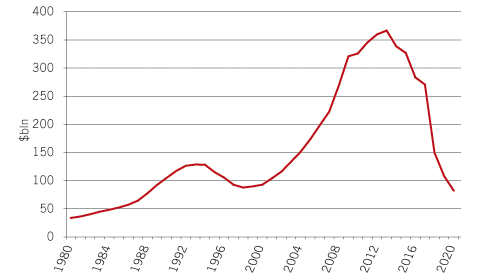
Although US banks have made widespread use of amend-and-extend policies to give borrowers more time to pay down loans, lenders face hundreds of billions of dollars-worth of redemptions each year, a problem exacerbated by depressed property values. According to Foresight data, US banks must now refinance $1.7 billion of CRE debt before 2015, up $300 billion from the $1.4 trillion estimated to fall due before 2014 this time last year. Some $345 billion is set to expire this year alone, with $360 billion due in 2012. Based on valuations data from the fourth quarter of 2010, some $1 trillion (60% of all mortgages due before 2015) remain underwater. If asset values were to recover by 20%, this level would fall to a still serious 14%.
The number of banks dragged under by non-performing CRE assets has also fallen, although CRE exposures continue to play a big role in bank failures in the US. The Federal Deposit Insurance Corporation took 13 banks into receivership this July with more than $1 billion of non-performing loans languishing on their balance sheets; commercial mortgages accounted for 31% of the total non-performing portfolio. Overall, the rate of bank failures appears to be slowing, with 64 reported so far in 2011, down from 157 in 2010, which was the highest level since 2007.
Matthew Anderson, managing director at Foresight, says that market conditions in the US continue to improve but CRE exposures remain a concern, especially since most US CRE lenders are increasing exposure. “CRE concentrations have come down over time because, broadly speaking, banks have been able to go out and raise new equity to shore up balance sheets,” he says. “At the same time, liquidity in the debt market is improving, as are absorption rates in the underlying rental markets. However, regulators are still concerned about CRE exposures. While there’s no hard rule that says you can’t have more than, say, CRE exposure of more than 300% of total capital, the more you have, the more scrutiny you will get. CRE is still a four-letter word.”
Lenders return
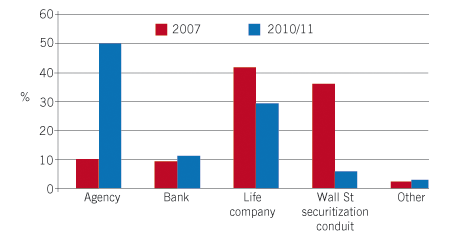
The search for yield is driving a risk-on mindset among real estate investors, or at least it was until S&P’s sovereign downgrade. Lending activity in the US had increased across global banks, life insurance companies, CMBS conduits, as well as government sponsored entities (GSEs) by the end of 2010, and continued to gain momentum into the first quarter of 2011. Motivated by historically low yields, a variety of cash-rich institutions increased capital allocations to real estate in search of a pick-up on the anaemic spreads available in government and corporate bond markets. Although GSEs Fannie Mae and Freddie Mac stepped into the void left by private CRE lenders in 2009, risk appetite and competition returned to the private sector in 2010, led by life companies and CMBS conduits, which accounted for more than 50% of US-based CRE debt finance by the end of the year, according to CBRE research.
|
Who is lending? |
|
Composition of mortgage finance, 2007 vs 2010 |
 |
|
Source: CBRE |
Despite the presence of motivated lenders, a recent Federal Reserve survey of commercial banks suggested that around a third of lenders active in the US tightened underwriting standards in the second quarter to levels not seen in more than six years. Although this suggests that it remains extremely difficult to find CRE funding in the US, CBRE research indicates that for loans that are granted, leverage on a weighted average basis is rising again. From a peak of a 75% average loan-to-value ratio, commercial mortgage average LTVs fell to a low of 55% in mid-2009. The gradual increase in non-bank activity has driven senior loan LTVs back above 60% for the past few quarters. CBRE’s Torto says: “Up until the beginning of August, US funding conditions had improved dramatically, with life companies willing to do deals with attractive leverage ratios and interest rates and the CMBS market starting to come back. Now the number of deals will slow down as lenders reconsider their risk appetite for CRE exposure. It remains to be seen whether the downgrade will be a watershed moment for the US CRE markets.”
CMBS technical knock-out
With some $22.5 billion of US CMBS priced in the first six months of the year, according to US-based data provider Commercial Mortgage Alert (CMA), the market was well on its way to quadrupling the $11.6 billion closed in 2010. And it still might, if S&P is able to get its house in order. Investors’ faith in the agency suffered a blow in late July when it suspended new CMBS ratings activity pending the outcome of an internal review of its rating methodology. So far three deals have fallen victim to the agency’s crisis of confidence, including a Citi and Goldman Sachs joint-sponsored $1.5 billion offering, the first CMBS deal in nearly 30 years to suffer the indignity of being pulled after it had priced.
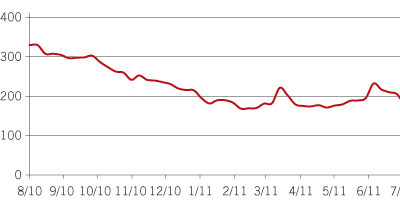
The sheen was already coming off the CMBS revival even before the S&P methodology debacle, however. According to a CMA report, new-issue spreads began to blow out in mid-July amid spiking sovereign default risk when RBS and Wells Fargo had to widen benchmark spreads by 35 basis points to clear a $1.5 billion multi-family offering. By the second week of August, five-year triple-A CMBS gapped wider by 64bp, making volatility in March and June seem like bumps in the road. At swaps plus about 250bp, five-year triple-A CMBS spreads are nearly 100bp wider than their 52-week average, CMA says. Despite the volatility, new deals continue to price, however, with Deutsche Bank and UBS launching a $1.4 billion trade with the publicly offered triple-A classes being multiple times oversubscribed. Nevertheless, it’s far from clear whether originators will be able to achieve price targets on the $6 billion of product slated for launch in September. Indeed, recent reports suggest that life insurance companies are pulling back from new loan origination in view of worsening market conditions.
 |
“CMBS was on fire through the first half of the year but has largely seized up over the past few weeks” |
Todd Sammann, principal with real estate-focused private equity firm Colony Capital in Los Angeles, says that after several quarters of searing activity, CMBS has quickly come off the rails and is now an unreliable source of debt for real estate investors. “CMBS was on fire through the first half of the year but has largely seized up over the past few weeks,” he says. “Uncertainty around ratings methodology and the postponement of several expected deals suggests the market may not yet be prepared to fully embrace CMBS 2.0.”
While distressed investors have been frustrated by the lack of volume opportunities, the sale of Anglo Irish Bank’s $10 billion US CRE portfolio has many private equity fund managers salivating at the prospect of finally getting their hands on some bargains. Although legacy players Goldman Sachs and Morgan Stanley have sold some 90 properties for more than $9 billion so far in 2011, according to Real Capital Analytics data, the Anglo Irish sale is the first volume discount opportunity of the current downturn. But it is unlikely that a single buyer will take the lot. As part of the conditions of its bailout and nationalization, the Irish government forced Anglo Irish to divest its US real estate assets, comprising more than 280 properties, according to sources familiar with the bidding process. New York-based broker Eastdil Secured is running the sale, which is expected to move into secondary bidding in late August. The portfolio has been divided into product-specific pools to attract a wide spectrum of bids from niche players with different costs of capital, according to a fund manager bidding on parts of the portfolio. Whether or not the sale proves to be a turning point for the distressed sector depends on the price it can achieve and whether other banks feel that is worth the risk of showing their hands. However, the poor timing of the deal could mean that the bids come in much lower than expected. “Are the risk premiums in the market today reflected in the bid we submitted yesterday? The volatility in the markets in the US has caused us to think carefully about how we are bidding,” says one fund manager.
Reits on
As predicted last year by the New York-based National Association of Real Estate Investment Trusts (Nareit), real estate investment trusts’ access to both equity and debt capital markets has driven good performance by the sector. In 2010 US Reits raised $47 billion from both equity and debt investors, more than double the volume raised the year before. So far in 2011, the sector has raised a further $40 billion. The industry has continued to deploy capital to de-leverage and strengthen balance sheets and, in the past six months, has shifted its focus to asset acquisition as well. “Reits as a sector have been able to acquire new properties on a disciplined and deliberate basis, although there haven’t been many opportunities to acquire quality properties,” says one specialist.
|
The sheen comes off |
|
10-year triple-A CMBS spreads over swaps |
 |
|
Source: Trepp |
After cutting dividends by 50% during the downturn, Reits have outperformed US equities and are expected to deliver attractive dividend growth for 2011. Michael Muller, a senior analyst with JPMorgan equity research, expects that leading player Simon Property Group, which increased its dividend to 80 cents at the end of last year, will probably do so again this year. However, the prospect of another recession in the US could mean a more measured increase. “We were looking at very big dividend increases across the board by year-end,” Muller says. “The economic repercussions of the past month could temper expectations. Dividend growth will come through, but it will be less future looking.” JPMorgan remains bullish on the stock.
UK lenders in stasis
Encouraged by an increase in lending activity last summer, UK participants had hoped that easier senior debt availability would drive the broader market over the year. Although competition to finance the best-quality assets in London’s City and West End has kept cap rates around 4%, few lenders have the appetite to fund lower-quality assets in non-core markets. Furthermore, regulatory capital restrictions, illiquid asset markets and sovereign risk contagion look likely to constrain UK CRE lending markets in the immediate future. Indeed, UK lending activity appears to have decreased since the first quarter, investors say, despite the arrival of new lenders from the insurance, mezzanine and equity sectors.
There are some positives, however. Piecemeal work-outs, valuation write-downs and asset sales have reduced the volume of debt coming due over the next four years, albeit by less than 10%, notes Barry Osilaja, a director in Jones Lang LaSalle’s European corporate finance group in London. Pointing to divestments from Royal Bank of Scotland, Lloyds/HBOS and Irish banks controlled by the government’s National Asset Management Agency, Osilaja says: “Banks are facing reality and beginning to deal with the write-downs and asset sales required to de-leverage. So far quantitative easing has helped repair balance sheets, and now more banks are comfortable to write off loans if they have to. The largest lenders have taken write-downs as big as £10 billion [$16.5 billion] in the past 12 months.”
As in the US, it’s a question of how long the banks can hold on for as improving property values make outright asset sales more manageable but less urgent. Rather than realizing today’s low values, some UK banks have adopted FDIC’s model by partnering with asset management specialists to improve the performance of their problem CRE loans. RBS’s recent deal with Blackstone, which gives the New York-based private equity firm a stake in a £1.2 billion portfolio, shows that while banks are addressing the problem, they are stopping short of full disposal. “The majority of UK CRE loans cannot be sold without mark-to-market pain, so banks are looking at other solutions. Structured sales that shift loans into joint-venture vehicles have been popular and we expect more of these over the next year,” says Osilaja.
Investors report little change in senior funding dynamics over the past year, with liquidity typically reserved for the core assets with strong covenants and long leases. Availability of leverage remains capped at around 55% to 65% for core London properties, with margins typically in the swaps plus 200bp area, slightly higher than this time last year.
In theory, banks’ limited appetite for leverage should create new opportunities for mezzanine and equity lenders to fill the funding gap. Over the past year, several US and European insurers have set up lending platforms in London with the objective of generating double-digit returns. However, the lack of liquidity in the senior markets has restricted the flow of opportunities to add leverage, and insurance companies have had to content themselves with a handful of transactions. Furthermore, increased competition for the relatively few opportunities is driving yields lower. Eric Adler, chief executive of Pramerica Europe, which this year launched a £500 million fund focused on mezzanine funding opportunities in core European markets, says: “Although we’ve closed some large trades and have more in the pipeline, there’s not a ton of deals getting done in the mezz space and interest rates have come in by a few percentage points. While these opportunities are still attractive on a risk-adjusted basis, the shortage of senior funding is restricting the flow of investible opportunities.”
With most of the institutional money crowding into core assets to shelter from volatile financial markets, non-core European markets are getting left behind. Falling cap rates in London, Frankfurt and Paris hide a very different reality for secondary assets, which have been largely ignored by investors and lenders. “Secondary assets throughout Europe have suffered from very poor liquidity in both asset sales and lending,” says Osilaja. “Although senior funding is available for these assets at around swaps plus 300bp, lenders are demanding very conservative covenant packages and these are rarely viable in current market conditions. Anything outside of the core markets has become very difficult to trade.”
|
Past its peak |
|
Commercial mortgage maturities by lender type |
 |
|
Source: Trepp, LLC |
Safe haven sought
|
|
|
Can commercial real estate keep going up? |
|
|
Results |
|
With investors increasingly looking at core CRE markets as safe-haven assets, will the latest bout of economic weakness drive more dollars into bricks and mortar? CBRE’s Torto argues that the volume of capital reaching for yield is greater now than it was during the structured finance boom, a dynamic that should ensure that CRE returns outpace the economic fundamentals over the short- to medium-term years. However, the concentration of capital on existing stock in established global financial centres might mean that secondary stock will languish for years. “Global capital will continue to flow into core real estate in New York, London, Paris, Hong Kong, but the lack of risk appetite to finance construction and development means that the non-core recovery will be pushed further out,” Torto says. Meanwhile, some investors are asking whether CRE valuations are sustainable. From the bear’s perspective, the risk-off mentality in the US CMBS market could signal a correction in CRE risk premia. “Zero interest rate policy and relative distress in Europe have been sufficient to drive foreign capital to US markets, further inflating asset valuation bubbles. Recent volatility could be the beginning of a correction to clear all of this undue leverage out of the system,” says Colony’s Sammann.
Asia is likely to be insulated from this angst by its superior economic and demographic fundamentals, and most local participants dismiss the idea that Chinese, Singaporean and Hong Kong markets are fit to burst. “The theme for Asia-Pacific doesn’t stop over the next few years, driven by massive demographic shifts in China and supply constraints in the gateway markets of Hong Kong and Singapore,” says Sammann. “The volume of money pouring into the region is simply too great for governments to control. We expect international investors to make more not less capital available for Asia-Pacific real estate in the near term.”