Last month China and France announced that they had agreed to form a taskforce to discuss the conditions under which the renminbi could become part of the IMF’s special drawing rights (SDR). This could have long-term implications for global currency markets. That task force will present its proposal ahead of the summit of leaders at the G20 in Cannes in November.
The development of a taskforce is important for two reasons. First, it recognizes that the world’s incumbent reserve currency, the US dollar, is no longer seen as being an unquestionable store of value. Secondly, the SDR basket would offer large creditor countries, such as China, an opportunity to reduce their reliance on the US as a destination to invest their vast trade surpluses.
Although there are several variables that determine the weights accorded to the SDR, the main one is international trade. As the weightings stand at present, the US dollar makes up 41.9% of the basket, the euro 37.4%, sterling 11.3% and the yen 9.4%.
Those weights are revised every five years by the IMF but can be revised earlier if the Fund finds that changed circumstances warrant it. According to some sources, at the last revision in November 2010 various comments by senior G7 officials suggested that a much earlier review might occur.
That is important, according to Andy Seaman, an adviser to Stratton Street Capital’s PCC Renminbi Bond Fund in London. The fund was one of the first international bond funds denominated in renminbis and was set up in 2007. He says that if the renminbi were included in SDR today, it would make up 20% of the basket. That isn’t likely to happen in the near future, because a currency must be fully convertible to be included but it is very telling of the shift in currency policy.
“Why would they do that unless they were considering adding in a different currency or weight?” Seaman says. He adds that last year’s creation of the freely convertible offshore renminbi (CNH) market means that the barriers to accepting the Chinese currency into the basket have been weakened.
Precocious infancy
Although the CNH market is only in its infancy, it’s now likely to be added to the SDR. “They might argue it’s too small even though it’s convertible but the market is growing rapidly and it’s not going to be very small for long,” Seaman says. “It represents a major change, in terms of the power between central banks across the world, and China is going to win.”
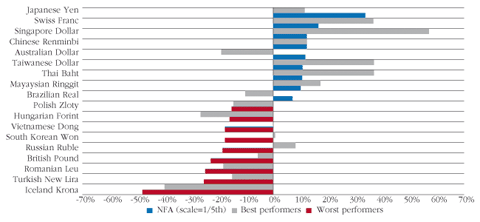
The potential inclusion of CNH in the SDR basket also highlights what could be a big shift in the global currency markets, argues Seaman. His analysis over 18 years, based on net foreign assets (NFA), found that in bull markets the flow of capital moved from creditor nations to debtor nations and in bear markets capital moved from debtor nations to creditor nations. NFA is defined as net debt, or assets held by an entire country, including government, corporate and individual debt.
This trend would only be compromised if interest rates of the debtors were high enough to encourage the creditors to leave their money where it is. That’s unlikely given that the Federal Reserve has signalled that it is going to leave rates on hold till 2013. “If you’re an Asian investor, you’d have to be absolutely mad to take on the exchange rate risk for no compensation whatsoever.”
In a deleveraging global economy, Seaman foresees a large broad-based rebalancing in the currency markets in the coming years. That presents the opportunity for a significant appreciation of the renminbi in line with the IMF’s stated desire to see a global rebalancing between the debtor nations in the west and the creditor nations, in particular China.
The deleveraging process means that indebted nations face three alternatives: They can either default or take drastic economic steps, such as raising taxes, necessary to pay down the debt. Those are probably unpalatable, asserts Seaman, so the only other option is for a structural shift in currency valuations similar to the Plaza Accord in the mid-1980s.
Stratton Street foresees a situation whereby the G7 nations will devalue, which they claim is already happening, whether it be that politicians have already tacitly agreed to do it collectively or, more likely, that market forces are dictating it for them.
The renminbi is the critical currency in this process. Stratton Street has also conducted another analysis that shows that China is following the Singaporean model of using the currency to target inflation, which leads Seaman to conclude that China is “letting the currency appreciate at a much faster pace than people assume”.
He adds: “So you’ve got this natural tendency where Asian currencies go up just through the policies they’re adopting. And you’ve got this natural tendency for the dollar to go down, because of the policies they’re adopting. It seems to me that we could have some very significant exchange rate movements.”
|
Currency shifts support NFA analysis |
|
November 2007 to January 2011 |
 |
|
Source: Bloomberg |
This article was originally published by Euromoney FX News. Sign up for a free trial today.




