Fund managers are urging investors to take another look at Japan’s battered stock markets after a combination of poor long-term performance and the March Tohoku earthquake have pushed valuations low across the board. Data from Chuo Mitsui Trust International, the London-based arm of the Japanese fund manager, reveal that 66% of listed Japanese companies were trading at a price to book (p/b) ratio of less than one as of April 1.
|
“The market has fully absorbed the implications of the damage suffered in the region and the direct consequences to firms that were particularly affected” |
The p/b ratio of a company is a means of comparing its current book value (tangible assets minus liabilities) with the price of its shares. A ratio below one is low and implies that the company might be underpriced or in trouble.
While CMTI’s number is still below the record of 75% of companies reached in 2009 it is an increase on the situation before the global financial crisis: between 2005 and mid-2007 the ratio of companies trading at a p/b ratio below one was under 30%. Some Tokyo-based fund managers believe there are many seriously undervalued Japanese firms lurking under that cloud.
Even before the recent disasters, global investors tended to be underweight in their allocations to Japan, reflecting attitudes to a market that has been in steady decline and leading to depressed prices. According to Chuo Mitsui Trust International, while Japan accounted for 22.1% of MSCI’s Europe, Australasia and Far East Index as of 2010, it accounted for just 16.6% of the average portfolio allocation among fund managers.
The broad-based Topix index stood at 1,743 at the beginning of April in 2006; it had fallen to 878 at the same point this year. Given the country’s well-known macroeconomic challenges, the costs of restructuring and consistently depressed stock markets, why would investors assume corporate valuations will rise?
Bad to worse
“It’s true that the past 10 years have been bad for Japanese equity markets,” says Daiji Ozawa, chief portfolio manager of Invesco Japan’s Value Equity Fund in Tokyo, “but 20 years ago they were among the worst – by which I mean most expensive – of any in the world, with average p/bs of up to 70 times at the peak of the bubble.”
|
“This year, if there had been no disaster, we’d have seen average return on equity up to around 8.4%” |
 |
That ratio has come down, Ozawa says, to reflect the low average returns on equity and capital of corporate Japan – around 6% for both. “Now corporate profits are improving,” Ozawa says, “companies are starting to increase dividends and do share buybacks. This year, if there had been no disaster, we’d have seen average return on equity up to around 8.4%. While top line growth in Japan will be limited, a lot of companies are growing their business outside Japan in such markets as China, India and southeast Asia.”
These companies are key to avoiding what Ozawa calls the value trap – the temptation to invest in Japanese stocks that look cheap but turn out to deserve those valuations because their businesses are correlated to a domestic GDP growth rate that is expected to be no better than 1% for the next few years. Ozawa says that despite the earthquake, he has made only minor adjustments to the portfolio of his fund, which invests for the long term in large-cap listed Japanese companies, because it is already targeted at companies that he thinks can overcome poor domestic prospects by growing their overseas businesses.
Dividends
Japanese companies have also become more shareholder-friendly over the past few years, with an increase in the number of companies paying dividends in particular. According to the World Intellectual Property Organization, that number rose from below 25% in 2000 to 37% in 2009, excluding non-profitable companies. While that is good news for shareholders, says one Tokyo-based fund manager, dividend yields are hard to predict after an earthquake. If companies hoard cash in the uncertain environment, the encouraging trend of an increase in dividend yields might be halted.
Invesco’s Ozawa argues that once supply-chain disruption and rolling blackouts recede in the second half of the year, the country could see positive GDP growth for 2011 because reconstruction efforts will be an important source of demand.
Nonetheless while the earthquake, tsunami and concerns over damaged nuclear reactors appear to have made Japan’s economic outlook worse, some argue that markets have already taken these factors into account.
“Although the outlook for the Japanese market remains uncertain,” says Chris Renwick, head of sales and marketing at Chuo Mitsui Trust International, “we continue to assume that the impact on the Nikkei, currency market and economy will be limited. In our view, the market has fully absorbed the implications of the damage suffered in the region and the direct consequences to firms that were particularly affected.”
|
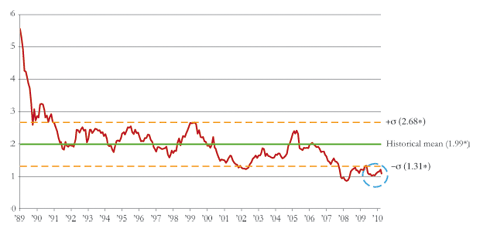
Profit appeal of Japan’s asset managers declines |
|
Operating margins of asset management firms (percentage of net revenues) |
 |
|
Source: BCG |