The Greek debt saga reveals a serious risk of a global sovereign debt crisis. Global public sector debt has soared to unsustainable levels as central banks and governments have tried to mitigate the impact of private sector deleveraging. But markets are now waking up to this. They are focusing on those sovereigns with large debt burdens and are beginning to price their paper accordingly.
There are many differences between the economies of the so-called Piigs (Portugal, Ireland, Italy, Greece and Spain) and the larger G7 economies – almost as many as the differences between sub-prime and prime mortgages. However, there is one common denominator – excessive leverage.
|
Government debt to GDP ratio* |
|
Projections for advanced G20 economies’ |
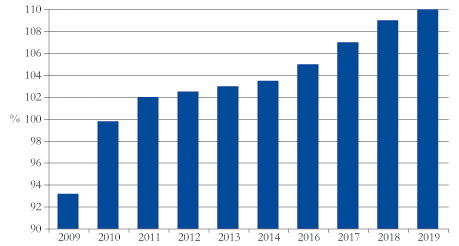 |
Note: * IMF forecasts based on impact on debt from automatic stabilisers, fiscal stimulus, financial sector support. |
|
Source: IMF |
It is baloney that the policymakers swapped public-sector debt for private-sector debt to combat the credit crisis. Rather, they added a high level of public-sector leverage to an almost unaltered level of private-sector debt to create a super-overleveraged situation. That public sector leverage is now becoming unsustainable. That is the common denominator between Greece and the other overleveraged states. But although OECD government borrowing is set to soak up more than 20% of world savings this year, real interest rates remain at lows.
Markets are only slowly latching on to this situation because the received wisdom is that this excessive leverage won’t come undone before vigorous economic recovery returns. By then, the argument goes, higher yields will matter less because there will be optimism, economic growth and wealth creation.
But this is wrong. Excess leverage becomes a credit crisis when it does; not when it rationally should do. The level of excess debt is all that matters. Many economies have reached a level of sovereign debt where increased public spending detracts from growth. This is the Ricardian effect, where individuals and corporations save to pay for the future taxes and reduction in government benefits that deficit spending ultimately entails.
|
Markets will not let |
Many countries outside the eurozone (Japan, the UK and the US, to name a few) are on the same tracks as Greece, but only a few stops before the Greek train; and some (such as Japan) are beyond Greece in terms of penetrating the death zone. It is only a matter of time. Stricken, or soon-to-be struck, governments are toying with the idea of “tolerating” higher inflation to reduce their debt burdens (or incur more). Bogus intellectual theories are being unwrapped to make the con palatable. But markets will not let government get away with debasing the assets they invest in. They will jack up the real yield (not just the nominal yield) on sovereign and other debt to offset the risk.
In Japan, if JGBs got to the same yield as German Bunds, it would cost the Japanese budget 12% (instead of today’s 3%) of total spending and nearly double the current 12% of GDP deficit. Moreover, according to the OECD, governments will be issuing mostly short-term paper in 2010, as they did in 2009.
Nevertheless, a sovereign debt crisis will not unfold like a private sector one because governments can theoretically avoid default on their debt by printing money and debasing it with inflation, and will try to do so. They can also increase taxation and reduce spending in ways that aren’t available to an overleveraged private sector in crisis – and their customers are captive taxpayers who cannot flee. And markets will assume a lower default risk for sovereigns than for private sector creditors. This might slow the spread of the sovereign global credit crisis.
At the risk of over-rationalizing, the most likely catalyst for the sovereign credit crisis is renascent inflation spreading from emerging markets (Latin America and Asia, in particular, where it has been worsening for a time) to developed markets. Inappropriate policies are always the cause of rising inflation. Both emerging and developed markets have similarly inappropriate policies. Emerging markets do have growth, but this might not be enough of a difference to prevent the contagion of inflation.
David Roche is president of Independent Strategy Ltd, a London-based research firm. www.instrategy.com


