| Abigail’s biography |
January is the cruellest month. Christmas cheer is in the rear-view mirror. Everyone talks about new beginnings but with snow and slush on the ground it feels like “same old same old”. I don’t know about you but in January I am normally fatter, poorer and more curmudgeonly than in other months. The annual IFR awards dinner in London in mid-January is therefore something of a relief, as hordes of financiers, in fancy evening attire, gather at the Grosvenor House Hotel.
Like moles emerging from their burrows after a hard winter, most bankers feel compelled to put in an appearance. Yet they grumble incessantly as they squeeze into their tuxedos. After a long day in the office, it’s not everyone’s idea of a good time to spend four hours in the company of colleagues, especially as feuds over the bonus pool usually escalate during January. I was invited to sit at one of the Credit Suisse tables. Credit Suisse won IFR’s Bank of the Year award.
 |
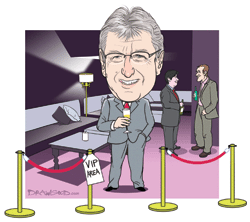
Brady Dougan, Credit Suisse’s chief executive, and Paul Calello, the head of its investment bank, have changed perceptions of the institution over the past few years. Once viewed as the poster child for “greed is good”: think football-style packages for dubious stars such as Frank Quattrone and disputes with regulators in numerous jurisdictions, Credit Suisse is now deemed the acceptable face of an unpopular industry. This might have something to do with Dougan’s personality, which is modest and thoughtful with the hint of a wry sense of humour. In other words, Dougan is about as far from a brash investment banker as you can get. And of course, he works all the time: sources report receiving emails from him at midnight. Indeed, a mole claims to have spotted Brady Dougan and a colleague boarding the 6am flight back to Zurich the morning after the IFR awards party. It is interesting to note that even for European short-haul travel Dougan doesn’t do private jets. On the other hand, no normal mortal takes a 6am flight, so the plane is probably empty and thus offers the privacy of a private jet. I intend to claim a small part in the resurgent reputation of Credit Suisse. I was an early believer in the firm and first wrote positively about it in October 2006 when commenting on the appointment of Fawzi Kyriakos-Saad, the former senior JPMorgan banker. Kyriakos-Saad now runs Credit Suisse’s Russian business. I continued my upbeat commentary and in June 2007 wrote: “I’m beginning to have a soft spot for Credit Suisse.” Last July, Euromoney named Credit Suisse as its best investment bank of 2009.
Many of Credit Suisse’s senior investment bankers attended the IFR dinner, including Gaël de Boissard, the head of global securities; James Leigh-Pemberton, chief executive of Credit Suisse in the UK; Luigi de Vecchi, co-head of the investment banking division; David Mathers, the chief operating officer; and Paul Tregidgo, vice-chairman of debt capital markets. A few days before the dinner, Gavin Sullivan, Credit Suisse’s head of communications, EMEA, told me that I would be seated between Leigh-Pemberton and Matthew Cestar, co-head of credit capital markets, EMEA. I was thus puzzled when I arrived at the table to find myself next to the delightful Chris Tuffey, head of debt capital markets, EMEA; and the cerebral Nick Williams, head of European equity markets. In my allocated place perched Mark Kleinman, the young and thrusting City editor of Sky News. As befits someone who writes a column entitled “Abigail with attitude”, I went over to Kleinman and asked if he had switched the place cards. “Of course, I didn’t,” he replied vehemently. In journalism, as in many other fields, who you know is as important as what you know. Indeed, in an interview last October with The Guardian newspaper, Kleinman, when asked about the secret of landing a scoop, responded: “It’s all about your contacts, it’s all about being trusted…” And undoubtedly James Leigh-Pemberton is an important person to count as a contact.
During dinner I pondered the saga of the wandering place cards and came up with three potential solutions to the mystery. The first, and the least likely, is that Gavin or one of her team had made a mistake and that the seating did not match the table plan. I consider this virtually inconceivable. I have known Gavin for nearly four years and her middle name might as well be efficiency. The second possibility is that place cards have suddenly become animate objects and can dance around the table at will. The final alternative is that there is a new version of placement protocol of which I was ignorant. According to this new etiquette, when you are invited as a guest to a formal dinner, you can seize the best seat and leave the little people to talk among themselves. Such behaviour is totally 2010 and totally in keeping with the “me, me me” tone of current mores. I only wish I had been aware of this development. I would then have switched place cards with the guest of honour, Princess Anne, president of the Save the Children Fund. The princess was seated at the top table next to Paul Calello, head of Credit Suisse’s investment bank. I hadn’t seen Calello for more than three months and I’m sure we would have had a lot to discuss.
At the top table I also glimpsed Anshu Jain, co-head of Deutsche’s investment bank; Michael Ridley and Kristian Orssten of JPMorgan as well as Martin Egan of BNP Paribas; and Paul Hearn, the recently appointed chief executive of Mizuho International. Paul raised one of the biggest cheers of the night when he went up to collect Mizuho’s award for best yen bond house. I wasn’t sure whether this was due to his popularity and people’s pleasure at seeing him back in the market or that the cheers had more than a hint of irony given that he had only started the job days earlier.
I also bumped into two of my favourite senior bankers, John Hourican, chief executive of RBS’ global markets division; and Jonathan Moulds, chief executive of Bank of America, EMEA. It was also a delightful surprise to see Barbara Bargagli-Petrucci of the European Investment Bank, who looked stunning in a mermaid-style long dress; and Doris Herrera-Pol of the World Bank, looking equally delectable in black harem pants.
Brady Dougan made a blissfully short speech when he accepted the Bank of the Year accolade. He spoke about how Credit Suisse had adapted to the new environment and the way that the culture of the firm had changed. And maybe the culture needed to change. Last December, Credit Suisse agreed to pay a $536 million fine for violating US sanctions against Iran and other countries. That’s a big hit even for a bank that had a net income of SFr2.4 billion ($2.3 billion) in the third quarter of 2009.
In the past, Credit Suisse’s culture might have prioritized profits over ethics. It was also a very masculine culture: the phrase testosterone-fuelled comes to mind. Far be it from me to suggest that there might be a link between these two things. There is only one woman, Noreen Doyle, on the board of directors, which is responsible for the overall direction, supervision and control of the group. And until recently there was not a single woman on the executive board, which is responsible for day-to-day management of the firm. Of course, most financial institutions have very few women in senior management. This is an industry-wide sore, not specific to Credit Suisse. I do, however, give Brady Dougan credit for trying to fix the problem. In January, it was announced that the firm had hired Pamela Thomas-Graham as its chief talent, branding and communications officer. Pamela, who has an impressive CV including roles as a partner at consultants McKinsey and as the chief executive of CNBC television, will sit on the executive board and reports directly to Dougan. Appointing a senior woman in a financial institution has limited upside for a chief executive, especially if she comes from outside the firm. There’s no guarantee she will fit in to, and thrive in, the organization. And if it all goes horribly wrong, the Luddite cries of “I told you so” will resemble the crescendo of a Greek chorus. However, I have high hopes for Thomas-Graham and I am very much looking forward to meeting her.
While we are on the subject of parties, one of the nicest events that I attended during December was a cocktail party at HSBC’s private banking headquarters in St James’s Street, London. Dating from the mid-nineteenth century the building was originally used as a club for members of the Conservative political party.
 |
The reception was held in the awe-inspiring main hall aptly named The Grand Room. The guest list was select and seemed to consist of very senior newspaper editors and me. I particularly enjoyed the chance to chat with the group’s senior management: Stuart Gulliver, HSBC’s head of global banking and markets; HSBC’s chairman, Stephen Green; and its chief executive. Mike Geoghegan. The surprise of the evening was how approachable and outgoing Geoghegan is. I had always imagined him to be grey and austere. To label Geoghegan flamboyant would be an overstatement but he was certainly very good company. I look forward to following the fortunes of HSBC in 2010 –a year which I predict will be very difficult for bank chief executives as they tiptoe across the tightrope of popular disdain, and deal with competing interests of governments and regulators worldwide. The backlash has become so extreme that venting venom against financiers has become mandatory rather than merely acceptable. As ordinary mortals toil under the burden of higher taxation, higher deficits and lacklustre economic recovery, Planet Banker seems ever more isolated behind its golden barricades. One senior European banker explained why his institution had raised base salaries for managing directors: “After all, these guys had not had a decent salary rise for years. And no-one can live on £150,000 a year, can they?” The UK one-off tax on bankers’ bonuses was daunting. The most difficult thing for bank chief executives was how it should be implemented. Should bonuses be deferred? Should UK employees alone be penalized or should the pain be spread across the whole bonus pool? And finally, if the firm pays large UK bonuses and therefore has a large tax charge as well, effectively the shareholders are taking the hit, which is outrageous. Credit Suisse gave early leadership to the industry when it announced in mid-January a 5% cut in the overall bonus pool and a 30% reduction for bonuses of its UK managing directors. Goldman Sachs is limiting UK partner payments to £1 million.
The eagerly awaited fourth-quarter reporting period for the US banks turned out to be a party without the punchbowl. In fact, all that anyone will remember about these results is how president Barack Obama popped up like the ugly fairy, stamped his tiny foot and sent all the revellers home.
In a way, the results contained few surprises. There are signs that the US economy is gradually recovering but the consumer is still weak. “We are encouraged by signs the economy is improving, ” said Brian Moynihan, chief executive of Bank of America. At BofA, which posted a net loss of $194 million, provisions for credit losses and net charge-off rates declined from the third quarter. However, JPMorgan, which reported a solid fourth-quarter profit of $3.3 billion, has difficulties with its retail financial services division. This reported a fourth-quarter net loss of $400 million, down from a profit of more than $600 million in the same period of 2008. Defaults continue to increase for home-equity loans as well as for both sub-prime and prime mortgages. Last year JPMorgan acquired mortgage lender Washington Mutual, whose credit-impaired portfolio continues to deteriorate. But JPMorgan’s investment bank performed well, reporting earnings of $1.9 billion in the fourth quarter, marginally less than the third quarter.
As expected, the investment banking trading boom tailed off early in the quarter when traders took risk off the table after a fabulous year. At Goldman Sachs, revenue from fixed income, commodities and currency trading fell 33% from the previous quarter. Nevertheless, Goldman earned $4.9 billion in the quarter and had a record year in 2009, making $13.4 billion. Morgan Stanley fared worse and announced a profit from continuing operations of $413 million for the final quarter of 2009. For the whole year, it reported income from continuing operations, applicable to Morgan Stanley, of $1.1 billion and a loss per share of $0.93. I have many friends at Morgan Stanley but I will incur their wrath by saying that the level of compensation for 2009 seems too high. Morgan Stanley’s compensation expenses for 2009 were $14.4 billion, which is some 60% of the firm’s total revenue for the year. The ratio would be lower (about 50%) if you ignore an accounting charge for improvement in the price of the company’s own debt. Goldman proved that it was less tin-eared than many commentators had feared. The firm set aside $16.2 billion for compensation, 35.8% of its net revenue, the lowest accrual for pay since the firm went public in 1999.
In a way, all this data is now meaningless. Banks are in purgatory. They have become a political football. Obama’s bombshell, without any industry or international consultation, that the administration intended to change the rules of the game, and stop banks undertaking certain activities including proprietary trading, was an obvious lurch to the left. It followed the loss, a few days earlier, of the supposedly safe Massachusetts senate seat, formerly held by Ted Kennedy. The only thing that is certain is that the outlook for bank shareholders and employees today looks cloudy (if you are an optimist) and dismal (if you are a pessimist).
How was your month? Please send news and views to abigail@euromoney.com