|
|
| Best Global hedge fund manager: Bluecrest Capital | |
| Also nominated: Renaissance Technologies and Brevan Howard Asset Management |
Since two senior proprietary traders from JPMorgan – Michael Platt and Bill Reeves – set up BlueCrest Capital in 2000, its three flagship funds have never had a down year. In the light of tanking stock markets, credit crunches, collateral calls and forced redemptions, such an achievement seems inconceivable.
The firm, which until recently was headquartered in London, has about $20 billion in assets under management, making it the third-largest hedge fund manager in Europe, and has nine funds in total. Roughly half of its funds are in discretionary fixed-income trading strategies and the other half in systematic trading funds.
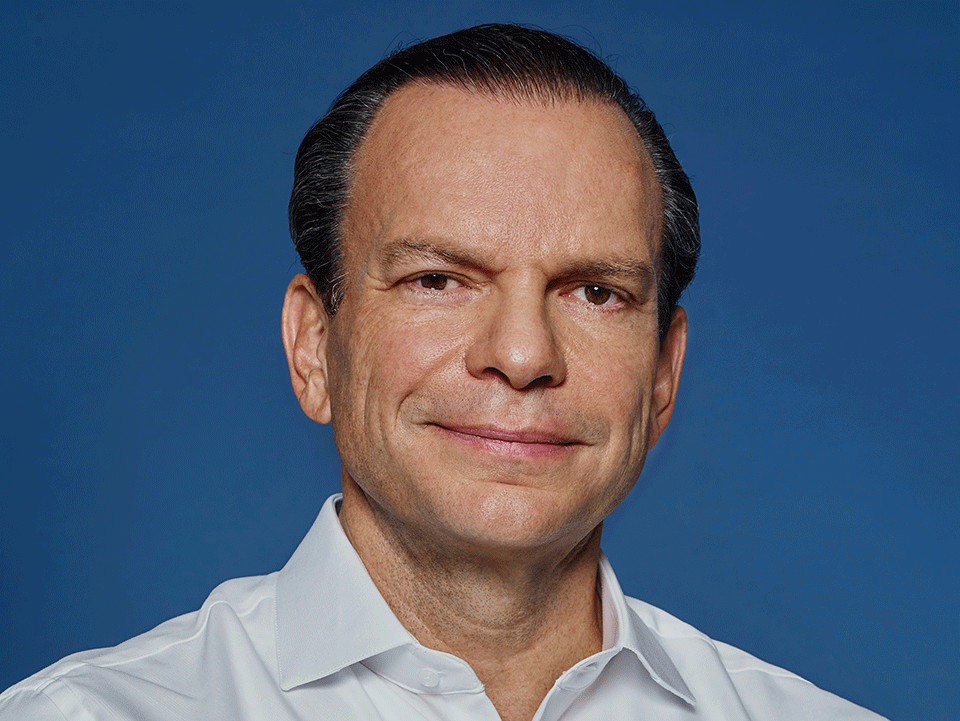
Andrew Dodd, chief financial officer at BlueCrest Capital, says the past 12 months in particular have offered an extremely attractive environment for its discretionary trading strategies. BlueCrest Capital International is the firm’s discretionary flagship fund, with which it launched the firm, and has about $6.5 billion in assets. Since its inception it has annualized almost 15% in returns, and in 2009 made a staggering 45%.
“Once we got through the last quarter of 2008, the levels of volatility were good for fixed-income trading-based strategies,” explains Dodd. “It coincided with a time when banks were reducing their proprietary trading business, so a lot of the competition was taken away. It was an uncrowded market with plenty of trading opportunities.”
The firm’s second flagship fund is a CTA, BlueTrend. Dodd says that the firm had been keen to have quantitative research to back up the discretionary trading of BlueCrest Capital International, so hired Leda Braga, also out of JPMorgan, in 2001 to oversee the team. This team quickly began to investigate systematic trading strategies and in 2004 launched BlueTrend, which now has approximately $10 billion in assets under management. In April this year, the firm soft-closed the fund to new commitments, as it had done in 2006 and 2008. “In an ideal world, capacity grows in line with asset inflows but recent inflows have been significant, so we have decided to take a break for the short term,” says Dodd. BlueTrend returned 43% in 2008. However, because of less attractive markets for trend-following it returned 4% in 2009, still ahead of its CTA peers. The HFRI systematic diversified index was down 1.7% in 2009.
 |
|
|
“It was an uncrowded market with plenty of trading opportunities”
Andrew Dodd, BlueCrest Capital |
One of the firm’s secrets to maintaining positive returns in challenging environments is that it is thorough in its risk management policies. If a trader loses 3% of his trading account, BlueCrest will halve his capital allocation. If a further 3% is lost, the trader has to stop, while a formal assessment is made. Dodd says investor interest in hedge funds has been coming back over the past 12 months. In spite of its positive returns, BlueCrest Capital suffered redemptions alongside its peers during the crisis, as investors needed liquidity. Assets dropped from $16 billion at the peak of the crisis in 2008 to $11 billion in June 2009. To have built that base back up to nearly $20 billion indicates the level of interest investors now have. Dodd says there has been a shift in the mix of investors. “We’ve seen more institutional money coming in both from in-house allocators and through consultants. And an increasing amount of investors from the US are also allocating to us.”
The firm has indeed made strides to become more international. Predominantly a London-based firm, BlueCrest Capital now has offices in New York, Boston, Singapore and Geneva. In April this year, it moved its headquarters to Guernsey from London.
Its third flagship fund is AllBlue, with $4 billion under management. AllBlue allocates across Capital International, BlueTrend and the remaining funds of BlueCrest Capital. It launched in September 2005, and has annualized performance of just over 12%. Dodd says: “It is the firm’s strategy to have the different trading strategies as individual funds.” In addition to BlueTrend and BlueCrest Capital International, such strategies are emerging markets fixed income, credit derivatives trading, trade finance, and two systematic equity market neutral funds.
Dodd says AllBlue is gaining traction with investors that had negative experiences with funds of funds over the crisis. “AllBlue appeals as investors can diversify their exposure to strategies but it is through a single manager. That means they can do due diligence on just one hedge fund manager but still spread their risk.”
Dodd says the plan for the next 12 months is business as usual. “We think the environment remains good for our fixed-income trading strategies, so hope to continue with the strong performance, and continue to hire selectively.” As investment banks continue to pull back from proprietary trading, and with the regulatory spotlight on their hedge fund businesses, the hiring environment could not be better.