|
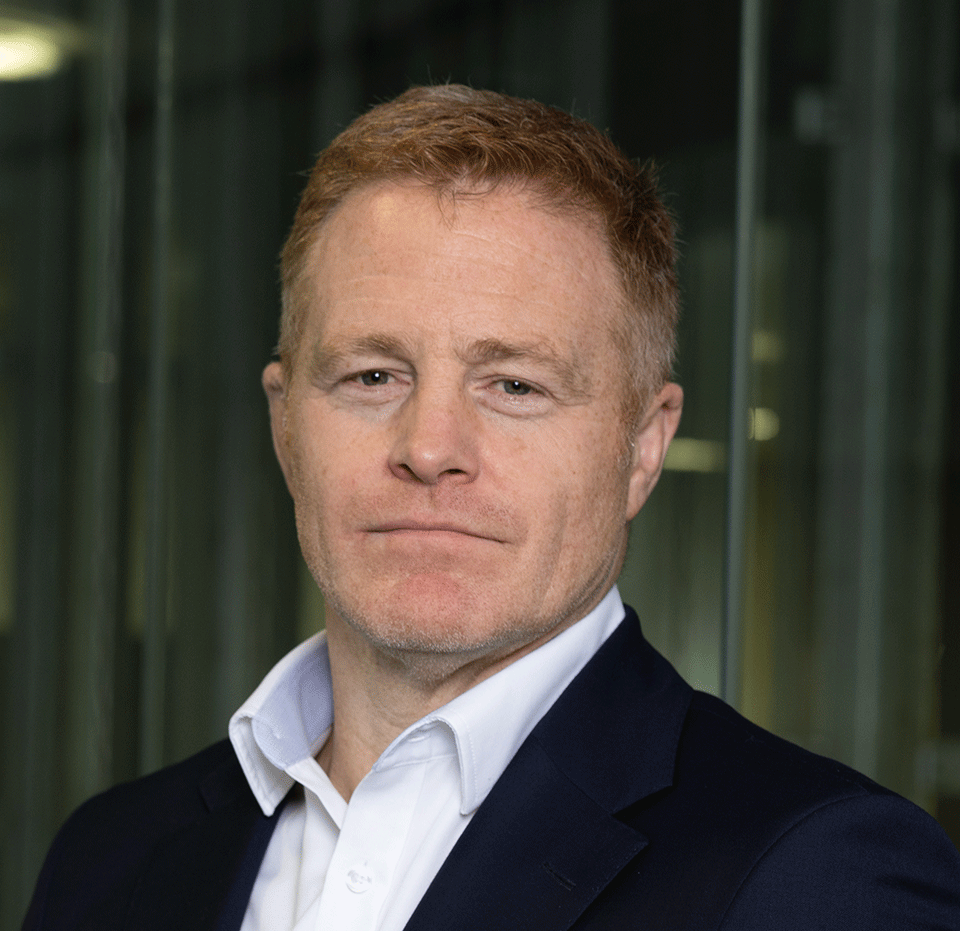
“The availability of private equity capital in Latin America continues to be limited relative to similarly sized economies in other emerging markets worldwide” Juan Carlos Torres, Advent International |
Ocroma Alternative Investments, an independent investment management firm based in São Paulo in Brazil, has set up the first private equity fund of funds focused on Brazil and other Latin American countries. The fund aims to raise $150 million and has already secured one-third of that amount. The firm invests $5 million to $15 million for each transaction and tries to diversify its investments by financing companies at different stages of development, including growth capital and buyout. It can also undertake co-investment opportunities with selected funds.
Leonardo Ribeiro, a managing partner at Ocroma, says: “We are the pioneers in private equity funds of funds in Brazil. There are a lot of investors who want to allocate to private equity but do not do so as they don’t know the market well enough. That is where we help. They also might not have enough capital to do so but we bring together a pool of investors.”
Up to now most private equity funds of funds, including those run by Partners Group, a Swiss private equity manager, and HarbourVest, a US private equity manager, have invested in the emerging markets generally, with a small proportion destined for Brazil.
Ribeiro says that many of the investors in the fund are Brazilian high-net-worth individuals. Ocroma invests with leading country-specific funds and regional funds, with a core position in Brazil. It considered investing in the funds of more than 30 private equity managers but finally selected nine (it has already carried out due diligence on three managers).
Rapid growth
Brazil’s private equity industry has grown dramatically during the past decade: according to Ocroma the country’s private equity managers had $6 billion in assets under management in 2004; today it is $38 billion.
In July, Capital Dynamics, the Swiss private equity investment firm that manages and has advised on a combined total of more than $21 billion in private equity and real estate funds, announced plans to open its first office in Brazil in the Leblon neighbourhood of Rio de Janeiro, home to many of the country’s best established private equity managers. Filipe Cerqueira Caldas, head of business development in Brazil, will lead the effort. He says: “Opening a new office in Brazil highlights our expectations for growth, as we are quite bullish on the region’s abundant opportunities, as well as our commitment to the region. With an office in Rio and local investment professionals on the ground, we will be ideally situated to identify and develop local business connections. We will be accessible and readily available to our local clients – essential components of the service our clients around the world have come to expect.”
In June, Caixa Econômica Federal, the Brazilian state-owned development bank, announced plans to launch a private equity fund for foreign investors.
Furthermore, in June, Banco Modal, one of Brazil’s leading privately owned firms, announced that its FIP Oil and Gas Private Equity Fund, administered by Caixa Econômica Federal, had made its first investment of R$90 million ($51 million) in Enesa Engenharia, a gas, steel and energy company. The fund is the first private equity fund aimed at companies in the oil and gas supply chain, mainly existing or potential Petrobras suppliers. Recently, Previ, Brazil’s biggest pension fund, and Valia, the pension fund of iron ore producer Vale, said they planned to start investing in PE funds.
Southern Cross, a Latin American private equity manager, is also said to be raising new capital for a fresh tranche of investments.
The Brazilian industry has been particularly active since the international financial crisis, with 34 managers investing about $4.8 billion in 63 deals. The number of managers active in this period amounts to 22% of the 130 managers with offices in Brazil. Another five managers made investments in the country without having a local presence.
“Since the second half of last year, activity has increased quarter by quarter, reaching a total of $3.4 billion since then,” says Ribeiro. “The second half this year should surpass the level of activity of the last four quarters. Between the second half of 2008 and the second half of last year, the raising of new funds with foreign investors was practically impossible. As those funds start to close their fundraising process now, more capital will be available and the average size of deals will also increase.”
The average deal size in Brazil since the financial crisis was $75 million but sizes range from less than $2 million to $500 million (it is understood that this was made by FirstReserve Corporation, an energy industry investor, in Barra Energia, an oil and gas company).
Most investments made since the crisis were directed to sectors with a strong link to domestic consumption and the growing and unleveraged Brazilian middle class. Retail, education, healthcare, media and financial services took half of the invested capital. Infrastructure investments, mainly energy and logistics, amounted to 30% of capital invested.
In a sign of the strength of the private equity industry in Brazil and the rest of Latin America, Advent International, a global private equity firm, closed its Latin American Private Equity Fund V at $1.65 billion in April, the largest private equity fund ever raised for Latin America. It is more than 25% larger than Advent’s previous fund dedicated to the region.
High-growth targets
Lapef V will focus on control buyouts and expansion financings of companies across the region, investing mainly in Brazil, Mexico and Argentina. It will target high-growth sectors in which Advent has deep expertise, including financial services, airport services, business services, retail/consumer and education. The typical equity investment will be $50 million to $200 million in companies with enterprise values of between $50 million and $750 million.
“We believe Latin America offers compelling investment opportunities for firms like ours that understand the region well and have a long track record of creating value here,” says Juan Carlos Torres, a managing partner and co-head of Latin America.