THE STAKES ARE higher than ever before for a seat at the table for Asian economies exporting to the US. And each month they get higher still. The rules of the game require Asian countries collectively to finance the US to the tune of roughly $1 billion a day. In exchange, the US buys all the manufactured goods that Asia’s factories can produce.
There are perhaps a dozen Asian players around the table, all paying the US to purchase the same basic goods. When the exporters sell the dollars they receive from the US, Asian governments eagerly buy them, selling their local currency in exchange. That keeps their exchange rates low and the US in the game so that the next hand can be dealt.
“The Asians are working their butts off to make Nike shoes for $10 which Nike sells for $50 in US malls,” says Marc Faber, managing director of Marc Faber Limited, an economist and self-avowed contrarian. “They then purchase dollars that are produced on a printing press.”
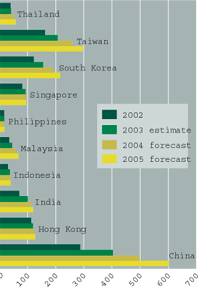
That printing press had churned out a staggering $490 billion in IOUs by the end of 2003, a sum that is forecast to jump perhaps as high as $600 billion in 2004. Asian governments now own roughly 70% of this US dollar debt mountain, with no sign of their appetite being sated. So long as US consumers want to buy goods from Asia, Asia will help them finance the purchase.
The problem, according to Michael Spencer, managing director, chief economist Asia, and head of global markets research Asia-Pacific at Deutsche Bank, is that Asia’s economies know how to do little else but export cheaply manufactured goods. “These economies were built by their colonial masters decades ago,” he says, “so they’re geared to exporting. It’s fine to say they need to diversify, but how can you when your GDP is 100% exports?”
Tim Condon, managing director and chief economist Asia at ING, argues that this model should have been improved by now. “Export-led growth delivers the goods in terms of rapid GDP growth over the long term,” he concedes.
But, he says: “They were doing this in Japan 30 years ago. You’d have thought that they could have moved on in terms of putting together a better model – more domestic consumption.”
Across Asia, almost without exception, countries have opted to grasp the export-led growth model at the expense of developing domestic consumption. Asia geared itself to demand in Japan, Europe and the US but has become ever more dependent on America as demand dried up elsewhere.
That’s a huge bet on one economy which others – domestic and foreign portfolio investors – are now being drawn into as economic recovery and abundant liquidity propel booming Asian financial markets.
Investors are flush with enthusiasm for Asia. But it is hot money flowing into the securities markets. Danger signs are appearing. Inflation is picking up. Asia’s leveraged bet on the US could backfire at any moment and at home, economic restructuring lags. It will take years to develop domestic markets.
Thailand is one of the few countries even trying and Euromoney reviews the huge experiment that is Thaksinomics. China has a vast domestic market, but a glance inside the extraordinary business exchanges through which its privatization efforts are slowly progressing, reveals the enormous task ahead.
Foreign fund managers attracted by the lure of that domestic market are finding the going tough in China after promising starts.
Blanket optimism about Asia even covers Indonesia which has recently emerged from its IMF programme and attracted buyers to bank privatizations and bonds. But public finances remain weak and corruption remains as with its neighbour Malaysia.
Time may not be on many Asian countries’ side. China is taking the assembly business away. Daniel Lian, southeast Asia economist for Morgan Stanley, in an economics research report, notes: “China’s aggressive embracement of this old thesis [export-led growth], its aggressive competition for FDI [foreign direct investment] and deflationary cost structure have made it even more difficult for the rest of Asia.”
While China continues to erode what is left of other Asian economies’ competitive edge, Asia’s central banks have continued to raise the stakes in their game of export poker with the US, ensuring that their currencies remain weak (and thus, their exports competitive) through intervention in the foreign exchange markets.
Recent intervention has been unprecedented in scale: in 2003, non-Japan Asian foreign exchange reserves increased by more than $148 billion. Japan’s reserves increased by almost $263 billion in the 12 months to January 2004, according to Barclays Capital. “Asia is accumulating $50 billion of reserves each month,” says Jonathan Anderson, managing director and head of Asia Pacific economics at UBS.
As the global economy attempts to adjust to imbalances of historic proportions, the dollar has embarked on a steady slide, slowed all the way by Asian governments’ attempts to hold their own currencies in check even as they strain at the leash. Given the vast numbers stacked against them, currency intervention on such a scale would appear to be pure folly and the potential losses from investing reserves in a declining currency must eventually become too painful to bear.
“The Asian central banks are no more intelligent than anyone else,” says Faber. “They’ll screw it up – they’re buying a currency that is doomed.”
Yet according to Deutsche Bank’s Spencer, the accumulated firepower of Asia’s central banks, coupled with prevailing fiscal conditions, mean that this perverse behaviour can continue for some time to come. “They can do it for ever,” he claims, “until they decide that exports are not so important to them, or there is something that’s going to stop them from sterilizing [selling local debt instruments to domestic banks to mop up excess liquidity]. Will banks be happy to carry on lending to the government? Asia’s saying: ‘We’ll max the US current account deficit because that’s the source of our growth. So we’ll buy the dollar and keep our currency low. If that means we’ll run a 2% to 3% GDP loss on our reserves, that’s a trade we’ll do for a while.’ That could happen for years yet.”
But that intervention comes at a cost.
When Asia’s central banks exchange the dollars earned by their exporters with their own currencies in their efforts to keep them weak, they also increase the supply of local currency in circulation significantly, risking increased inflation.
In order to soak up this excess local liquidity and thus staunch the inflationary threat, Asia’s governments issue local bonds and bills to the banking system in exchange for the currency, effectively removing it from the system. This process, known as sterilization, has become a massive operation in its own right in Asia.
Unfortunately for Asia’s governments, as the stakes in Asia’s poker game with the US rise inexorably with each new hand, they find it increasingly difficult to sterilize all of the excess cash. So it finds its way into the local markets and usually not in the places the governments would like it to be.
Rob Subbaraman, senior economist, Asia, for Lehman Brothers, sees signs that excess liquidity is already affecting Asia’s economies. “Narrow money supply growth is picking up very rapidly,” he warns. “At some point we’re going to see consumer price inflation and maybe even asset price inflation – you’re seeing it in China on the assets side, and look at equity markets around Asia.”
So even as investors and investment banks rejoice in the rise of Asian markets, the risk persists that the inability of Asia’s domestic economies to absorb investment due to years of neglect is already leading to a dangerous ramp in securities markets. The money has to go somewhere.
|
Foreign exchange reserves Asia ex Japan ($bn) |
 |
| Source: Deutsche Bank |
Are we returning to 1997?
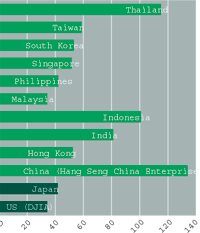
Consider Asian stock markets’ recent performance against what is, by anyone’s reckoning, a strong US bourse. Surging equity issuance across Asia in the second half of 2003, and especially in Taiwan, South Korea, and China is further evidence of the volume of local liquidity in Asian economies. Indonesia’s equity markets have came back from the dead and Hong Kong has started to show symptoms of the IPO frenzy before the 2000 crash, with record subscription rates for over-valued H shares. The US$3.2 billion China Life IPO alone generated demand of some US$80 billion.
“Having all this liquidity lying around is like a powder keg,” says UBS’s Anderson. “It’s either going to go straight out or it’s going to get into a speculative bubble. Now, no-one is investing because there is excess demand: no-one’s borrowing back home.”
Faber says: “What is beginning to transpire is a huge wealth transfer from the western economy to Asia as a result of the US deficit and Asia’s trade surplus. That will lead to asset inflation in Asia.”
Arguably, that asset inflation has already arrived. Real estate prices are beginning to come back to life, strongly in certain markets.
“We have virtually free money [in Asia],” says Deutsche’s Spencer. “People should buy assets – stocks and properties. But a year from now, we’re going to look and say ‘interest rates are too low, P/Es are too high and we’ve under-invested in our economy’. The day of reckoning has to come soon: we’re giving them a billion and a half dollars a day on average.”
That day might yet be some way off. But assuming that come it will, trouble is clearly brewing in Asia. A further unfortunate side effect of Asian government’s heroic efforts to stabilize and sterilize is that it discourages local banks from lending into the local economy to increase capital investment and domestic consumption.
Local domestic lending is critical if Asia is to kick its export addiction to the US economy. Yet instead of making loans to local businesses, entrepreneurs or even consumers, banks simply purchase the local currency bills issued by the government’s sterilization efforts, effectively lending the money back to the government and, by extension, straight back to the US consumer.
The absence of meaningful domestic markets in most Asian countries perpetuates the problem. The banking system becomes constipated: banks cease to perform their critical function of stimulating local investment and revert to zombie-like deposit-taking institutions that enjoy a round-trip free lunch courtesy of the government for assisting with the sterilization effort. The rapid build-up in the deposit bases of local Asian banks, the erosion of loan-to-deposit ratios and negligible deposit rates are testament to the scale of the problem.
According to Spencer, the problem with the local banks is exacerbated by their experiences in Asia’s last financial crisis. “They’re scared off by NPL problems in the past. Since the banking crisis, the banking system hasn’t really lent into the private sector, except to consumers in Korea. The corporates say: ‘I’m scared of borrowing because the last time I borrowed I nearly went bust.’ The financial system is not doing what it should do.”
UBS’s Anderson says: “It would be nice to have an Asia that invests in their own economies. Maybe that’ll happen if the US goes belly up in the next five years. In the meantime, they want to keep their currencies cheap because they have export demand and no import demand. All of these capital reserves are not a sign of strength – it’s a sign of a weak economy. You have a big trade surplus because you’re not consuming at home – there’s no demand.”
Even in Thailand, the one Asian economy that has made a serious attempt to stimulate domestic demand, it is the government-controlled banks that are doing all of the lending, which is itself government-directed. The privately owned banks are still wary of extending credit, so horrific was their experience in the 1997 crisis.
Deputy governor of the Bank of Thailand, Bandid Nijathaworn, admits the problem, but hopes the situation will right itself. “Of course, if the banks were lending, it could help stimulate demand,” he says, “but bank lending could improve as the economy picks up. It’ll be a key factor to support the economy.”
Nijathaworn eschews any intervention. “Bank credit is a matter on which the banks know best,” he says, “after the crisis, bank lending was negative and as the economy improves, it has slowly increased.”
With Asia continuing to place such leveraged bets on the US consumer economy, itself already geared to the hilt, and with each bet increasing by the day, it would be prudent to consider the potential effect on Asia’s economies of a collapse in the US.
“If the US dollar were to collapse,” says Lehman’s Subbaraman, “or there was a crash in the housing market, it’s going to have big implications for Asia. Initially, there’d be a sharp slowdown in Asian exports, which would have spill-over effects in domestic demand. There would be big cuts in FDI and that would hit Asian equity markets.”
|
Stock markets change (%) 52 weeks (dollar terms) |
 |
| Source: Bloomberg |
Kissing goodbye to the US
One man who is prepared to call the ultimate demise of the US consumer-driven economy is Marc Faber. “The US economy lives on rising asset prices,” he argues. “Employment is not rising, real wages are diminishing: the only reason consumption is rising more rapidly is tax cuts and the asset bubble. Once the asset inflation is over,” he warns, “you can kiss goodbye to the US economy. That’s going to happen as night follows day. I just don’t know when it’s going to happen.” Although Faber concedes that the immediate implications of a US collapse would be serious for Asia, he takes a more sanguine view of the longer-term effects. “In an extreme scenario, where the exports to the US went to zero, who would suffer more, Asia or the US?” he asks. “Sure it would be a great shock to Asia immediately. Asia has 56% of the world’s population and 50% higher industrial production than the US and Europe. But as trade flows rebalanced, I think Asia would be big enough after two years to come out OK. The US on the other hand would be hit much harder – import prices would go through the roof, the
quality of life would plummet, interest rates would go up. In an economy that is geared to a low interest rate environment it would lead to a housing crash.”
ING’s Condon takes perhaps the most relaxed view. “We’ve gone from fear of never-ending deficits to fear of never-ending surpluses, back to fear of never-ending deficits,” he says, laughing. “The reason the bond market has not reacted to the fiscal numbers [in the US] is that there’s no confidence in the economic forecasts – they’re worse than weather forecasts. The lesson of the last 20 years is that growth will heal all fiscal problems.”
Whatever the view taken, significant risks exist in Asia’s gamble on relentless export-led growth to the US, which raises the question why some of Asia’s governments haven’t tried to cash in at least some of their dollar chips and diversify their risk?
Most obviously, Asia’s central banks are at risk of substantial losses on their own balance sheets. There have been recent attempts to find other uses for their burgeoning US dollar reserves. Japan has talked of investing in gold, China has bolstered bank capital bases, South Korea has floated the idea of investing in private-equity funds, Thailand has repaid external debt, Taiwan may support development of local technology industries.
The harsh reality, however, is that Asian government stakes at the US dollar export table are so high now that significant diversification out of dollar reserves is not a viable option. To do so would risk a stampede by other players and a run on the dollar that would abruptly end the very game that they all want and need to continue playing. For sure, no-one wants to be the last to fold his hand: but no one wants to be the first either.
Escaping the Faustian pact
Is there anything that can be done to unwind Asia’s Faustian pact with the American consumer?
“In the long run, there are only three ways to get out of the trouble in which they find themselves,” says UBS’s Anderson. “One is for Europe and Japan to grow very fast: we don’t really expect that to happen. The second way is for the US to grow at a lower than trend rate, say 2% to 3%, which would lower import demand. The third way is for a very sharp US downturn – people baling out of the dollar, bond yields through the roof, the consumers dropping the ball completely.”
Anderson believes that the second prospect is the most likely. “That’s not so bad for Asia. What’s going to make the US go from 6% [GDP growth] to 3%? That’s easy: we’ve had four quarters of massive fiscal stimulus, that’s going to run out of steam and we’re going to see some tightening, this side or the other side of the election.”
Subbaraman believes that the Asians are going to have to make decisions for themselves. “They have a choice,” he says. “They can keep doing this [intervention and sterilization] and they’ll end up with inflation. Or they can back off and let their nominal [exchange] rates increase. A lot of Asian governments have elections this year and they’d like to see currencies weak but central banks like to keep inflation low. It’s going to be interesting to see how independent some of these banks are.”
Faber says currency appreciation may not be the pariah that Asian governments believe it to be. “The Asians are making a huge policy mistake,” he says. “If the whole region allowed their currencies to appreciate, it wouldn’t matter at all. Maybe they’d be at a competitive disadvantage against Mexico, but it wouldn’t be great. They should revalue their currencies but they have to do it together. If China revalued to say, four to one [four renminbi to one dollar], do you think the manufacturing would move back to the US? No way!”
UBS’s Anderson agrees. “The only way that Asia can break free of the tyranny of exports is to unify, to become a huge internal market,” he says. “The lesson for Asean is to hurry up: get some consultation, create free trade zones. That’s the choice that Asia faces: they can’t do it alone. Maybe in 10 years’ time China will play that role: a bit like the US plays with Canada and Mexico.”
There may be a glimmer of hope on the horizon for concerted Asian action. The much vaunted Asian Bond Fund initiative, albeit modest in its infancy (ABF 1 was a mere $1 billion) appears to have gathered some support and momentum. Plans are well-advanced for the launch of ABF 2, which according to Vijit Supinit, adviser to Thailand’s Minister of Finance as well as chairman of the Stock Exchange of Thailand, will be a much bigger beast.
“ABF 2 could be used to launch Asian currency issues,” he says. “The central concept is to mobilize the forex reserves in Asia for Asian bond issues, rather than invest outside of the region. We need to develop the Asian bond markets: we need to diversify to some extent. At the moment if you need to borrow, you go to London or New York to borrow your own money: it restricts the development of the markets here.”
Despite what appears to be at least some progress on pan-Asian cooperation, Spencer believes even greater structural changes are needed for Asia to kick its export addiction. “The accepted wisdom of manufacturing export growth versus commodities export needs to be reconsidered,” he says.
“Their investment in agriculture and commodities has been lacking. Any charts you look at, commodity prices are going up; manufacturing goods are coming down; services are flat. Their mindset is ‘let’s get people to put electronics together’. Politically it’s difficult for them to admit their mistake: ‘sorry, we bet on the wrong horse!'”
Whichever solution they pursue to reduce their dependency on the one-way exports bet, Asia’s governments would be well advised to get moving. The longer they stay in the game, the greater the risk of inflation, speculative bubbles and an eventual collapse in demand from the US consumer.
Perhaps the greatest risk of all is that with swelling coffers stuffed with US dollars and increased liquidity fuelling local financial markets, Asians get seduced into yet another false sense of security, awakening to the dangers only after it is too late.
“Surging capital flows and significantly undervalued Asian exchange rates are the preconditions for reigniting credit booms around the region and ultimately inflation,” warns ING’s Condon. “That will turn external surpluses to deficits and then you’ll see external debt. I wouldn’t be holding my breath for this to happen,” he says. “We’ve got several years of strong growth ahead of us – really sweet years.”
It’s not a return to 1997 yet, but maybe to 1995. Investors can squeeze a couple more sweet years out of Asian stocks. But the time to cash in those chips could be soon.


