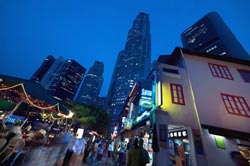
Glittering skyscrapers, air-conditioned malls, manicured lawns, litter-free boulevards, and a law-abiding population… It is hard to believe that 200 years ago Singapore was a disease-ridden backwater populated by fisherman and pirates. And just 40 years ago the island state was racially divided, lacking in resources and reliant on unfriendly neighbours for food and water. Singapore?s transformation into a thriving global financial centre, however, is not a result of natural evolution. Rather, its leaders have approached it as a carefully thought-out project. What Singapore has lacked, it has simply created ? it?s ?a man-made miracle?.
In 1971 the Ministry of National Development undertook to ?optimize every square inch of scarce land resources to stimulate Singapore?s economic growth and improve the quality of life for all Singaporeans?. Shipyards were transformed into residential areas, skyscrapers sprouted, restaurants and bars opened, parks and gardens were planted, a vast tropical tourist resort was built, historical buildings renovated, and when there wasn?t enough land, Singapore simply filled in the shoreline. Singapore is 33 square kilometres larger than it was 40 years ago, and it plans to get bigger still.
Simultaneously, the government motivated its workforce. Posters encouraging the people to smile, to be more productive, and to take pride in their work were put up, while a strict judicial system was introduced to keep the island safe and clean. ?It?s like living in Disneyland,? says one expatriate banker.
The country?s artificial perfection, however, is wearing a bit thin with the locals. The past three years have been a struggle and for some 2003 is a year best forgotten. Favoured as a stopover for long-haul travellers, the island was already suffering a slump in tourism post-September 11 when it was hit by the Sars epidemic, which claimed 33 lives and added the fear of sudden death to a nation suffering from falling exports and a weak economy. Work stopped on the expansion of Changi airport, and offices and apartments, which had been recently erected, remained empty.
Unemployment hit a 17-year high of 5.9%, and with no unemployment benefits and little welfare aid provision, Singapore?s people were unconvinced by the government?s optimistic rhetoric. ?No, the Singapore dream is not shattered,? said prime minister Goh Chok Tong at 2003?s national day rally speech. ?True, the sky is grey now. But grey clouds do not stay forever. After the rain, they give way to clear, blue skies. If we use this grey period to remake Singapore, and trim ourselves to become more nimble, we will be ready to grow again when the sun comes out.?
For those without work and unable to keep up with the country?s rising cost of living, such speeches from one of the world?s highest-paid heads of government were considered patronizing. In 2002, Goh earned around $600,000, and two years previously he had commanded a salary of more than $1 million.
?People come here and see the shops, the skyscrapers, the clean streets, and the trees, and think we have a good standard of living,? says Lee Chang, who has been a taxi driver for six years. ?And the government keeps up this proud front. But these buildings are empty, and the ordinary people of Singapore are being forgotten. We can?t keep up with these prices.? Consumer prices for the poorest 20% of households in Singapore rose 1.1% in 2003, and the official CPI forecast for 2004 has been increased to between 1.5% and 2%.
And despite GDP growth forecasts for 2004 having been revised upwards twice already to between 5.5% and 7.5%, and unemployment stabilizing at 4.5%, Singaporeans remain anxious. ?If costs continue to rise at this rate, Singapore will price itself out of the Asian market,? says a consultant. Competition from other Asian states is certainly mounting. For every manufacturing worker hired in Singapore, a company can hire three in Malaysia, eight in Thailand, 13 in China or 18 in India.
Goh?s proposed solution is more-productive workers, a stronger entrepreneurial spirit, more risk-taking and more experimentation. And in order to achieve this, he has placed the final piece in the modernization jigsaw ? he is cutting the apron strings before he steps down in the summer. ?In the past,? he says, ?we operated largely on the principle that ?everything is not allowed unless we say it is?. Now, we will give greater room for experimentation. Increasingly, it will be ?everything is allowed unless we say it is not?….?
For some Singaporeans, such views are seen as indicative of the government washing its hands of responsibility but for the younger generation it is a chance to breathe life into a country that they see as sterile and create a Singaporean culture. Dedication to developing arts and culture has been evident over the past few years, bolstered by the establishment of the ultra-modern Esplanade, a six-hectare waterfront complex of studios, theatres, concert halls, shops and restaurants. The number of art galleries and film and theatre companies established by Singaporeans is now double that of 10 years ago. And Goh is serious about encouraging people to have fun. Last year, he lifted restrictions on bar-top dancing, and permitted a New Zealand company to set up a reverse bungee jump.
For a society whose only entertainment was the cinema, this is refreshing. ?I?ve lived here for four years and I?ve never seen so many films in my life,? says an ex-pat banker. ?But I don?t suppose I?ll be dancing on bar-tops just yet ? unless I see a poster telling me to.?


