The strongest markets franchises in Asia-Pacific do more than manufacture products. They connect investors with difficult-to-access markets, bring together capabilities across asset classes and turn ideas from separate desks into transactions that could not be executed by any one team alone.
UBS combines an on-the-ground presence across 13 markets with a platform connecting institutional markets, global banking, research, asset management and one of the world’s largest wealth businesses through what it calls OneUBS – a coverage model that connects the divisions while respecting information barriers. That combination of regional reach and internal coordination defined UBS’s performance during the review period.
“APAC remains a key growth engine for a global franchise, and we want to keep strengthening global footprint by deepening global connectivity,” says Tim Wannenmacher, head of global markets, Asia-Pacific and co-head of OneUBS, Asia-Pacific. “Through our OneUBS approach, we will continue to build on our strong franchise presence across UBS in the region, leverage access for global banking, research, wealth management, and asset management to bring the full firm to our clients in a highly connected way across regions, products, and divisions.”
It begins with the diversity of its client franchise. UBS serves institutional investors, hedge funds, asset managers, family offices, private banks and distributors across the region. The breadth of that network gives the bank insight into demand from different pools of capital and allows it to connect buyers and sellers across products and jurisdictions.
Nowhere is that more important than in China. As a fully licensed international bank in the A-share market with a broad global markets offering, UBS provides overseas investors with access to both index and single-stock opportunities. In 2026, it added OTC options on individual Chinese companies, extending its capabilities beyond the index products traditionally used by international investors. The bank says its China business recorded approximately 50% year-on-year growth in the first half of 2026.
Connecting markets, products and clients
The convertible bond market demonstrated how the bank can marshal several parts of its platform around a single client problem. With conventional investment grade bond supply from Asian issuers declining, UBS separated the credit and equity option components of convertible bonds and repackaged the credit exposure in note and loan formats. That gives credit investors access to additional carry while allowing convertible bondholders to release capital.
The transaction required coordination across global banking, convertible bond trading, credit solutions, corporate and credit sales, financing and regional distribution. UBS executed a $150 million block transaction and distributed $220 million through note format and a further $70 million as loans. The significance lay not just in the size of the transaction but in the bank’s ability to transform an equity-linked instrument into formats suitable for investors with different mandates.
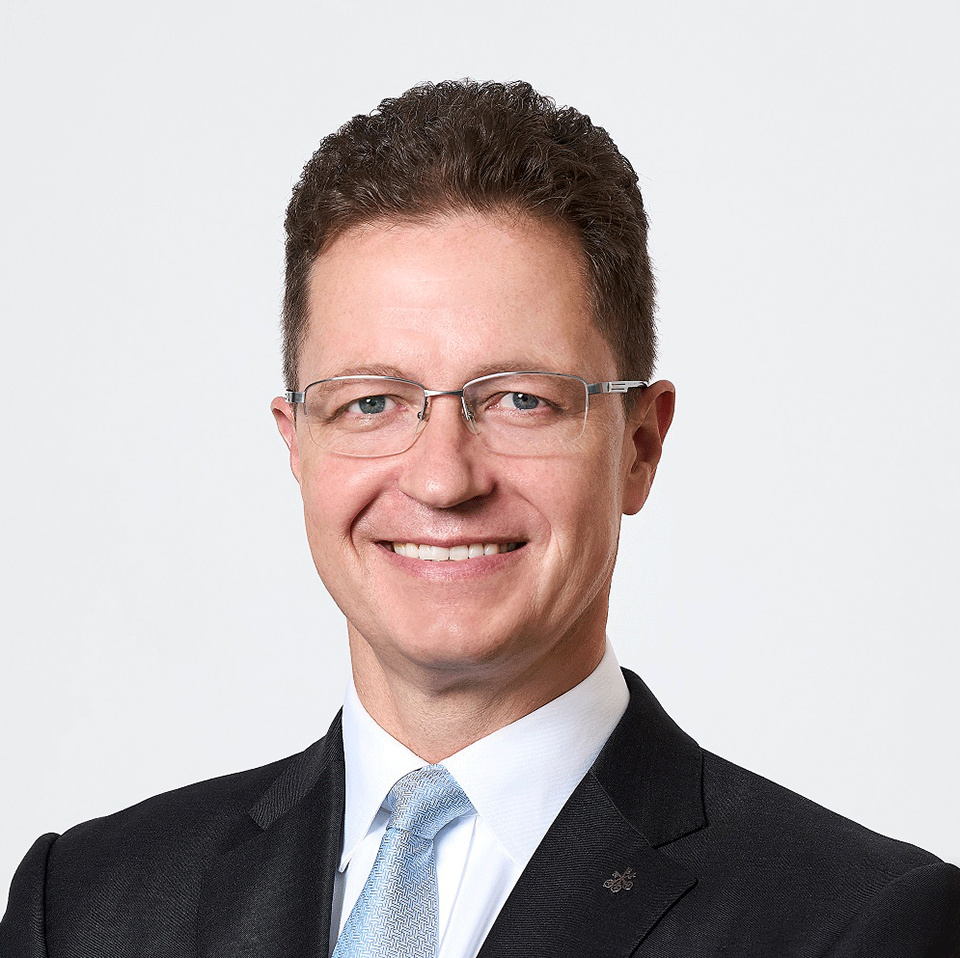
APAC remains a key growth engine for a global franchise, and we want to keep strengthening global footprint by deepening global connectivity
Tim Wannenmacher
The same emphasis on connectivity shaped the bank’s wealth offering. Project Singular uses actively managed certificates to place institutional trading capabilities inside a single investment wrapper for eligible wealth clients. Investors can manage multi-asset strategies through the UBS Neo platform, including equities, futures, options, FX and bonds, while the bank handles execution, financing, corporate actions and reporting. Nine certificates had been launched by mid-2026, accumulating more than $200 million across Hong Kong, Singapore and Southeast Asia.
Technology was also applied to the daily work of sales and trading. Ask Neo FX Options allows users to retrieve market analytics, examine volatility surfaces, generate charts and build pricing requests using natural-language prompts. Its purpose is practical: reducing the time between identifying an opportunity, analysing it and preparing a transaction.
UBS also retained considerable scale in listed markets. In Hong Kong, it ranked first by notional value in warrants and callable bull/bear contracts among 16 issuers in 2025. It sold more than $12 billion of notional value through more than six million trades, while issuing more than 7,000 listed products across APAC covering more than 120 underlying assets.
Taken together, those businesses show a markets platform operating across the boundaries between investment banking, institutional trading and wealth management. Its strength was not confined to one trading desk but rested on its ability to convert regional distribution, technology and product expertise into access and execution for clients across the APAC region.
Wannenmacher says: “Looking ahead, our focus is clear: to further gain share in our champion businesses, including strengthen our share in China, Australia, New Zealand, and Southeast Asia, and deepen one bank collaboration (One UBS model) to drive further growth, maximizing group franchise benefits and unlocking greater potential for our pre-eminent wealth franchise.”