Thursday, October 30, 2008

Email a Friend

  • All fields are compulsory


To include more than one recipient, please separate each email address with a semi-colon ';'


Add Your Comment


  • All fields are compulsory
  • All comments are subject to editorial review as we are subject to the same regulations adhered to in publishing our own content. For this reason, your comment may not be live immediately, or may not be published.


I have read and agree to the Terms and Conditions


Wednesday, October 8: The financial structure has changed. Looking into the black hole


What now is the model for hedge funds, finance companies and the former users of the securitization markets?


The week Wall Street capitulated

"The financial structure has changed, ending credit-led financing and disintermediation, and into a funded model"
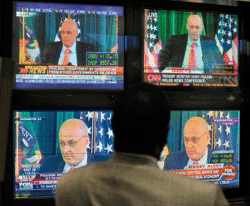
Wednesday, October 8: The US Treasury hints it is considering injecting capital into banks

Wednesday, October 8: The US Treasury hints it is considering injecting capital into banks

For the first time, US Treasury Secretary Paulson opens up the possibility of government directly injecting capital into financial institutions. As ever, it is all talk and no action. The tailspin continues...

The day started with meetings with two US mortgage market specialists. "We don’t know what the endgame is," one said with brutal honesty. The other pointed out that the rate at which US household debt fell in the second quarter was outright deflationary. And that leverage in the non-financial sector was increasing. Net debt had fallen in the period from 2002 until 2006 but 2007 was a record year for gross corporate issuance. Now these institutions were tapping their credit lines.

At another encounter, the same bank’s chief economist noted the momentous backdrop. "We are moving away from 20 years of borrowing money," he said. "The financial structure has changed, ending credit-led financing and disintermediation, and into a funded model."

In the meantime, he continued: "We are looking into a black hole. We can only hope there is a bottom... It’s a global recession according to forward-looking indicators. This won’t be a typical slowdown. It will be 2010 before the market recovers."

Next was an experienced securitization banker at a US bank. He calmly dismissed the Tarp as fraught with execution difficulties. It was nearly impossible, he argued, to try to compare different portfolios of assets. How would a reverse auction work? He had no qualms about saying that an outright recapitalization of the US banking system would be a far smarter solution. He also pointed out that US presidential candidate John McCain’s attempt to solve the sub-prime problem might have some merit. "It’s a work-out solution," he said. "Rescheduling the loans makes a lot of sense."

But what now is the model for hedge funds, finance companies and the former users of the securitization markets? They all need to refinance and cannot fund themselves now that it’s back to the basic traditional banking model for major dealers. "At least you have lots of interesting stories to write," he said.

Euromoney couldn’t help but feel a tad uneasy about that.

On October 8, US stocks closed lower – again. It was the worst five days since 1987. Forget the 10,000 barrier, the Dow was heading towards 9000. It finished the day at 9258. The continued tightness in credit markets was weighing on sentiment. And then there were Paulson’s helpful comments that further bank failures were likely.

The next day, at an early morning meeting, the head of fixed-income trading at a big European bank exuded the easy air of someone who knew his firm was likely to be one of the long-term winners from the turmoil. "We are seeing more business at the expense of our weakened competitors," he said. "The crisis accelerates our increasing market share."

But on market conditions his views were far from rosy. He pointed out that Libor rates had still risen after the coordinated rate cuts. The system was still deteriorating. It was imperative that the money market funds returned, he said. They provided key funding for secured and unsecured markets. They were getting redemptions, which meant liquidity was drying up.

Thursday, October 9: It feels like capitulation
"Enough! Just sell my stock, sell me anything with credit risk and buy T-bills – at least I know I’ll get my money back"

Post-script: Washington DC, Friday, October 10 to Monday, 13
"Either we get a coordinated response from the world’s leaders by the end of the weekend, or we might as well give up and go home"